

Commentary
Trump has promised Belarus a massive potash deal. But Minsk is seeking something greater: restored Western transit and greater room for maneuver from Russia.
Balázs Jarábik
{
  "authors": [
    "Richard Sokolsky",
    "Aaron David Miller"
  ],
  "type": "legacyinthemedia",
  "centerAffiliationAll": "",
  "centers": [
    "Carnegie Endowment for International Peace"
  ],
  "collections": [],
  "englishNewsletterAll": "",
  "nonEnglishNewsletterAll": "",
  "primaryCenter": "Carnegie Endowment for International Peace",
  "programAffiliation": "",
  "programs": [],
  "projects": [],
  "regions": [
    "United States"
  ],
  "topics": [
    "Foreign Policy"
  ]
}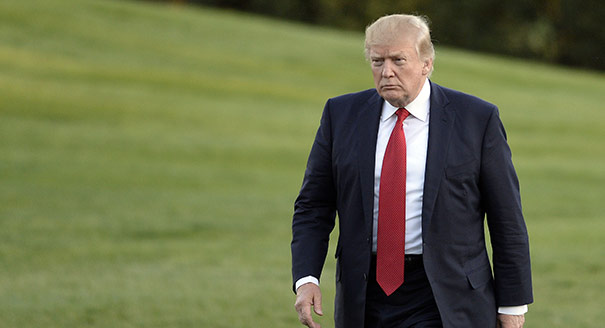
Source: Getty
In 2017, the United States is contending with a world whose challenges would be excruciatingly difficult even for the most experienced and well-managed administration. Nine months in, President Trump has demonstrated neither strategy nor competence on foreign policy.
Source: CNN
Speaking to Fox News on Sunday, H.R. McMaster -- President Donald Trump's national security adviser, and a thinking warrior with a firm grasp of history and reality -- made a stunning claim: Trump has "helped us restore our strategic competence."
Having worked for decades for both Republican and Democratic administrations on American foreign policy, we don't see it that way. In 2017, America is contending with a world whose challenges would be excruciatingly difficult even for the most experienced and well-managed administration.
But nine months in, we see neither strategy nor competence on foreign policy from this President -- on process or substance. And here's why:
It's not unusual during the transition from one administration to the next for there to be a shift of emphasis and focus -- to course correct and even to abandon one initiative for another. But there's no precedent for Trump's head-spinning and wholesale abandonment of his predecessor's policies.
Some of the Obama-era policies remain -- for example, part of the outreach on Cuba. And, of course, this administration has built upon President Obama's efforts in Iraq and Syria, not just to contain ISIS but to roll back and destroy it. But from withdrawing from the Trans-Pacific Partnership and the Paris climate accord to not certifying the Iran nuclear accord, to courting authoritarians with abandon (see Vladimir Putin; Abdel Fattah el-Sisi; Recep Tayyip Erdogan; King Salman), this President has apparently made disruption and destruction of his predecessor's policies his key prime directive.
And the logic of the approach seems driven not by ideology as much as Trump's personal aversion to Obama's policies and the need to satisfy his campaign commitments and the political requirements of his base. Disruption might be a plausible policy if executed as an effort to conceive and implement alternative policies. But Trump has left a vacuum that has shaken US allies, provided opportunities for adversaries and undermined US credibility and influence around the world.
Trump cannot be blamed for the North Korean conundrum he inherited from at least three of his predecessors. Unlike the United States, however, Kim Jong Un does have a strategy and it's to acquire enough nuclear weapons and missile systems to deliver them so he can protect his regime from attack and perhaps further his objectives against South Korea.
Part of what Trump has done makes sense -- apply sanctions, try to get China to squeeze Kim and support US allies South Korea and Japan. But not only is the approach not working, Trump's idea -- what we call "strategic impatience" (as opposed to his predecessor's policy of strategic patience) has only deepened Kim's resolve to hang tough. Trump's bombastic and intemperate rhetoric threatening to totally destroy North Korea, and his seeming intention to create the image of the President as a madman, hasn't scared Kim as much as it has scared US allies and created the perception that the "madman" is really a paper tiger.
Indeed, Trump cannot bomb for fear of setting off a massive conflict on the Korean Peninsula, and he doesn't appear willing to deal with Kim, who admittedly doesn't seem ready to talk yet either. Still, the only real strategy on North Korea is to engage Kim diplomatically while keeping him under pressure. But Trump has consistently undercut his secretary of state's own instincts and willingness to do so. In fact, Trump has no credible strategy on North Korea if he's unwilling to consider serious engagement and decides to play out the role of the mad President.
This isn't strategy; it's dysfunction -- and it could get the United States into a disastrous military conflict with Pyongyang.
Nowhere is the absence of strategic thinking more painfully obvious than in Trump's decision to decertify the Iran deal in hopes that congressional Republicans can pass tougher sanctions that will frighten the Europeans and Iranians into amending the nuclear accord. The Iran deal is flawed, but it is functional and has succeeded as a limited effort to keep Iran away from developing enough fissile material to weaponize, should they want to.
Trump has now set into motion the possibility that the deal will unravel over time without the slightest indication that a new plan will be in place should that happen. And in reopening the nuclear agreement he risks having Iran advance its nuclear weapons program at a time when he confronts a far worse nuclear challenge from North Korea that he can't resolve. Indeed, walking away from the Iran deal will only convince Kim -- and our allies -- that Washington's word can't be trusted and there's no point in pursuing diplomacy. That plan is both reckless and unnecessary, the very antithesis of strategic competence.
We don't expect Trump to fix the world. But we do expect -- and American national interests demand -- competence in managing it. Trump's actions have put America in a deep hole that he has showed no sign of digging the United States out of. Strategic competence? Far from it. Sadly, so far, there's a strong case to be made for strategic malpractice.

Nonresident Senior Fellow, Russia and Eurasia Program
Richard Sokolsky is a nonresident senior fellow in Carnegie’s Russia and Eurasia Program. His work focuses on U.S. policy toward Russia in the wake of the Ukraine crisis.

Senior Fellow, American Statecraft Program
Aaron David Miller is a senior fellow at the Carnegie Endowment for International Peace, focusing on U.S. foreign policy.
Carnegie does not take institutional positions on public policy issues; the views represented herein are those of the author(s) and do not necessarily reflect the views of Carnegie, its staff, or its trustees.

Trump has promised Belarus a massive potash deal. But Minsk is seeking something greater: restored Western transit and greater room for maneuver from Russia.

Balázs Jarábik
The real test may come after the leaders leave the room.



Sheena Chestnut Greitens, Oriana Skylar Mastro, Yukon Huang, …

The Horn of Africa countries are among those facing a new security calculus.


Andrew Leber, Lesley Anne Warner

The new U.S.–Denmark–Greenland agreement will help Washington exert political, economic, and financial dominance under the guise of security. Yet, it acknowledged Copenhagen’s and Nuuk’s sovereignty on the island.

Marc Pierini

The nuclear relationship between China and the United States is increasingly shaped by widening perception gaps rather than deliberate strategic design.

Tong Zhao