Volodymyr Zelensky won Ukraine’s presidential election back in April as the candidate for peace. Now, a hostage of his own high ratings, the new president must demonstrate to the Ukrainian public that he is taking decisive steps to resolve the armed conflict in the country’s Donbas region.
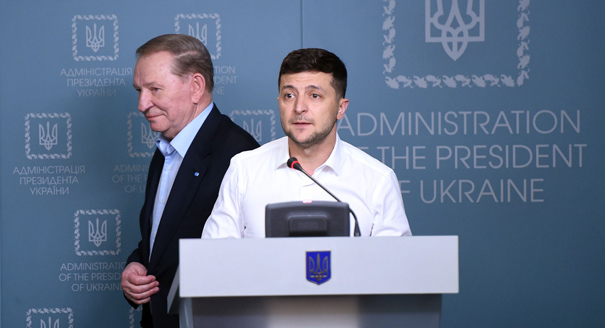
Zelensky’s first move regarding the Donbas prompted fierce debate in Ukrainian society: he appointed former president Leonid Kuchma the country’s representative in the Trilateral Contact Group aimed at resolving the conflict in Ukraine.
This doesn’t sit well with the new president’s promise to radically shake up the ruling authorities, since Kuchma is the living embodiment of the oligarchic clan system that formed during his rule. Yet the former president is an experienced negotiator and a figure who is acceptable to the Russian side, and who previously represented Ukraine in the Minsk talks aimed at ending the conflict under Zelensky’s predecessor, Petro Poroshenko.
Zelensky’s desire to find common ground with representatives of the oligarchs is understandable: they have already said that they plan to take part in restoring the part of Donbas controlled by Ukraine by financing infrastructure and humanitarian projects. Zelensky also wants to raise European investment in the Donbas, which would make it possible to turn the Ukraine-controlled territory into a showcase for the country’s new policy in its eastern regions, and would serve as a symbol of defused tension and a guarantee that there will not be another flare-up there.
Further evidence of the new policy was the disengagement of the two sides in a sector of the contact line near Stanytsia Luhanska, a process stipulated by the Minsk agreements and overseen by the OSCE Special Monitoring Mission.
Polls ahead of Ukraine’s parliamentary elections due to be held on July 21 show that Zelensky’s party, Servant of the People, will win a majority, but the latest poll by the Rating group recorded a small decrease in support for Servant of the People and an increase in the popularity of the pro-European Holos (Voice) party led by rock musician Svyatoslav Vakarchuk, and of Poroshenko’s European Solidarity party. The gap between the president’s party and its rivals, however, remains enormous.
Against this backdrop, Zelensky is trying to find balance on the incendiary issue of the Donbas. During his visits to Berlin and London, he adhered carefully to the previous foreign policy line, calling on European leaders to keep up pressure on Russia through sanctions, and refusing to attend direct negotiations with the leaders of the self-proclaimed Luhansk and Donetsk people’s republics.
At the same time, the head of his administration, Andriy Bohdan, has shown willingness to compromise. In an interview with RBC Ukraine, he proposed giving the Russian language the status of a regional, second language in the Donbas—which would contravene a new law giving Ukrainian special status that Poroshenko signed off on shortly before leaving office—on condition that the breakaway regions go back to being Ukrainian territory.
Even this kind of cautious opinion prompted outcry among some “patriots,” though overall, Ukrainian society is inclined to support Zelensky’s team. According to a June poll conducted jointly by the Yaremenko Institute for Social Research and the Social Monitoring Center, nearly half of Ukrainians (49.5 percent) are prepared to support the Donbas having some autonomy within Ukraine, if it would mean peace.
Zelensky’s tactics don’t suit Moscow, which still regards the new Ukrainian leader with suspicious reserve that borders on openly ignoring him. Moscow’s position has not changed: Ukraine must fulfil its obligations under the Minsk accords. In Russia’s interpretation, that means the start of talks with representatives of the unrecognized republics and reducing the conflict to the formula of a civil war, in which Russia’s only role is that of a peacekeeper.
The Kremlin has plenty of time: the first triumphant reports are coming out of the Donbas of local residents receiving Russian passports. Zelensky is faced with the fact that refusing to take part in talks on Russia’s terms only leads to the closer integration of the Donbas with Russia.
The new administration’s attempts to get rid of the Ukrainian politician and oligarch Viktor Medvedchuk—a close associate of Russian President Vladimir Putin—as a negotiator for the Ukrainian side have also incurred Moscow’s displeasure. The Kremlin continues to demonstrate its favor for Medvedchuk, welcoming him at the St. Petersburg International Economic Forum as a representative of “a Ukraine that is capable of reaching an agreement,” and promising gas supply contracts on favorable terms.
Putin is clearly waiting for Ukraine’s parliamentary elections to see what the position of Medvedchuk and his Opposition Platform-For Life party will be in the new configuration of power. As the main pro-Russian faction, the Opposition Platform is competing for second place, meaning that Medvedchuk could be transformed from a goodwill ambassador with ill-defined authority into deputy speaker of the parliament, with drastically increased influence.
Medvedchuk has not been idle during the election campaign, holding separate talks with the leaders of the Luhansk and Donetsk people’s republics in which he brokered an agreement on the freeing of four Ukrainian soldiers who were being held in captivity by the separatists. He is also increasing his influence on the media, gaining control of a media holding of TV channels, with another rumored to follow.
Meanwhile, Europe expects a new road map on the Donbas from Zelensky. His administration has promised to unveil a strategy, but so far it seems there is none, and Zelensky is simply improvising while biding time until his party’s victory in the parliamentary elections.
To bureaucrats in European capitals, the situation in neighboring Moldova may appear promising. There, a coalition of pro-European and pro-Russian parties has put an end to the country’s political crisis and the reign of the shady and omnipotent oligarch Vladimir Plahotniuc.
In February 2019, a plan was published on the website of Moldova’s president for the Munich Security Conference. The plan envisages a neutral status for Moldova, and a role for the country as a platform for Russia-EU dialogue with the aim of resolving the problem of Moldova’s own breakaway territory, Transnistria. The plan notes that “the Moldovan project could serve as the basis for establishing a phased peace process to resolve the conflict situation on the territory of Ukraine.”
If things go to plan in Moldova, then it really could become an example of how European officials would like to see the Ukrainian crisis conclude.
Zelensky won the presidential election having managed to combine wide-ranging expectations, and now, under pressure from external forces and his own voters, he is trying to find compromise solutions. His most important political asset is that he has support all across the country, in spite of the traditional division along southeast/west lines. After the parliamentary elections, however, Zelensky will have to decide on his strategy for the Donbas. After all, the reforms he promised are not possible without resolving the key issue of war and peace. Yet even the peace process itself will require Zelensky’s team to make a departure from the post-Soviet rules of the game, for which a replacement has not yet been found.