

Commentary
Alexander Gabuev
{
  "authors": [
    "Alexander Gabuev"
  ],
  "type": "legacyinthemedia",
  "centerAffiliationAll": "",
  "centers": [
    "Carnegie Endowment for International Peace",
    "Carnegie Russia Eurasia Center"
  ],
  "collections": [
    "Pax Sinica"
  ],
  "englishNewsletterAll": "",
  "nonEnglishNewsletterAll": "",
  "primaryCenter": "Carnegie Endowment for International Peace",
  "programAffiliation": "",
  "programs": [],
  "projects": [],
  "regions": [],
  "topics": []
}
Source: Getty
There’s one thing that perhaps says more about the investment climate in Russia’s Far East than all the swish presentations put together, and that’s the unfinished buildings of two five-star Hyatt hotels in Vladivostok.
Source: Kommersant
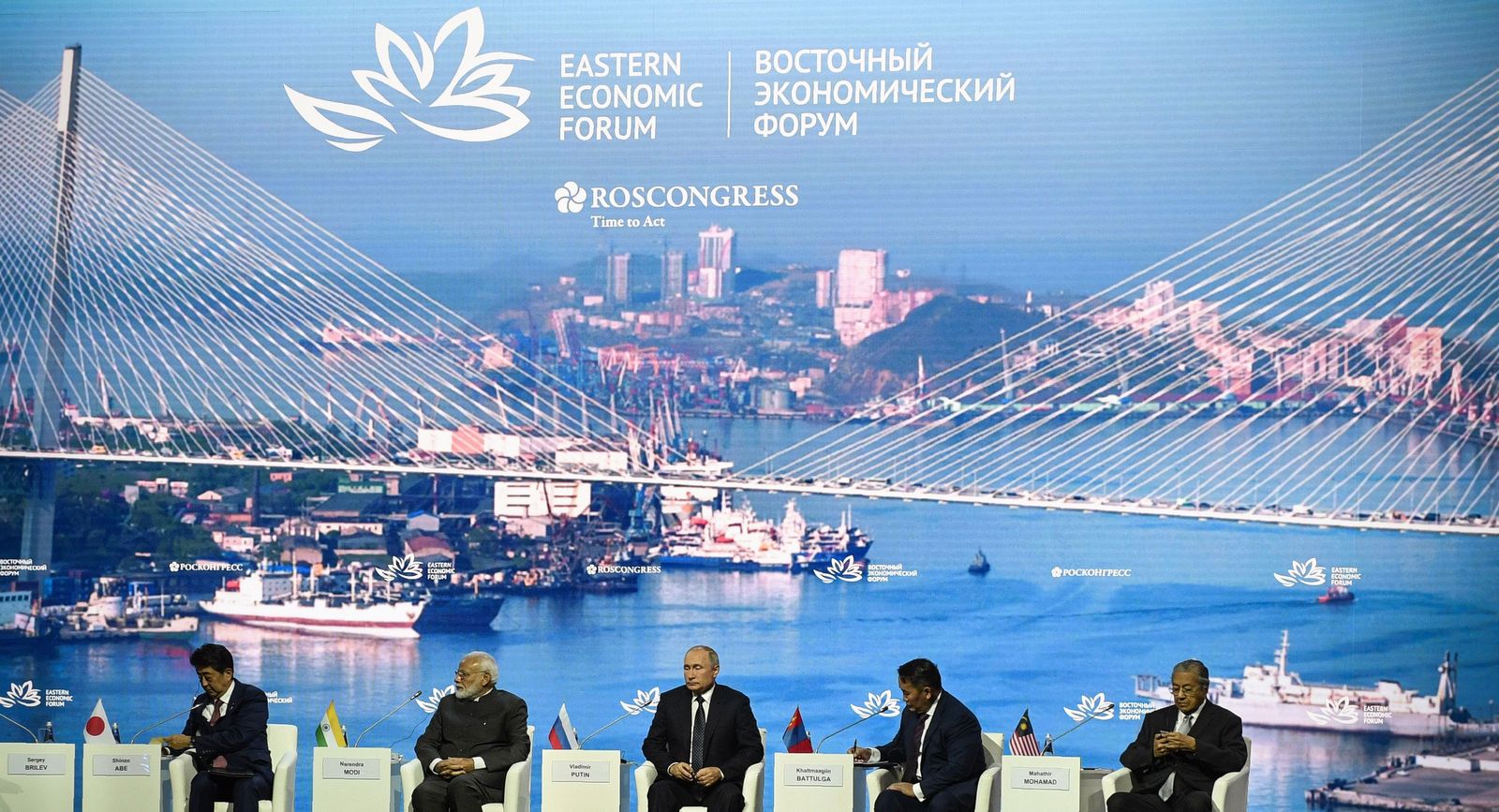
The Eastern Economic Forum (EEF) that drew to a close in Russia’s Far East city of Vladivostok on September 6 was the fifth time the event had been held, which makes it a good time to evaluate the forum’s work. When Deputy Prime Minister and presidential envoy to the Far East Yury Trutnev first discussed the idea for the forum with experts in 2014, the stated aim was to do something as different as possible from other events, especially the St. Petersburg International Economic Forum (SPIEF).
“We need an anti-forum: not a huge, flashy event, where people sign memoranda that will never come to anything, but a combination of an intensive expert seminar and a practical meeting with senior investors,” said officials working on preparations for the first EEF.
But in the end, the EEF fell into a well-trodden rut and started to resemble the SPIEF more and more: the same record numbers of attendees, the same dozens of agreements worth astronomical sums that are far from certain to be implemented, the same hype around the top restaurants, and the endless closing of major roads to the public to allow official corteges to pass unhindered by traffic. In terms of these parameters, the forum is a complete success. But is it successful as an instrument for attracting money to the Far East?
On the one hand, the methods advertised at the EEF, such as establishing advanced development zones and a free port of Vladivostok, really are leading to a rise in investment: more than 600 billion rubles ($9.1 billion at current exchange rates) has been invested in the region since 2013. But less than 20 percent of that is from foreign investors. They have invested less than $2 billion in Russia’s biggest region, rich with natural resources spanning the entire periodic table. The rest is all Russian investment, and under the methodology used to track investment, a company that has long been working in the Far East and has decided to become a resident of the advanced development zone or the port in order to qualify for financial incentives is counted as new investment and new jobs.
There are a multitude of reasons for investor reluctance, and many of them are articulated not only at the EEF, but at the St. Petersburg forum too. It’s guaranteed at any forum in Russia that the topics of discussion will include the ever-changing rules of the game, the growing tax burden, excess regulation, corruption, sanctions, high interest rates on loans, and the interference of the security services in business. At this most recent forum, demonstratively located amid the trade stands of companies and economic institutions was a stand representing the Prosecutor General’s Office, no less.
But there is one thing that perhaps says more about the investment climate in Russia’s Far East than all the swish presentations put together, and that’s the unfinished buildings of two five-star Hyatt hotels in Vladivostok.
They were planned to open in time for the APEC summit back in 2012, and when they weren’t ready in time, it was considered an emergency. The head of VTB bank, Andrei Kostin, and Summa Group majority shareholder Ziyavudin Magomedov (who is now jailed on embezzlement charges), who represented Russia on the APEC Business Advisory Council, went halves on hiring out the Legend of the Seas cruise liner to serve as a floating hotel for forum guests. Seven years later, the fact that there is a floating hotel instead of the unfinished Hyatts is now a source of pride for the EEF organizers, who boast on their website that forum participants can “feel like a resident of Venice at the same time.”
But foreign investors I know who have attended the forum not as part of government delegations—like the Japanese one led by Prime Minister Shinzo Abe in hopeless pursuit of a territorial deal with Russian President Vladimir Putin—are skeptical. When asked whether they will return, they usually enquire whether the hotels have been completed. Having ascertained that nothing has changed, they generally send back an ironic smiley or two, and don’t waste their time attending the EEF.
This article was originally published in Russian in Kommersant newspaper.

Director, Carnegie Russia Eurasia Center
Alexander Gabuev is director of the Carnegie Russia Eurasia Center. Gabuev’s research is focused on Russian foreign policy with particular focus on the impact of the war in Ukraine and the Sino-Russia relationship. Since joining Carnegie in 2015, Gabuev has contributed commentary and analysis to a wide range of publications, including the Financial Times, the New York Times, the Wall Street Journal, and the Economist.
Recent Work
Alexander Gabuev
Alexander Gabuev
Carnegie does not take institutional positions on public policy issues; the views represented herein are those of the author(s) and do not necessarily reflect the views of Carnegie, its staff, or its trustees.
Even if there is cause for competition in Central Asia, both Moscow and Beijing see friendly bilateral relations as a priority, especially against the backdrop of their escalating confrontation with the West.

Temur Umarov

Russia needs foreign students, and not only to diversify its exports. Connections with people who have lived in a partner state are a valuable resource for fostering cooperation and an instrument of soft power.
Raisa Epikhina
If the pandemic has highlighted one source of friction in Russia-China relations, it is inadequate governance.

Yanliang Pan
By acting as the driving force behind anti-Chinese initiatives, Lithuania hopes to focus U.S. attention on the region and procure guarantees that Washington will not scale back its presence in Eastern Europe and the Baltic states.

Denis Kishinevsky

China’s new isolation has created plenty of difficulties in Sino-Russian ties, but its influence on strategic relations should not be exaggerated: the problems that have arisen can hardly be described as a serious crisis.
Yaroslav Shevchenko