

Commentary
Russian strikes are weakening the economy sustaining Ukraine’s war effort. Closing the growing funding gap will require more European support and politically contentious reforms in Kyiv.
Balázs Jarábik
{
  "authors": [
    "Raisa Epikhina"
  ],
  "type": "commentary",
  "centerAffiliationAll": "",
  "centers": [
    "Carnegie Endowment for International Peace",
    "Carnegie Russia Eurasia Center"
  ],
  "collections": [
    "Pax Sinica"
  ],
  "englishNewsletterAll": "",
  "nonEnglishNewsletterAll": "",
  "primaryCenter": "Carnegie Endowment for International Peace",
  "programAffiliation": "",
  "programs": [],
  "projects": [],
  "regions": [
    "East Asia",
    "China",
    "Russia"
  ],
  "topics": [
    "Economy"
  ]
}
Source: Getty
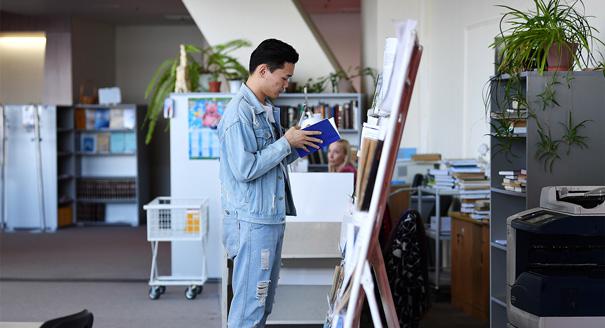
Russia needs foreign students, and not only to diversify its exports. Connections with people who have lived in a partner state are a valuable resource for fostering cooperation and an instrument of soft power.
Natural resources may comprise the majority of Russia’s exports to China, but oil and gas aren’t all it has to offer. Russian education is a promising and competitive export commodity, with Russian universities and other educational institutions currently attracting hundreds of thousands of students from the former Soviet republics. The question is whether the Russian educational sector can become part of the “pivot to the East.”
In May 2017, the Russian government launched the Export of Education project, whose main objective is to make Russian education more attractive and competitive internationally. The project envisages the number of international students in Russia more than tripling by 2025 to 710,000 students on campus and 3.5 million online.
China will certainly play an important role in this projected increase. In the last five years, the numbers of Chinese students in Russian universities and their percentage among all foreign students have grown steadily, and China is already one of the key target markets for Russian universities. According to Russia’s Education Ministry, 10 percent of the 323,000 foreign students currently enrolled on programs in Russia are from China.
The main draw for the Chinese is the relatively low cost of tuition at Russian universities and the decent quality of education they offer. Favorable exchange rates allow the Chinese to pay relatively little (especially by Western standards) for internationally rated schools. The Chinese cult of education and fierce competition for places at home are driving up demand for schools overseas.
Russian university education costs $3,000 a year on average, plus room and board expenses of roughly $150 a month. Moscow State University (MSU), Russia’s top-ranked university (78th in the world in the QS rankings), charges $5,000–$6,000 a year. For comparison, University of Illinois Urbana-Champaign (82nd place in the same rating) costs seven times as much: $35,000–$40,000.
It’s also quite easy to win a place at a Russian university. Foreign students don’t need to be proficient in Russian when they apply. Of course, not everyone passes the entrance exams, but, as a rule, most applicants are successful. In contrast, several hundred people may compete for a single place at a leading Chinese university. Only 2–3 percent of applicants are able to get in to the 150 best Chinese universities. Western universities, meanwhile, are only open to those proficient in English.
Had it not been for the pandemic, the number of Chinese students in Russia would have continued to grow. On February 20, 2020, the Russian authorities temporarily banned most Chinese nationals from entering the country, including student visa holders, as part of coronavirus restrictions. As a result, some prospective students decided not to apply to Russian schools.
The ban has now been lifted, but some students are still unable to visit Russia and continue to study online. In 2021, the number of new Chinese students in Russia dropped for the first time in five years (a 3 percent decline compared with a 25 percent increase a year before).
COVID is not the only issue, however. Even before the pandemic, Chinese students saw other countries as more attractive places to study. According to UNESCO data, only 2.3 percent of Chinese students studying abroad chose Russia in 2019. The majority preferred colleges in North America, Europe, Australia, Hong Kong, Japan, and Singapore.
Russia’s shortcomings in this sphere are quite similar to those thwarting the growth of other non-raw material exports. Russians don’t know much about the Chinese education market, are reluctant to adjust to local demands, and have problems communicating with their Chinese partners. This, coupled with sluggishness in introducing digital technologies, means they fail to take full advantage of the Chinese market.
There is also the issue of the language barrier. Chinese students often have difficulties understanding Russian-language lectures, especially in their freshman and sophomore years. The year they take to learn Russian (often from scratch) before starting to take college-level classes is insufficient to have command of professional terminology. Yet digital innovations triggered by the pandemic could help in this respect too, such as by allowing students to access recorded lectures online. It would also make sense to create a unified database of video lectures with subtitles and glossaries for the most popular foundation classes.
There are many ways to make the Russian educational system more attractive to the Chinese, such as by creating a consolidated internet portal that would market Russian educational services in China. A similar website—Studyinrussia.ru—already exists, but it’s missing information about the leading Russian colleges like MSU and St. Petersburg State University, which prefer their own means of attracting students. In 2020, MSU alone enrolled about 4,500 students from China, or 15 percent of all Chinese students in Russia.
Russian universities would also benefit considerably from a presence on WeChat, China’s most popular social network, used by a billion people monthly. The vast majority of Russian universities are not on WeChat, nor do they have any Chinese-speaking personnel in their foreign student departments. Some colleges, such as Kazan Federal University and Tomsk State University, have accounts on Weibo, the Chinese counterpart to Twitter, but they have few subscribers. The few Russian universities that do have WeChat accounts run them with the help of Chinese intermediaries. MSU opened its own official WeChat account only in November 2021; Vyatka State University got one in May 2021.
Russian universities also fail to take into account that some online platforms are unavailable in China. They should be conducting their open house sessions on video services that aren’t blocked by Chinese regulators. In addition, college representatives and recruiting agencies in China need to more actively focus on prospective students, especially on those learning Russian in high school.
Right now, the educational programs in most demand are those that take into account Russia’s image as a culturally rich country. For instance, most MSU arts students are from China (about 70 percent of all students accepted onto bachelor’s and specialist degree programs in 2020). It would make sense, therefore, to also develop science and technology programs targeting foreign students.
Russia needs foreign students, and not only to diversify its exports and raise extra funds for its universities. Connections with people who speak the language of their partner state and have lived there are a valuable resource for fostering cooperation and an instrument of soft power. Closer ties between the students and their Russian alma mater, as well as more active alumni communities, will result in more grassroots initiatives and joint projects.
Raisa Epikhina

Russian strikes are weakening the economy sustaining Ukraine’s war effort. Closing the growing funding gap will require more European support and politically contentious reforms in Kyiv.

Balázs Jarábik

While the EU and European governments are embracing the much-lauded middle-power moment, this entails three difficult conundrums.

Richard Youngs

Europe is facing rising populism internally as well as external pressures from Russia, China, Turkey, and the United States.

Dimitar Bechev

Economic recovery has brought Sri Lanka a modicum of stability, but domestic strains and great-power rivalry could test how long it lasts.

Avinash Paliwal

Policy proposals on sovereign debt must both match the scale of the challenge and be implementable within existing political constraints.
David McNair