

Commentary
Konstantin Skorkin
{
  "authors": [
    "Konstantin Skorkin"
  ],
  "type": "commentary",
  "centerAffiliationAll": "",
  "centers": [
    "Carnegie Endowment for International Peace",
    "Carnegie Russia Eurasia Center"
  ],
  "collections": [],
  "englishNewsletterAll": "",
  "nonEnglishNewsletterAll": "",
  "primaryCenter": "Carnegie Russia Eurasia Center",
  "programAffiliation": "",
  "programs": [],
  "projects": [],
  "regions": [],
  "topics": []
}
Source: Getty
The coronavirus pandemic has turned the mounting tension between the center and the regions into an open conflict. Now threats loom of revenge by the old elites and a new wave of populism exploiting the idea of regional independence.
Ukrainian President Volodymyr Zelensky’s team has managed to alleviate the old standoff between east and west that had dominated Ukrainian politics for many years. But it’s being replaced by a new dividing line: between the center and regional clans. While old foes from both east and west have been sidelined, local barons—unified by their unhappiness with the lockdown—are ready to challenge Zelensky’s hegemony in regional elections this fall.
The president’s attempts to strengthen control over the regions immediately face two major obstacles. The first is a long-running reform aimed at decentralizing Ukraine, which boosts the position of regional elected officials. The second is resistance to the center from local clans, which dislike the president’s fight against corruption and the fresh blood his team has brought in. The mayors of big cities such as Kiev, Kharkiv, Odessa, and Lviv, who have close ties to regional and national business groups, are becoming the president’s main opponents.
Zelensky cannot abandon the decentralization reform. It’s part of the process of closer integration with the EU, and is financed by international institutions, in addition to being one of the terms of the Minsk agreements aimed at ending the conflict in eastern Ukraine. Those agreements stipulate decentralization and special status for the self-proclaimed Donetsk and Luhansk people’s republics. The problem is that local government has essentially been hijacked by regional factions that are largely in opposition to the president. In the west of the country, they are controlled by supporters of Zelensky’s predecessor, Petro Poroshenko, while in the southeast, they are the heirs of the Party of Regions, Ukraine’s ruling party under former president Viktor Yanukovych.
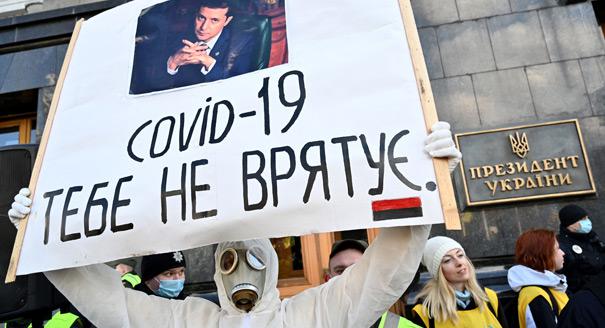
The coronavirus pandemic has turned the mounting tension between the center and the regions into an open conflict. Zelensky’s lockdown measures were instantly met with insubordination and sabotage from influential regional politicians, such as Kharkiv Mayor Hennadiy Kernes, who protested orders to close the city metro, only giving in when Zelensky publicly threatened him with legal action.
The longer the pandemic rages, the louder and more numerous regional protest voices become. Cherkasy Mayor Anatoliy Bondarenko began lifting lockdown measures in the city of his own accord, ignoring the timeline set out by the cabinet. When threatened with consequences by the president and Interior Minister Arsen Avakov, Bondarenko retorted that as the capital of Ukraine’s Cossacks, Cherkasy was prepared to resist the dictates of the center. People began to talk of a “creeping federalization” and comparisons were made with the Donbas region—home to the breakaway Donetsk and Luhansk regions—back in 2014.
There is no real risk of separatism for now, but a new line of confrontation is forming in Ukrainian politics: between the center and a motley coalition of regional clans united by the desire to preserve their authority and the status quo, and using slogans about local autonomy to achieve that goal. The standoff between the center and the heads of major cities has prompted speculation that the latter might unite into a party of mayors based on regional clans with a revanchist political agenda, which could become a serious rival for Zelensky’s Servant of the People party.
These clans don’t share a political agenda. The groups in western and central Ukraine would like to bring back Poroshenko’s consensus of corruption and patriotism, while the former Party of Regions supporters in the southeast would like to see the return of Yanukovych’s Ukraine. But both pose an equal threat to the political center that has evolved under Zelensky. Both wings would be satisfied with a polarized country in which, under the guise of squabbles over the official status of the Russian language in Ukraine or joining NATO, the clans will be free to conduct their corrupt affairs.
It would be wrong, however, to overestimate the potential of a party of mayors. A prototype—the Trust in Deeds party organized by the Kharkiv mayor Kernes and his Odessa counterpart, Gennadiy Trukhanov—took part in last year’s parliamentary elections and performed badly. The Opposition Bloc, which included Trust in Deeds, didn’t even make it over the 5 percent threshold needed to enter parliament.
It would also be very difficult to unify the diverse positions of various mayors into a national party, given Ukraine’s east-west division. More likely would be the creation of regional blocs bringing together the mayors of cities in the west or east.
Then there’s the question of who would be the bloc’s leader. Logic suggests that that person could be Kiev Mayor Vitali Klitschko, as first among equals. He said previously—after a series of conflicts with Zelensky’s team—that he was in talks with his colleagues on setting up a party of mayors, but has since made up with the presidential administration, making it unlikely that he would agree to head a party of mayors unhappy with Zelensky.
Other possible candidates for the leader of such a party include former prime minister Volodymyr Groysman, who has a reputation for being able to reach compromises with both east and west, and Cherkasy Mayor Bondarenko, who has quickly gained nationwide fame and the image of a man of the people.
Whether or not the mayors find common ground, the regional elections are likely to be a big headache for Zelensky.
Meanwhile, the confrontation with regional clans is set to be a long-term factor in Ukrainian politics. That will cause problems for decentralization reform, which is a major focus of Western funding and assistance and supposed to be one of the keys to unlocking the Donbas conflict.
Last year, the presidential team decided against holding early local elections, meaning a full overhaul of government was not completed. Now the country could become unmanageable, as the threats loom of revenge by the old elites and a new wave of populism exploiting the idea of regional independence.

An independent journalist.
Recent Work
Konstantin Skorkin
Konstantin Skorkin
Carnegie does not take institutional positions on public policy issues; the views represented herein are those of the author(s) and do not necessarily reflect the views of Carnegie, its staff, or its trustees.