Not All Barriers Are Made Equal
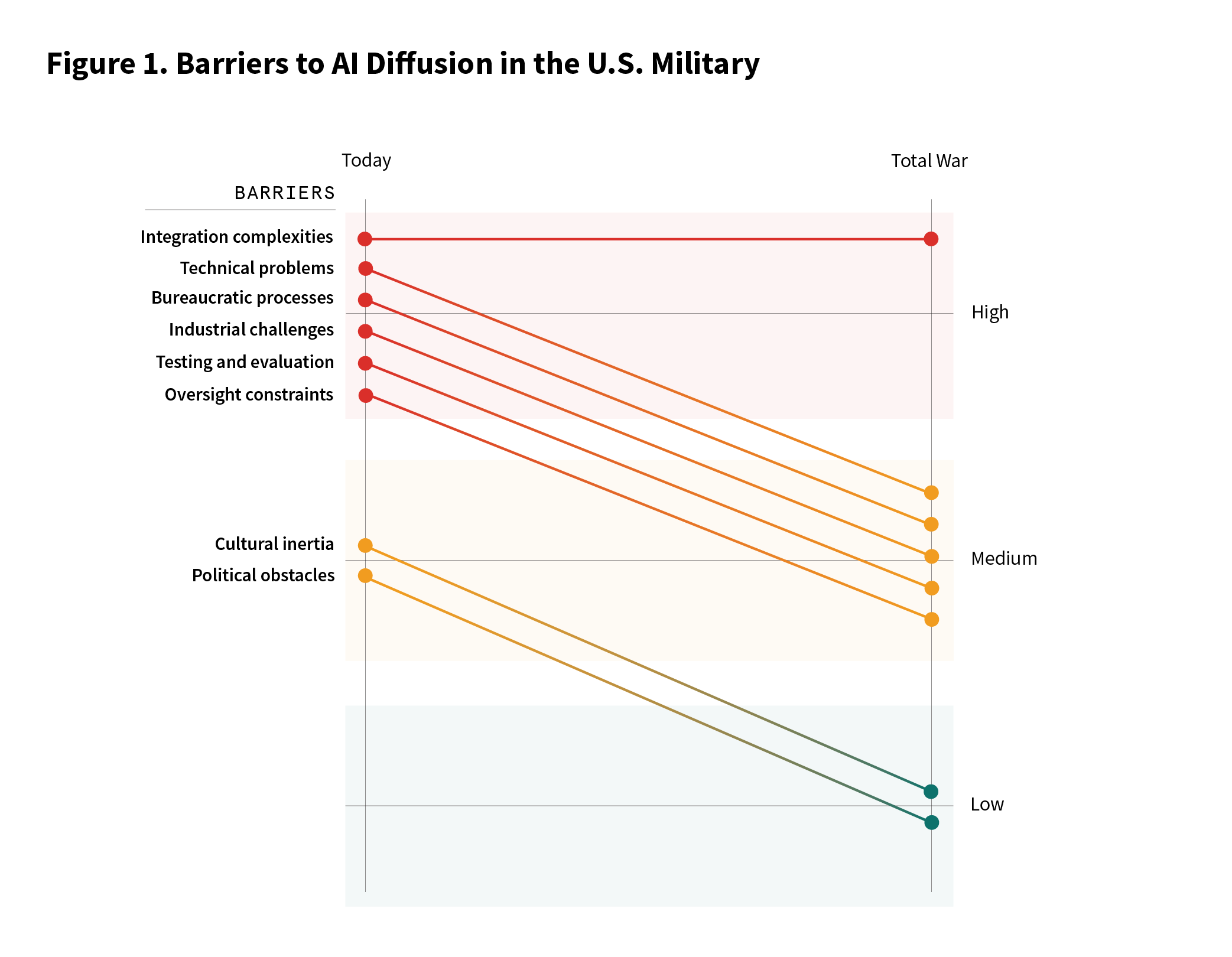
The bottlenecks to diffusion vary greatly by how easily the military can overcome them. The remaining technical problems require steady progress in edge computing and the generalizability of AI models to operate in diverse and unexpected real-world environments. The types of platforms these models are built into also matters. For large, exquisite systems like Anduril’s YFQ-44A, an unmanned wingman for fighter jets like the F35, the compute and sensor requirements for capable autonomy are likely imminently achievable. For small, attritable systems, significant breakthroughs in model performance and battery and compute efficiency are still necessary, and will likely be harder to achieve than for less resource-constrained systems. Army Materiel Command recently launched SkyFoundry, a public-private partnership aiming to “produce and procure millions of drones within the next 2-3 years.” Enduring technical challenges may produce a dichotomy while meeting that goal: an abundance of cheaper operator-controlled systems alongside a far smaller number of larger autonomous ones.
The tractability of cultural and bureaucratic hurdles is harder to evaluate. The Trump administration is making a sustained effort to prioritize speed in DoD acquisitions, generating significant optimism from defense tech startups. Fielding new weapons can be ordered through the chain of command. But effective use is a different matter, and the Apache-Shadow case showed how units can sideline systems they don’t see as serving the fight. Widespread adoption requires not just acquisitions reform but a mindset shift across the force—convincing leaders at every echelon, including hundreds of thousands of field and company grade officers and noncommissioned officers, that adopting emerging technologies will make them more effective. That could take years.
Political barriers are currently weak when it comes to acquisitions reform, given bipartisan support for legislation like the SPEED and FoRGED Acts. But last year saw the longest government shutdown in American history. A dysfunctional Congress can always threaten efforts to fund or implement autonomous systems at scale. And given recent public backlash to data center construction and the Pentagon’s potential use of AI for lethal autonomous weapons systems and mass surveillance, constituent pressure is likely to play a meaningful role in the coming months.
Industrial challenges, meanwhile, present reasons for both optimism and pessimism. The recent influx of public and private capital signals that government and industry are serious about domestic production capacity. But decades of offshoring this capacity, coupled with economic uncertainty—exacerbated by sweeping tariff regimes, persistent inflation, and concerns of an AI bubble—could slow America’s manufacturing buildup. While manufacturing jobs and construction spending climbed from the lows of the COVID-19 era, manufacturing construction spending peaked in mid-2024 and has declined since, capacity utilization sits below its 1972–2025 average, and output remains below 2022 levels.
Testing and evaluating autonomous systems and implementing them across the force are problems with resource- and time-intensive solutions. Once capabilities exist, their usefulness will depend on how well the military validates them for contested environments and trains servicemembers to fight with them. Even in wartime—which, for the United States, is often fought overseas and may not come with existential political stakes—and even with battle-tested technologies, this can take months or even years. In May 2023, the United States agreed to send F-16s to Ukraine, and top Ukrainian pilots began training soon after. But the first jets did not arrive until August 2024, and it took several more months—marked by crashes linked to pilot error—before Ukraine could fly them consistently and see meaningful battlefield effects.
Oversight constraints are in some ways binding, at least in the near term. Human decisionmakers, and the risk mitigation procedures they demand, will continue to limit the number of missions executed by autonomous systems. While war will accelerate certain processes, it’s difficult to foresee an immediate future where military leaders are stripped of their authority to approve the use of force or where the rank-and-file are not relied upon to monitor, maintain, and deploy these systems. A conflict significantly larger and faster than anything seen so far, in which servicemembers are largely removed from the line of fire, could shift that calculus. But those conditions are yet to exist.
There are pathways to overcome each of these bottlenecks. War or imminent crises can unify stakeholders to circumvent or eliminate barriers to rapid action. Under the right conditions, industry can move at speed and scale, as evidenced by America’s industrial buildup during World War II and Ukraine’s emergence as a top-tier drone producer today. But haste can endanger warfighters, as in Vietnam where the rapid fielding of the M-16 rifle forced marines to rely on a weapon highly prone to failure, or when the U.S. Army issued soldiers untested body armor in the early 2000s. Whether the government should seek to overcome these bottlenecks is therefore a complex question requiring deeper, case-specific analysis of each barrier’s purpose and desirability.
Some Barriers Can and Should Be Broken
To maintain a favorable balance of power, the United States should prioritize several reforms. Many reforms to bureaucratic, industrial, and political barriers have been discussed extensively elsewhere. The Pentagon must become more agile in its adoption of emerging technologies and shift from contracts that incentivize runaway costs to those that reward performance. The United States must maintain the political will to invest in domestic industrial capacity and fund basic and applied R&D to overcome technical hurdles. With Chinese-origin researchers increasingly choosing to work in China, the federal government should make concerted efforts to attract and retain talent. And to counterbalance China’s manufacturing dominance, the United States must leverage its alliances. The Pentagon’s request for Ukraine’s support to counter Iranian drones (after declining Ukraine’s earlier offer), and the victory of a Ukrainian drone company in its Drone Dominance program competition, underscore these realities. Less well understood is the importance of understanding and addressing the integration complexities and testing and evaluation requirements that impact AI diffusion.
To overcome integration complexities, the DoD must invest in human capital and unit-level buy-in. The military must recruit and train AI experts not just to work in the Pentagon but to serve as warfighters themselves. In the Army, UAS operators are enlisted soldiers with lower pay and education requirements than their manned aviation counterparts. Although expected to perform as technical and tactical experts, they still shoulder the menial taskings associated with their rank—a dynamic that undervalues the expertise required to integrate and employ novel technologies. Recruiting and retaining the right talent requires better alignment of rank and pay with the complexity of these roles.
The DoD’s current approach is too narrowly tailored to senior levels and too small in scale. The Tech Force is a Pentagon-level initiative. The Army is reportedly attempting to streamline its Direct Commission Program, but the pathway has struggled to deliver for years. In 2023, then Army Reserve chief Lt. Gen. Jody Daniels called it a “disaster,” and the program’s highest-profile success has been the direct commissioning of Big Tech executives into senior advisory roles. The Army’s new AI and robotics career paths set their sights lower, but the AI officer’s graduate-level requirements will likely produce too few officers, and robotics technicians won’t be assigned below the brigade level. To diffuse expertise more broadly, the military will need to build in-house training pipelines at the scale it uses for other specialties like aviation, intelligence, and special operations.
Likewise, existing programs have been marred by inefficiencies, like the Army Artificial Intelligence Scholar program producing worse promotion outcomes than the Army at large. The military’s educational ambitions are further complicated by Hegseth’s recent order to end Pentagon-funded attendance at many of the nation’s top technical schools. Existing programs may suffice for a drone fleet in the single digit thousands, as the United States has maintained for decades, but they cannot support one demanding hundreds of thousands or millions of unmanned systems. Autonomy promises to reduce operators per platform, but that reality is yet to unfold in Ukraine, and such a scenario would still expand demand for engineers, maintainers, mission planners, and commanders with the expertise to deploy autonomous capabilities into the fight.
Other integration issues require technical solutions. Funding should prioritize the digital and physical infrastructure needed to synchronously manage autonomous systems at scale, especially in denied environments without cloud compute access, and the unmanned systems compatible with this infrastructure. Without this foundational layer, even mature technologies will remain isolated tools rather than transformative operational capabilities.
This will also require cultural change. Senior leaders must accept honest feedback from the frontlines rather than mandating adoption of technologies that don’t serve frontline needs. The services should establish mechanisms enabling units to evaluate whether leaders’ expectations are realistic given the systems at hand. Had the Army better encouraged candid feedback on teaming Shadows and Apaches, the program might have been abandoned or modified far earlier—before it had consumed a decade of time, money, and manpower. Effective innovation depends on rapid iteration, which requires accepting early failures and pivoting when technologies or concepts fall short.
Some constraints require accepting more risk. The federal government and private industry should invest in domestic capacity even if returns are uncertain. The DoD must be willing to experiment with and discard technologies that do not work. And the military must try new ways of integrating talent and encouraging servicemembers of any rank to innovate. Another set of bottlenecks, however, calls for much greater caution.
Other Barriers Serve a Critical Purpose
Not all slowdowns are obstacles—some exist for good reason. Procurement reforms, while necessary, must also establish baseline standards as old ones are dismantled. The Pentagon should define minimum technology readiness levels and interoperability requirements for systems entering service, require technical data packages to measure these standards, and specify clear roles within each Portfolio Acquisition Executive’s office.
For cheaper systems with narrow capabilities, field testing by end users may be enough. But for platforms capable of carrying out complex operations, scrutiny is imperative. While it would be possible to speed up T&E by lowering requirements for effectiveness and safety, fielding unready equipment leads to one of two outcomes: lack of adoption or increased risk to soldiers’ lives and mission success. Rather than reducing T&E staff, the DoD must better equip its testing teams by expanding operations and developing innovative ways to evaluate emerging technologies.
The DoD should hire staff dedicated to red teaming autonomous systems and challenging them with the techniques U.S. adversaries are likely to use, including poisoning training data and fooling sensors. Testing capacity should be expanded through digital environments like the Navy and Air Force’s Joint Simulation Environment, and live ones like White Sands Missile Range and Yuma Proving Ground. Beyond that, the DoD installations need physical and regulatory updates to better support UAS training at scale, including dedicated drone ranges where units can learn through routine flying and crashing, something most training areas can’t currently support.
Faster access to state-of-the-art technology demands mechanisms for candid feedback at scale. The Army has recognized the need to involve ground-level users in the R&D process before: Programs like Soldier Touch Points have been designed precisely to integrate warfighters into acquisitions and T&E processes early and often. The 25th Infantry Division's Lightning Lab, a thirteen-person unit building and testing its own drones, reflects a promising step forward, as do reports that the 82nd Airborne and 4th Infantry Divisions are running their own experiments in field training. Whether the institution solicits and absorbs feedback from those doing this real-world testing will determine how successfully it adopts and integrates these new technologies across the force. The DoD should provide structured opportunities for leaders with operational experience to assess emerging technologies by integrating these engagements into existing professional military education courses like the Army’s Captain’s Career Course and Senior Leader Course. To generate unvarnished feedback without fear of reprisal, the DoD should create anonymous reporting channels for servicemembers to flag failing systems or aging doctrine.
Likewise, the military could overcome oversight constraints by carelessly offloading responsibilities from human commanders to autonomous systems. Doing so, however, would likely lower the threshold for use of force and increase the likelihood of conflict—counter to the DoD’s mission to deter war—while creating a race to the bottom with adversaries and accelerating escalatory spirals. There are tasks, especially defensive ones like intercepting a missile threatening a population center, where total autonomy can save lives. Other situations, like weighing the potential for collateral damage, call for moral decisions that demand human consideration. The line between these types of operations is blurred, however—is a Ukrainian frontline unit launching an attack to repel Russian forces acting offensively, or defensively? The most important structure to preserve, then, is a clear and enforceable accountability regime.
This Framework Applies Broadly to All Military AI Applications, With Caveats
While there are important differences between autonomous drones and other applications of AI in the military, these unmanned systems offer a framework to think about AI adoption more broadly. The technical and industrial requirements for physical systems, of course, diverge from AI applications that are software-based, like decision support and intelligence fusion. In this sense, some of the challenges raised in this paper, like autonomous navigation and mass producibility, may not generalize to other use cases. However, other underlying limitations in machine learning apply more broadly.
Given the continued existence of hallucinations in large language models, for example, military leaders and the frontier labs themselves have expressed trust and reliability concerns for high-stakes decisions. AI agents represent a meaningful step forward technologically, but accuracy and consistency remain elusive, and researchers expect this to be true in high-stakes contexts for the foreseeable future. Cultural resistance and integration in these domains is likely to vary; AI use is already prevalent in strategic planning and intelligence analysis, evidenced by the integration of Claude in U.S. strikes on Iran, but is expected to face varying degrees of enthusiasm from top brass when it comes to offloading decisionmaking especially at the operational and tactical levels. Lt. Gen. Lawrence Ferguson, commander of U.S. Army Special Operations Command, told the Senate Armed Services Committee in May 2026 that AI is a “tool for queuing human action . . . it is not a replacement for human decision-making.”
Even exclusively digital AI applications face physical infrastructure constraints. As autonomy scales, so do compute requirements. Ukraine’s computational architecture, consisting of Western cloud access, domestic data centers, and forward-deployed compute nodes, is already straining as it integrates more AI into targeting and coordination. A larger military projecting power across greater distances will require even more robust compute resources. And building that infrastructure in the United States faces its own industrial, political, and bureaucratic headwinds, with some data center construction projects across the United States stalled by grid limitations and local opposition leveraging environmental reviews and zoning regulations to halt progress. The Pentagon has signaled intent to address these constraints, with its latest budget request calling for $4.2 billion for “sovereign AI infrastructure.” The White House could also use national security concerns as justification to accelerate permitting and land-use processes that normally slow buildouts. But Congress has not yet approved funding for this effort, and even with waivers, physical infrastructure takes years to build.
Testing and evaluation for digital-only tools is cheaper and more readily available than physical testing requirements. But designing realistic and robust benchmarks and validation tests for environments as complex as war will be an ongoing challenge. Oversight constraints over nonlethal AI tools will be significantly streamlined in comparison to lethal weapons. But regardless of differences across use cases, one key tenet will persist: The extent that servicemembers and senior leaders trust these systems will determine whether they use them.
The Urgency of War Can Solve Some Bottlenecks, But Not All
If a total war with a peer adversary began tomorrow, some of these barriers would likely evaporate while others would remain intractable. The distinction between these types of bottlenecks matters greatly, especially against an adversary like China that has invested in the very diffusion mechanisms the United States and its allies struggle with most.
Political obstacles would likely be among the first to fall. The opening weeks of a major war would likely nix any quibbles over line-by-line accounting of Pentagon budget requests. An existential threat—especially one in which an adversary is visibly leveraging AI to threaten Americans—would almost certainly eliminate meaningful domestic resistance to military AI. Budgets would pass quickly, though hyperpartisanship could still be a risk, especially if the war drags on.
Bureaucratic processes would accelerate in tandem with those political changes as reality sets in that quickly fielding AI is paramount while risk aversion would likely diminish. For example, the War Production Board was established within weeks after Pearl Harbor, and it was given sweeping authority to redirect American industry. The bureaucratic challenges that hamstrung Replicator would likely be streamlined under similar circumstances.
Cultural inertia would likely pose issues in the early stages of a conflict, as military leaders cling to familiar systems and doctrines. But military culture would succumb to the pressure of new ways of operating once the consequences are made real. Recall that Ukrainian leaders initially resisted FPV drones, before their skepticism gave way once the reality of the war was made apparent.
Technical problems would benefit from surges in both funding and talent. War could motivate the best engineers and scientists to work on the hardest problems, although the most complex challenges may not yield to more resources. Testing and evaluation would accelerate too, as it has in Ukraine. But no commander is going to field equipment that puts their own forces at unacceptable risk. Systems would still need to meet some minimal threshold of safety and reliability—which would more than likely push the military toward cheaper, less capable systems fielded en masse rather than waiting on the most exquisite autonomous platforms. The pattern Ukraine has established, where entirely pilot-operated FPVs vastly outnumber semi-autonomous drones while fully autonomous systems are being developed, would likely prevail.
Industrial capacity would ramp up, driven by the same surges in funding and national will. But the hardest industrial bottlenecks would endure. Labor economics do not change overnight, so domestic production would remain far more expensive than it is for adversaries with cheaper labor forces. This would either leave the United States to massively increase deficit spending or find international partners to offshore production. And components the United States is not yet physically capable of producing simply cannot be willed into existence. Ukraine has worked for years to decouple from Chinese drone components, and the effort is still ongoing. For physical AI systems, the United States faces the same challenge with rare earth minerals, batteries, and legacy chips—chokepoints that no amount of wartime urgency can easily bypass without years of prior investment.
World War II offers an enticing example of the ways war can rapidly mobilize an all-of-society effort. But the United States had time to prepare, only entering after two years of supporting from the sidelines, and it still faced technological adoption challenges; the B-29 Superfortress, rushed into production before testing was complete, lost more aircraft to engine problems than enemy fire. More recent history urges further caution about how fast the United States can overcome these barriers. The wars in Iraq and Afghanistan had significant public and political attention early on, yet the military struggled for years to adapt to the nature of the fight. The Army and Marine Corps didn’t start developing new counterinsurgency doctrine in earnest for several years. And despite urgent requests for mine-resistant vehicles to counter the growing threat of improvised explosive devices, multi-year delays cost the lives of hundreds of soldiers and marines.
The implication is stark: what the U.S. military can improvise under fire will matter far less than what it built, tested, trained on, and integrated before the first shot was fired. There is no guarantee a conflict with an adversary that has already achieved faster diffusion will afford the time to catch up.