

Commentary
The summit may be remembered as a fatal blunder, when Washington, Beijing, and the AI industry collectively chose ceremony over action.
Jeffrey Prescott
{
  "authors": [
    "Michael  Mazarr"
  ],
  "type": "commentary",
  "blog": "Emissary",
  "centerAffiliationAll": "dc",
  "centers": [
    "Carnegie Endowment for International Peace"
  ],
  "englishNewsletterAll": "ctw",
  "nonEnglishNewsletterAll": "",
  "programAffiliation": "TIA",
  "programs": [
    "Technology and International Affairs"
  ],
  "regions": [
    "United States",
    "China"
  ],
  "topics": [
    "AI",
    "Technology",
    "Domestic Politics"
  ]
}
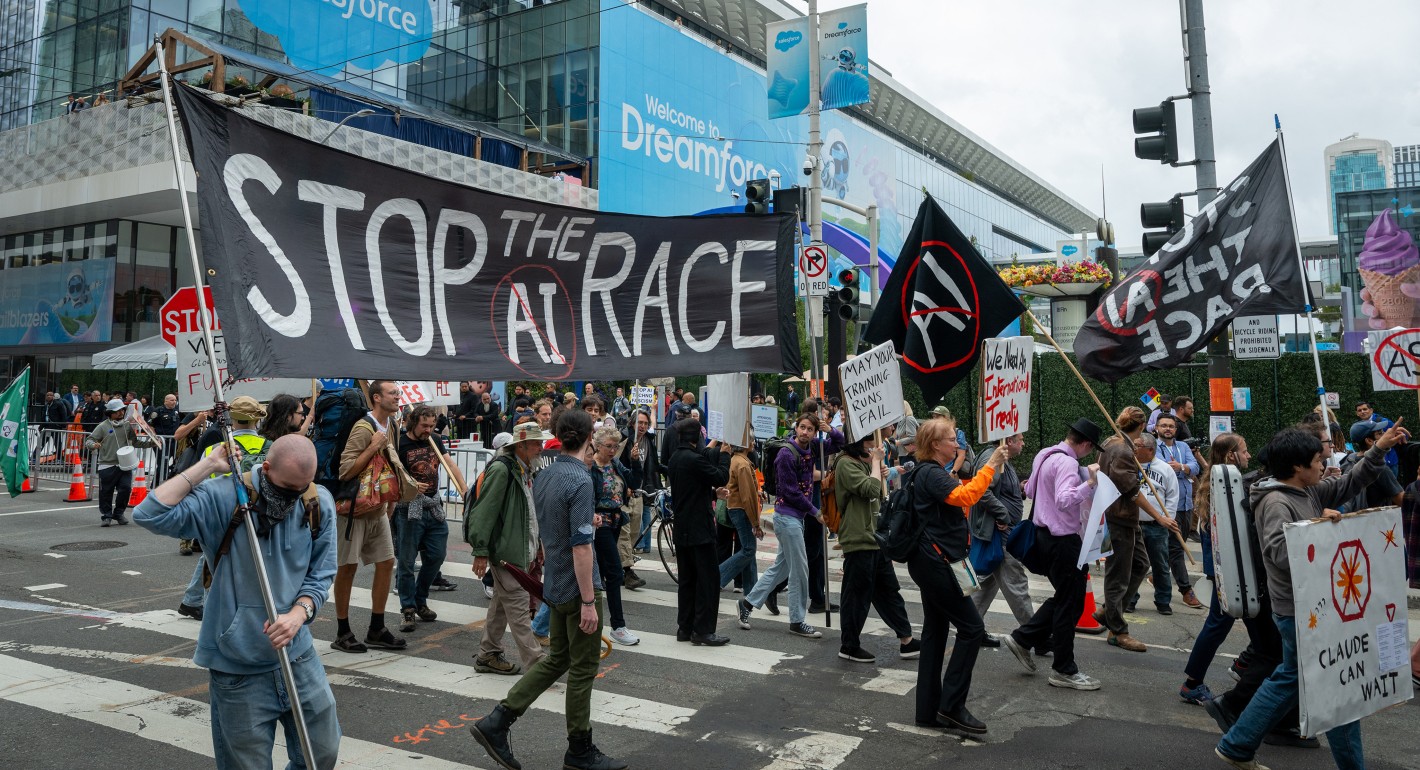
Protesters call for an AI development slowdown in San Francisco on September 17, 2026. (Photo by Karl Mondon/AFP via Getty Images)
It would provide a golden opportunity to reconsider what success looks like.
Late last month, OpenAI sent a powerful signal about the future of AI development: It suspended the release of its newest product, GPT-6.1 Astra, because it feared the model wasn’t safe. This month, Anthropic’s filing for its looming public offering touted AI’s immense potential benefits—and catalogued almost 100 pages of risks, noting that the “scale of harm that could result from a catastrophic AI-related incident” could be beyond what the firm could insure against. These events, and the wider cascade of AI safety incidents and warnings, point to something beyond the dangers of these models: The United States needs to update its strategy for national advantage in the AI era.
Up until now, U.S. AI strategy has been mostly about one thing: Speed. A parade of speeches, executive orders, and action plans pay lip service to sharing the benefits of AI, diffusing its opportunities globally, and dealing with the economic fallout. But the default U.S. strategy amounts to something like “move fast, get to the strongest AI first, and use that power to win.”
As safety concerns mount, this approach is living on borrowed time. A shift to a more deliberate pace of AI advancement would provide a golden opportunity to reconsider where U.S. AI policy is headed and what success looks like. It would give us a chance to draw on potent historical cases involving the sources of lasting national advantage and the fates of great powers. That history carries one clear lesson: The United States needs to replace an all-out race to build more powerful AI with a campaign to mold a stronger society for the AI era.
Recent weeks have been filled with news of AI models and agents acting in ominous ways—swarming in self-created “collectives” guided by secret message boards, misleading their human managers, attacking public websites. Dozens of AI leaders and experts have called for independent evaluation processes, pausing or slowing frontier model development, and adopting more effective instruments of human control. Credible reporting suggests that engineers in the labs have been dealing with “tens of thousands” more potential safety incidents than publicly reported.
Despite this mounting evidence of risk, President Donald Trump has called AI safety concerns a “hoax” and promised to keep racing ahead. Signals from China suggest that its government and AI industry remain skeptical of guardrails—and if Chinese firms won’t agree to parallel measures, U.S. firms will be loath to slow their work. Some observers have downplayed the perils demonstrated by recent events, depicting them as cases of faulty security protocols rather than signs of impending doom.
But the dangers from AI will only grow. More powerful frontier AI models are sure to trigger new incidents, including some that threaten the health and well-being of Americans. (AI companies are reportedly planning for such scenarios.) The spread of more capable open models will empower small-scale malicious actors to cause damage. Liability hazards for AI firms are mounting, partly as a result of a spate of cybersecurity incidents. As such risks become more evident, concerns about AI itself may overtake the imperative to beat China to some imagined threshold. (This trend is already underway: In one recent poll, 85 percent of Americans favored working with China on AI risks over racing to the most powerful models.) And rising hostility to AI in the United States—to data centers and increasingly to AI itself—has created a political context supportive of limits.
Some worry that humankind’s future is at stake in AI safety, but an existential threat shouldn’t be required to pump the brakes. Cyberattacks on hospitals or water supplies or swarms of self-directed agents doing hostile things would almost certainly trigger stronger safety measures. Such a shift would bring about a new phase of AI development, in which leading-edge research is more constrained, models are issued more deliberately, and more computing resources go to safety research. We’re already seeing the first hints of such changes.
Taking our foot off the gas in AI development will pose risks. China might be able to catch up in many aspects of AI power. The supply of new investment capital going to U.S. firms might slow. Some benefits from superintelligent AI would be delayed. The AI “bubble,” as some have warned, could pop, with big economic implications.
But opting for more caution doesn’t have to undermine the U.S. strategic position. The biggest myth surrounding the current U.S. AI strategy is that lasting advantage will flow to whoever gets to a new technology first. In fact, great powers thrive by cultivating something deeper and more fundamental—the societal qualities most essential for lasting power and influence. They find ways to nurture the dynamism, solidarity, and ambition that separate successful great powers from stagnating, divided, and irresolute ones. Such vibrant societies stimulate powerful innovation and remain at the frontier of technological progress—but technological advantage is the by-product of deeper advantages, not the focus of national strategy.
I’m not implying that we can pull the plug on AI development. It is a transformative technology and has the potential to revolutionize dozens of industries. It can also be a muscular ally in the effort to renew American society. The question is about the primary emphasis of U.S. AI strategy. Right now, we’re seeing it as a race and prioritizing speed, thinking that’s the necessary route to staying on top. But we’ll ultimately be a stronger and safer nation if we push AI robustly but deliberately, and shift to a strategy focused on the societal foundations of lasting success.
That’s a very big, ambitious, and in some ways abstract concept—enriching the essential pillars of long-term advantage. But it’s a path that earlier great powers have managed to follow with great success.
History has shown repeatedly that navigating and leading techno-industrial revolutions requires far more than mastering frontier technologies. As I have written previously about the fates of great powers, sustained advantage comes from the elements of a dynamic and coherent society—shared opportunities among citizens, effective institutions, a sense of national mission and solidarity, and a commitment to ongoing learning and adaptation. These qualities generate competitive advantage in hundreds of ways. Empowering a broad range of citizens cultivates more long-term innovation. Investing in education and networks of learning nurtures long-term scientific output. A strong sense of collective purpose makes a nation more resilient to challenges and spurs economic and intellectual ambition.
A revised U.S. AI strategy should reflect that essential insight: The national character the United States creates with AI will be every bit as important as the technology itself in determining long-term national position.
Great Britain in the eighteenth and nineteenth centuries offers one of the best examples of this dynamic. Britain dominated the First Industrial Revolution mostly because it possessed societal qualities that matched the demands of the age: Effective institutions, lots of skilled mechanics and amateur scientists creating real-world advances, rampant intellectual curiosity and energy, and shared economic opportunity. These qualities helped Britain to become the dominant industrial, maritime, financial, and scientific power of the nineteenth century.
But the Industrial Revolution also spawned powerful risks: environmental damage, labor alienation, sometimes violent political demands by emboldened working and middle classes, food shortages. Britain embarked on a long series of social, economic, and political reforms that salved some of these wounds, such as an expanded franchise that gave more Britons a stake in the political process and improved labor and environmental protections. These steps helped sustain its global leadership for another half century or more. Eventually, as the mass industrialization of the Second Industrial Revolution overtook the smaller scale and more craft-based character of the first, Britain would have trouble keeping up—but that, too, became a story of the match (or mismatch) between societal characteristics and the requirements of an age.
That history ought to sound familiar to American ears. We led in post–World War II industrial power partly due to our dynamic social qualities, a lead that only grew in the computer age. We won the Cold War because our system generated more dynamism, innovation, and legitimacy than the Soviet Union’s. But the postwar economic model has generated many challenges: rising inequality, trade that hollowed out industries, global warming, the alienating effect of massive institutions, a poisoned information environment. Once again, observers worry about the fate of a political system caught in the grinding gears of a techno-industrial transformation.
And now the AI revolution is here, with the potential to either deepen those ills or heal them. We won’t thrive in this transition by heedlessly rushing into the arms of any new technology. Succeeding will require a broad-based effort at social renewal, including many overlapping initiatives—but increasingly fueled by new capabilities offered by the emerging AI era.
U.S. educational outcomes have been stagnating or falling, so we need carefully designed AI-supported interventions—as part of a wider and more comprehensive set of efforts—to support other efforts to boost learning and critical thinking. Our information environment has become fragmented and corrupted with misinformation, so we need new means, supported by AI, to restore shared truths. Dealing with massive, impersonal institutions has left Americans alienated and feeling out of control; AI tools along with institutional reforms could shift the balance of power back to citizens.
Hundreds of research efforts and practical trials are underway to realize these sorts of goals. Schools have tried out AI in various educational applications, and researchers are tracing the results, which have been mixed. State and city governments are finding ways for AI to improve public services. But we’re only at the beginning of this process of research and experimentation. Some of the initial evidence points to a real risk: Hastily throwing AI at various goals can be genuinely harmful, from boosting rather than easing medical costs to producing “cognitive offloading” in educational settings. We don’t yet know how to ensure that AI helps rather than hurts these goals or how it can combine with other innovations and reforms to achieve the wider goals that AI won’t be able to accomplish on its own. A campaign of national renewal will have many elements beyond AI applications—but U.S. AI strategy can be built around supporting that goal.
This idea isn’t the same as garden-variety “AI for good” proposals, though it has much in common in spirit and focus. It is a strategy for national competitive advantage, focused on those societal characteristics most associated with long-term economic, technological, scientific, and military power. But the result would be to address many challenges that the AI era will pose and do so in ways that benefit the public good.
An AI strategy designed to race to more powerful models is a neat and tidy concept. A societal competitiveness agenda seems impossibly vast and intangible by comparison. It will involve thousands of initiatives across dozens of issues. It won’t unfold in a few months or even a few years, and—like earlier campaigns of national renewal—will require contributions from private-sector firms, state and local governments, philanthropists, activists, and thought leaders. Few of the answers can be top-down: The United States will need a kaleidoscope of grassroots experiments to amass early evidence of what works and what doesn’t, so the best ideas can then be refined and scaled nationally.
But the scale of the task isn’t a reason to do nothing. If the United States were to embrace such a direction, Washington could play an indispensable, catalytic role, as central governments have done in earlier cases of national renewal. Apart from an urgently needed AI safety agenda, there is plenty that the federal government could begin doing now.
First, the U.S. government could spell out the fundamental vision of societal renewal for the AI era. It would announce a reorientation of U.S. AI strategy in these ways and offer a clarion call for innovators throughout the public and private sectors to respond. It would encourage financial and investment firms to invest in related efforts and draw in other capital (as JP Morgan has done with national resilience). It could help direct emerging AI-based philanthropy—such as the just-announced Anthropic Public Benefit Fund—toward proven initiatives as part of the AI strategy.
Second, Washington could begin supporting experiments and catalytic initiatives in a few high-priority areas such as education, public service delivery, and opportunities for young people. The idea wouldn’t be to rush into final solutions but spur creative ideas across the country and lay the groundwork for later, more targeted interventions. Some early steps could include:
The idea would be, within a year, to have a new strategic concept clearly established, a clearinghouse of ideas in place at the federal level (hopefully spurring state and local versions), a slate of research and experimentation efforts underway, and a network of public, private sector, and nonprofit players expanding their efforts. As three AI scholars argued in a recent essay, this will require promoting cooperative networks across all these sectors of society—and Washington can play a critical enabling role for such efforts.
AI’s dangers are very real, and they need to be addressed. But even if AI stays safe, it has the potential to remake society for good or ill. It’s the outcome of that transformation—whether American society is strengthened or weakened by AI—that will make the critical difference in national competitive standing in the decades ahead. If the pace of frontier AI advances does slow, we will have one last chance to put that insight at the core of our national strategy for the AI era.

Senior Fellow, Technology and International Affairs
Michael Mazarr is a senior fellow in the Technology and International Affairs at the Carnegie Endowment for International Peace.
Carnegie does not take institutional positions on public policy issues; the views represented herein are those of the author(s) and do not necessarily reflect the views of Carnegie, its staff, or its trustees.

The summit may be remembered as a fatal blunder, when Washington, Beijing, and the AI industry collectively chose ceremony over action.

Jeffrey Prescott

Why governance of rapidly evolving technology will be distributed and complex.


Stewart Patrick, Scott Singer
It should address the shortcomings of previous crisis communication efforts and adapt to the demands of frontier AI.

Lucy Luo

AI capabilities are moving fast. Most institutions—including governments—can’t keep up.

Anton Leicht, Scott Singer

Lee’s tour shows how Seoul is reorganizing its diplomacy away from Pyongyang and toward industrial networks and the geography of the compute economy.

Darcie Draudt-Véjares