

Commentary
Sergey Vakulenko
{
  "authors": [
    "Sergey Vakulenko"
  ],
  "type": "commentary",
  "blog": "Carnegie Politika",
  "centerAffiliationAll": "dc",
  "centers": [
    "Carnegie Endowment for International Peace",
    "Carnegie Russia Eurasia Center"
  ],
  "collections": [],
  "englishNewsletterAll": "ctw",
  "nonEnglishNewsletterAll": "",
  "primaryCenter": "Carnegie Russia Eurasia Center",
  "programAffiliation": "russia",
  "programs": [
    "Russia and Eurasia"
  ],
  "projects": [],
  "regions": [
    "Russia",
    "Caucasus"
  ],
  "topics": [
    "Economy",
    "Climate Change",
    "Foreign Policy",
    "Political Reform",
    "Domestic Politics"
  ]
}
Source: Getty
Ukrainian aerial attacks could cause significant problems as international isolation makes it harder for Russian companies to fix broken equipment.
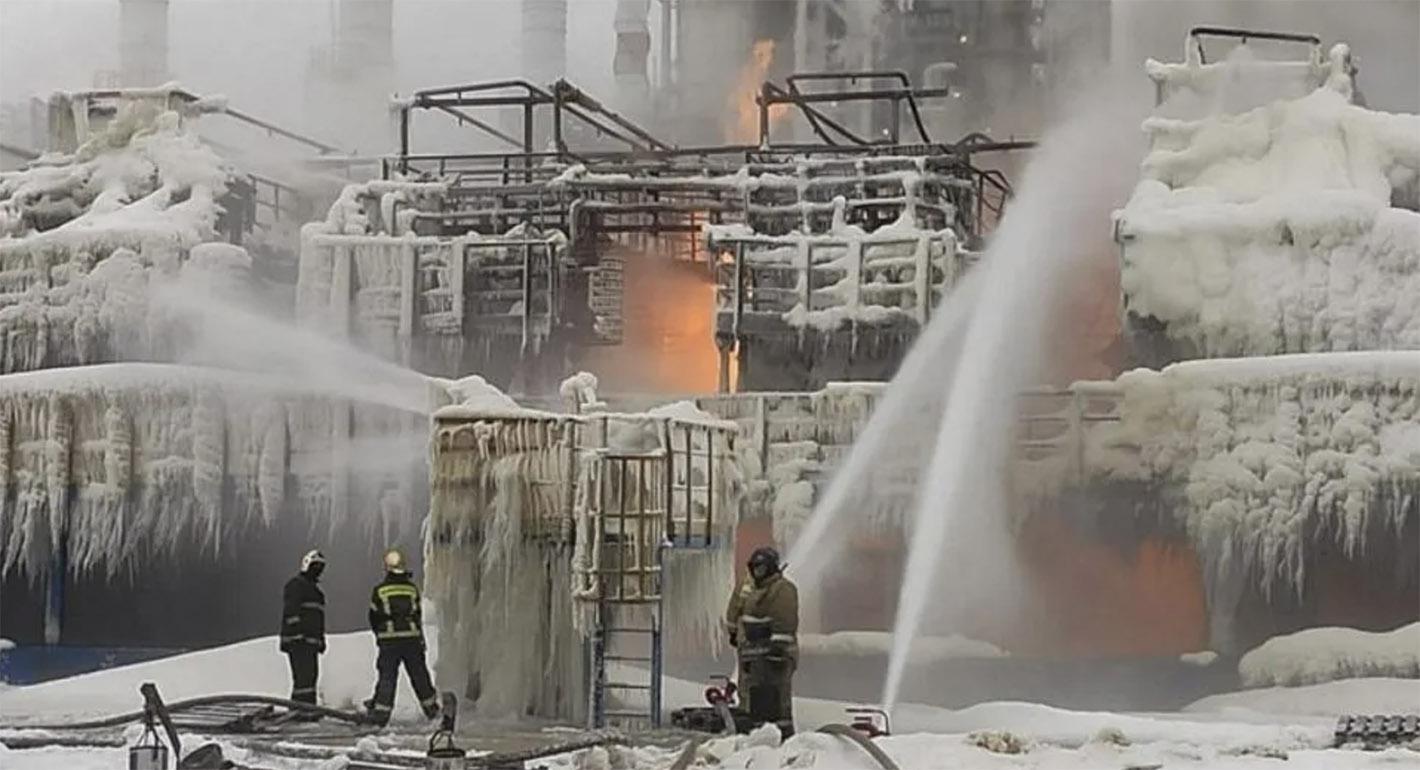
Russian oil refineries rarely generate much news. Yet since the start of 2024, they have barely left the front pages: first, there was an accident at Lukoil’s Kstovo refinery; then successful Ukrainian attacks on refineries in Ust-Luga on the Baltic Sea, and Tuapse on the Black Sea. These incidents garnered so much media attention because they pose major questions about how well Russia’s energy industry is coping with the pressures of wartime.
On one hand, the additional income Russia receives from exporting the products made by its refineries instead of the oil they are made from, is relatively insignificant compared to what it makes from selling the crude oil. Ironically, Russia’s tax system means that the state loses money if energy companies export oil products instead of crude oil.
On the other, oil products exports allow Russia to target multiple segments of the global oil market. And, of course, refineries are crucial for both the Russian economy and waging war in Ukraine: cars, trucks, tractors, harvesters, tanks, ships, and planes need gasoline, diesel, and jet fuel; they cannot run on crude oil.
Russia was given a reminder of the importance of refineries last summer, when the country was gripped by a fuel crisis that triggered gasoline shortages, and a blanket ban on gasoline exports. Although this was mostly caused by poor political decisionmaking, there were also some issues in the energy sector.
The two refineries attacked by Ukraine in January are export-oriented, and do not play a major role in the domestic market. However, if small drones with no more than 5 kilograms of explosives managed to reach Ust-Luga, which is 620 miles from Ukrainian territory, this means there are a total of eighteen Russian refineries with a combined capacity of 3.5 million barrels per day (more than half the Russian total) that are possible targets.
In the mind of a non-expert, a refinery full of highly flammable liquids can easily turn into a huge fireball. The reality is different. Russian construction codes—a relic of the Cold War—make refineries resilient against traditional air bombing. And they usually have plenty of firefighting equipment available. This means drones cannot destroy a whole refinery. They can, however, create a fire. And if they are lucky, managing to hit a gas fractionation unit, they may even be able to cause a bigger explosion.
After both the recent attacks, resulting fires were extinguished within a few hours, and the damage was successfully contained. It’s likely that the Ust-Luga and Tuapse refineries will be able to immediately resume operations, albeit with reduced throughput and limited product slate. Under normal circumstances, a full repair would be expected to take no more than a couple of months.
However, the circumstances in which the Russian refining sector finds itself at the moment are far from normal. When Russia began rebuilding its industrial base in the early 2000s, the country largely used imported equipment. As it gradually integrated into the global economy, Russia was able to purchase many different kinds of machines—far more than the limited selection produced in the Soviet Union. This came to an abrupt end in 2022, when the full-scale invasion of Ukraine destroyed the globally integrated model. Now, almost two years into the conflict, there are growing concerns about whether Russia’s industrial base can function in isolation over the long term.
Even before the drone attacks, the announcement on January 12 of a stoppage at Lukoil’s Kstovo refinery attracted significant media attention. This was because Western sanctions mean Lukoil may not be able to fix the faulty gas compressor for several months—not a couple of weeks as might have been expected before the war. In the process, Lukoil will almost certainly experience significant difficulties in integrating non-original parts. In a worst-case scenario, the refinery may even need to acquire entirely new equipment.
It’s true that gas compressors are not particularly complicated machines, and they are produced by Russian and Chinese factories. But that will not solve Lukoil’s problem—just like you can’t replace a faulty clutch in a BMW with a similar part from a Russian-made Lada, the same applies in industry. And “making do” with what’s available creates a host of knock-on problems.
One of the biggest issues for Lukoil—and for the refineries in Tuapse and Ust-Luga—will likely be obtaining approval for repairs from the Russian agency responsible for overseeing safety. Existing rules require equipment to be fixed according to the service manuals of the original manufacturers, and using original parts. This is a tall order when the original equipment manufacturers refuse to speak with their former clients because of Western sanctions.
Small drones like those used in Ust-Luga and Tuapse cannot cause major destruction. Still, they are cheap, and can be used for nuisance attacks. With a bit of luck, they can damage not just pipelines, but also compressors, valves, control units, and other pieces of equipment that are tricky to replace because of sanctions.
If this is Kyiv’s plan, it’s similar to the tactics employed by Russia a year ago, when it targeted the Ukrainian power system, bombing transformers in the hope that repairs would take time. In the end, Ukraine managed to source enough spare parts, and come up with enough quick fixes that Russia’s campaign failed. Now, it’s Russia’s energy infrastructure that’s in the crosshairs—and Russia needs to find a coping strategy.
On the one hand, there’s no doubt that Russia has a much larger industrial base than Ukraine, which means there are more opportunities to source parts domestically. On the other hand, Russia is more isolated from international markets than Ukraine.
If we are seeing the beginning of a wave of attacks on western Russia’s oil refineries, the consequences will be serious. Either way, Russia’s reserves of resilience and ingenuity look set to be severely tested. The speed and quality of the repairs at Kstovo, Ust-Luga, and Tuapse will be key indicators of Moscow’s readiness.

Senior Fellow, Carnegie Russia Eurasia Center
Sergey Vakulenko is a senior fellow at the Carnegie Russia Eurasia Center.
Recent Work
Sergey Vakulenko
Sergey Vakulenko
Carnegie does not take institutional positions on public policy issues; the views represented herein are those of the author(s) and do not necessarily reflect the views of Carnegie, its staff, or its trustees.

The truth of the strategic situation is that Europe and Russia are extremely unlikely to be able to “turn the page” on their confrontation within the next two decades.

Arkady Moshes

Russia spent years building a “sovereign internet,” concentrating web infrastructure exclusively within Russian territory. Ukrainian drone attacks have shown how vulnerable that approach has left the Russian internet.

Maria Kolomychenko

Putin’s conservative staffing policies and search for ever greater control have cemented parliament’s transformation into a bureaucratic appendage of the executive branch.

Andrey Pertsev

Russia’s AI-driven propaganda campaigns operate in a fragmented, chaotic, and often illogical manner. That’s not necessarily a problem for the Kremlin, though: It’s much easier to mimic genuine public debate that way.

Ilya Klishin

Without a ceasefire with Ukraine on attacking each other’s energy infrastructure—to which the Kremlin is unlikely to agree—the diesel agreement between Putin and Trump is largely for show, rather than representing a genuine increase in the volumes of Russian diesel on the global market.
Sergey Vakulenko