
• Research
  • Emissary
  • About
  • Experts
Carnegie Global logoCarnegie lettermark logo
DemocracyIran
  • Donate
{
  "authors": [
    "Mansoor Al-Jamri"
  ],
  "type": "commentary",
  "blog": "Sada",
  "centerAffiliationAll": "",
  "centers": [
    "Carnegie Endowment for International Peace"
  ],
  "collections": [],
  "englishNewsletterAll": "",
  "nonEnglishNewsletterAll": "",
  "primaryCenter": "Carnegie Endowment for International Peace",
  "programAffiliation": "",
  "programs": [],
  "projects": [],
  "regions": [
    "Bahrain"
  ],
  "topics": []
}

Attribution logo
REQUIRED IMAGE

REQUIRED IMAGE

Commentary
Sada

Are Constitutional Amendments Possible in Bahrain?

Opposition Shi'i deputies in parliament have had unusual success lately in getting agreement from pro-government Sunni deputies on amending the constitution to increase the powers of the elected lower house. But even with such cooperation the legislative process will be nearly impossible to navigate.

Link Copied
By Mansoor Al-Jamri
Published on Apr 2, 2009
Sada

Blog

Sada

Sada is an online journal rooted in Carnegie’s Middle East Program that seeks to foster and enrich debate about key political, economic, and social issues in the Arab world and provides a venue for new and established voices to deliver reflective analysis on these issues.

Learn More

The Bahraini lower house of parliament has seen an unusual development in recent months: cooperation between opposition and pro-government factions on proposals to amend the kingdom's 2002 constitution. While the two groups differ on almost every subject, they share a desire to increase the powers of the body to which both belong. 

But the deck is stacked against the parliamentarians, even when they clear the difficult hurdle of cooperation. Under the 2002 constitution, amendments are only possible with the approval of 27 of the 40 members of the elected lower house (House of Representatives) and the same number in the forty-member appointed upper house (Shura Council). The House of Representatives includes the opposition Shi’i al-Wefaq bloc (seventeen MPs), Sunni Salafist al-Asala bloc (eight MPs), Sunni Muslim Brotherhood al-Manbar bloc (seven MPs), Sunni al-Mustaqbal bloc (four MPs), three other Sunni MPs, and one MP of an independent liberal tendency. Generally this adds up to seventeen or eighteen votes for the opposition and twenty-two that are reliably pro-government. The 40 Shura Council members, however, are all considered to be in line with the will of the government and will never agree to any amendment that may not be accepted by top leadership.
 
Amending the 2002 constitution has been among the major goals of al-Wefaq MPs since they entered parliament in 2006, the first time the Shi’i opposition movement participated in national elections. Remarkably, al-Wefaq managed to convince many of its opponents in the lower house to support a set of amendments to expedite the legislative process, including:
  • enabling the two houses of parliament to modify “laws by decree” issued by the king outside parliamentary sessions, which they currently may only accept or reject in their entirety;
  • permitting elected members to question government officials about the reasons for not implementing non-mandatory motions passed by parliament;
  • increasing the duration of annual sessions of parliament from seven to nine months;
  • deleting an article that empowers the government to impose a limit of fifteen days for each house to approve bills relating to financial and economic matters, after which the king may pass the bill as law without legislative approval;
  • requiring the government to solicit elected members’ views on the government’s policy statement;
  • giving supervision of proposed bills and constitutional amendments to a committee of the elected lower house rather than a government office;
  • requiring government budgets to be submitted annually rather than for several years at a time.
The pro-government blocs in the lower house rejected, however, some of al-Wefaq’s other proposed amendments that would directly take powers away from the upper house, such as:
  • reducing the size of the appointed Shura Council from 40 to twenty members;
  • giving the lower house the final say on bills that do not gain a majority of votes in the two chambers;
  • designating the speaker of the lower elected house as the chair of any combined session (currently the prerogative of the Shura speaker);
  • authorizing the speaker of the elected lower house, instead of the Shura, to transmit bills to the government.
Thus far negotiations between the blocs of the lower house are moving slowly. The blocs will meet again in April but are unlikely to reach a workable agreement despite their statements to the contrary. And the fact remains that even if they do agree on a proposed set of amendments, they would need to gain the support of 27 of the appointed Shura members, nearly an impossible task.
 
Al-Wefaq’s MPs will get one thing, however, out of all these tedious and probably fruitless negotiations. They will be able to go back to their constituents and prove that they tried hard to change parts of the constitution, as promised during their election campaigns. It remains to be seen how well that will work to shore up public support for al-Wefaq in view of constant campaigns from other opposition movements (such as Haqq) that eschew participation in a system they view as fundamentally unfair.
 
Mansoor al-Jamri is editor-in-chief of al-Wasat newspaper.

About the Author

Mansoor Al-Jamri

Mansoor Al-Jamri
Bahrain

Carnegie does not take institutional positions on public policy issues; the views represented herein are those of the author(s) and do not necessarily reflect the views of Carnegie, its staff, or its trustees.
More Work from Sada

  • Commentary
    Sada
    Finding Clarity in a Middle East Unbalanced

    Sada launches its first eBook, a collection of essays that explores the region’s deep political changes since the Arab uprisings.

      Intissar Fakir

  • Commentary
    Sada
    Bahrain’s Opportunity for Economic Reform

    Falling government revenues are pushing Bahrain’s government to implement economic reforms, but it will need to make political concessions to pursue long-term changes.

      Abdulla Abdulaal
  • Commentary
    Sada
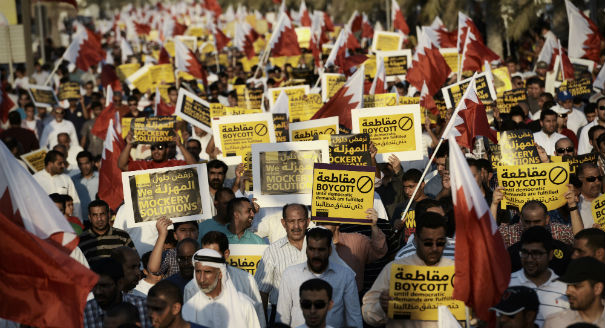
    Boycott in Bahrain

    Upcoming elections in Bahrain are likely to prompt more opposition protests, rather than providing a means of channeling and containing opposition activity.

      Jane Kinninmont
  • Commentary
    Sada
    Bahrain Between its Backers and the Brotherhood

    The recent efforts to label the Muslim Brotherhood as a terrorist organization puts Bahrain’s leadership at odds with its domestic ally against the Shia opposition.

      Ibrahim Hatlani
  • Commentary
    Sada
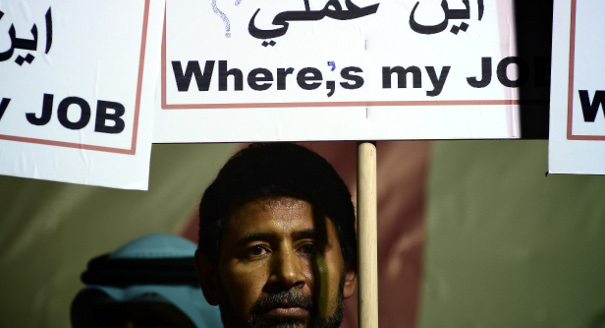
    Laboring Against Themselves

    The responses of Gulf Cooperation Council countries to the 2011 uprisings only reinforce a culture of state dependency.

      Suliman Al-Atiqi

Get more news and analysis from
Carnegie Endowment for International Peace
Carnegie global logo, stacked
1779 Massachusetts Avenue NWWashington, DC, 20036-2103Phone: 202 483 7600Fax: 202 483 1840
  • Research
  • Emissary
  • About
  • Experts
  • Donate
  • Programs
  • Events
  • Blogs
  • Podcasts
  • Contact
  • Annual Reports
  • Careers
  • Privacy
  • For Media
  • Government Resources
Get more news and analysis from
Carnegie Endowment for International Peace
© 2026 Carnegie Endowment for International Peace. All rights reserved.