

Commentary
Sada launches its first eBook, a collection of essays that explores the region’s deep political changes since the Arab uprisings.
Intissar Fakir
{
  "authors": [
    "Laurence Clements"
  ],
  "type": "commentary",
  "blog": "Sada",
  "centerAffiliationAll": "",
  "centers": [
    "Carnegie Endowment for International Peace"
  ],
  "collections": [],
  "englishNewsletterAll": "",
  "nonEnglishNewsletterAll": "",
  "primaryCenter": "Carnegie Endowment for International Peace",
  "programAffiliation": "",
  "programs": [],
  "projects": [],
  "regions": [
    "Bahrain"
  ],
  "topics": []
}

Source: Getty
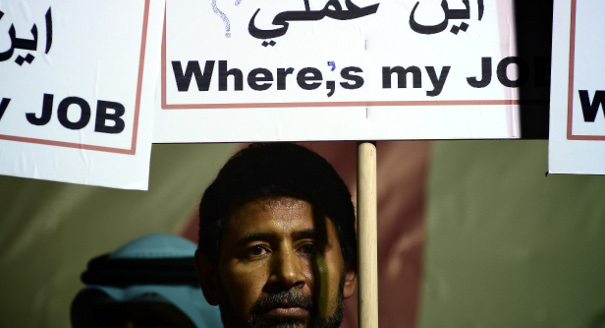
This case study from Bahrain shows how workers and unions are responding to the global economic crisis.
The International Labor Organization (ILO) predicts that the Arab world will lose five million jobs in 2009 and that remittances from migrant workers will be significantly reduced, thus placing a burden on the countries sending workers abroad. Even in oil rich Gulf states the shockwaves are being felt, albeit with different degrees of severity. Declining oil prices have led governments to look critically at their budgets. In Bahrain, the government requires oil prices of $75 per barrel to balance its current budget; Kuwait by contrast requires only $30 per barrel. Within the Gulf Cooperation Council (GCC), the United Arab Emirates, Saudi Arabia, and Kuwait have substantial reserves that can allay the worst aspects of the crisis. But in Bahrain, growth projections for 2009 have fallen to 1.9 percent.
Laurence Clements
Carnegie does not take institutional positions on public policy issues; the views represented herein are those of the author(s) and do not necessarily reflect the views of Carnegie, its staff, or its trustees.
Sada launches its first eBook, a collection of essays that explores the region’s deep political changes since the Arab uprisings.

Intissar Fakir
Falling government revenues are pushing Bahrain’s government to implement economic reforms, but it will need to make political concessions to pursue long-term changes.
Abdulla Abdulaal
Upcoming elections in Bahrain are likely to prompt more opposition protests, rather than providing a means of channeling and containing opposition activity.

Jane Kinninmont
The recent efforts to label the Muslim Brotherhood as a terrorist organization puts Bahrain’s leadership at odds with its domestic ally against the Shia opposition.
Ibrahim Hatlani
The responses of Gulf Cooperation Council countries to the 2011 uprisings only reinforce a culture of state dependency.
Suliman Al-Atiqi