

In The Media
Michele Dunne, Robert Kagan
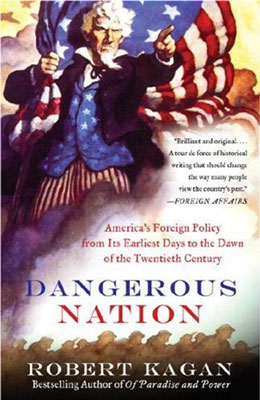
Robert Kagan strips away the myth of America’s isolationist tradition and reveals a more complicated reality: that Americans have been increasing their global power and influence steadily for the past four centuries. Even before the nation’s birth, Americans believed they were destined for global leadership. Underlying their ambitions was a set of ideas and ideals about the world and human nature.
Source: Vintage

Robert Kagan strips away the myth of America’s isolationist tradition and reveals a more complicated reality: that Americans have been increasing their global power and influence steadily for the past four centuries. Even from the time of the Puritans, he reveals, America was no shining “city up on a hill” but an engine of commercial and territorial expansion that drove Native Americans, as well as French, Spanish, Russian, and ultimately even British power, from the North American continent. Even before the birth of the nation, Americans believed they were destined for global leadership. Underlying their ambitions, Kagan argues, was a set of ideas and ideals about the world and human nature. He focuses on the Declaration of Independence as the document that firmly established the American conviction that the inalienable rights of all mankind transcended territorial borders and blood ties. American nationalism, he shows, was always internationalist at its core. He also makes a startling discovery: that the Civil War and the abolition of slavery—the fulfillment of the ideals of the Declaration—were the decisive turning point in the history of American foreign policy as well. Kagan's brilliant and comprehensive reexamination of early American foreign policy makes clear why America, from its very beginning, has been viewed worldwide not only as a wellspring of political, cultural, and social revolution, but as an ambitious and, at times, dangerous nation.
About the Author
Robert Kagan is senior associate at the Carnegie Endowment for International Peace, transatlantic fellow at the German Marshall Fund, and a columnist for The Washington Post. He is also the author of A Twilight Struggle: American Power and Nicaragua, 1977–1990, and editor, with William Kristol, of Present Dangers: Crisis and Opportunity in American Foreign and Defense Policy. Kagan served in the U.S. State Department from 1984 to 1988. He lives in Brussels with his family.
"Provocative . . . Powerfully persuasive, sophisticated."
- Publishers Weekly [starred review]

Former Senior Associate
Kagan, author of the recent book, The Return of History and the End of Dreams (Knopf 2008), writes a monthly column on world affairs for the Washington Post and is a contributing editor at both the Weekly Standard and the New Republic.
Recent Work

Michele Dunne, Robert Kagan
Robert Kagan, Michele Dunne
Carnegie does not take institutional positions on public policy issues; the views represented herein are those of the author(s) and do not necessarily reflect the views of Carnegie, its staff, or its trustees.

The acknowledgment has sparked fears of a new arms race with China and Russia.

Chris O’Meara

Smaller powers cannot go it alone, but Canadian history shows that integration with the United States will not always be benign.
Paul Samson

The summit may be remembered as a fatal blunder, when Washington, Beijing, and the AI industry collectively chose ceremony over action.

Jeffrey Prescott

European NATO countries are wrestling with the possibility of U.S. disengagement from the alliance. With the continent’s security increasingly uncertain, governments must restore the credibility of their collective defense.



Hans-Dieter Lucas, Adam Thomson, Pierre Vimont
Soft power on its own is insufficient to meet U.S. national security needs, but hard power also has its limits. Soft power allows for more effective and efficient use of hard power than hard power alone, as it encourages cooperation and compliance which deters the need for hard power.

Sarah Yerkes