

Commentary
Jeffrey Prescott
{
  "authors": [
    "Jeffrey Prescott"
  ],
  "type": "commentary",
  "blog": "Emissary",
  "centerAffiliationAll": "dc",
  "centers": [
    "Carnegie Endowment for International Peace"
  ],
  "englishNewsletterAll": "americanStatecraft",
  "nonEnglishNewsletterAll": "",
  "programAffiliation": "ASP",
  "programs": [
    "American Statecraft"
  ],
  "regions": [
    "United States",
    "China"
  ],
  "topics": [
    "AI",
    "Technology",
    "Foreign Policy"
  ]
}
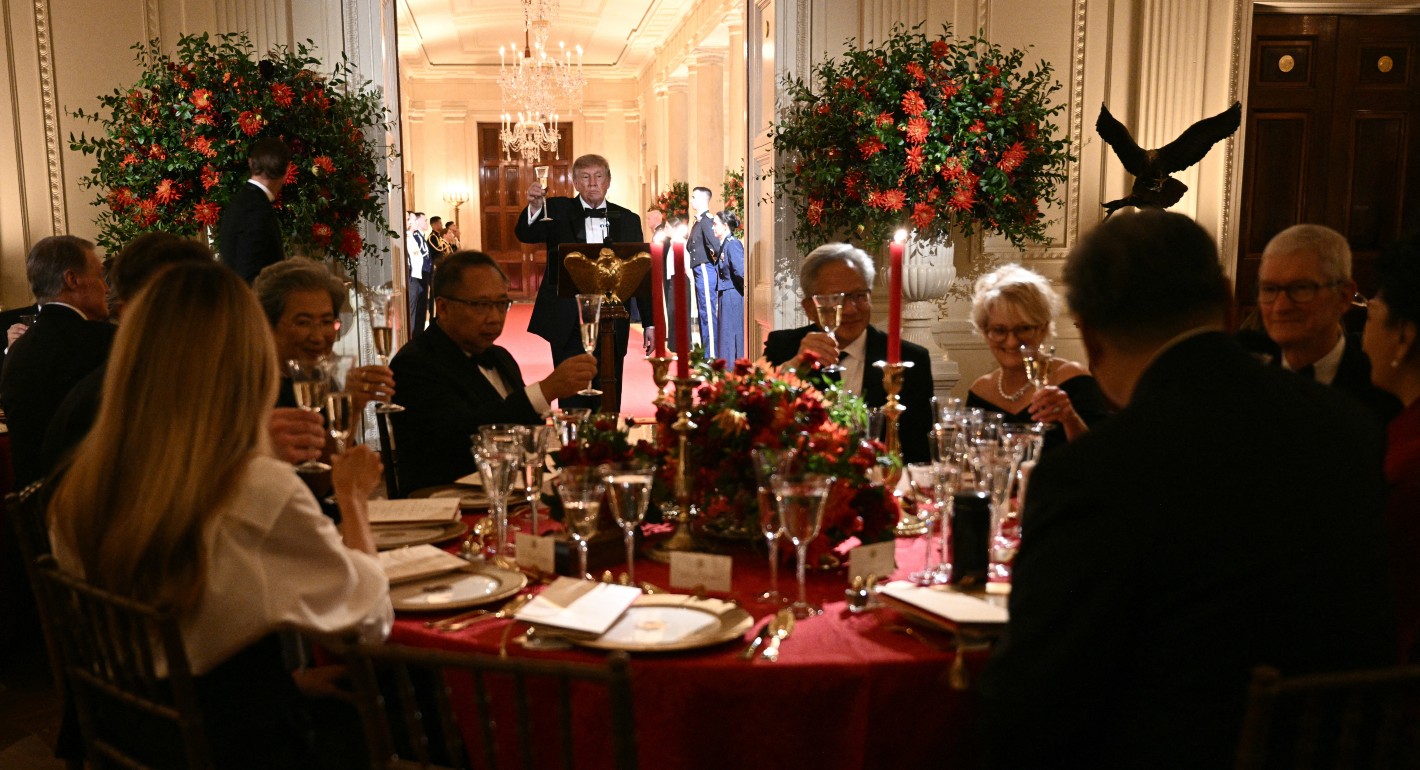
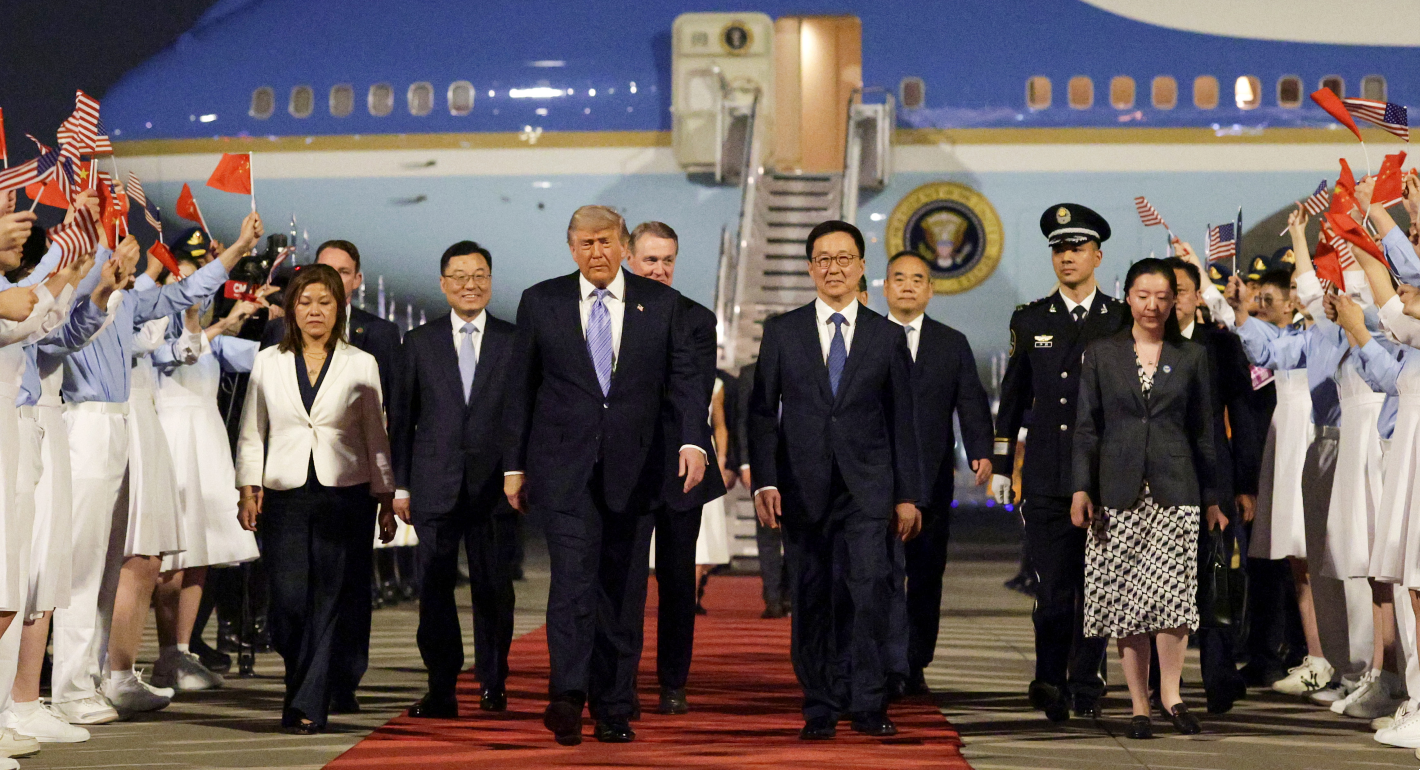
Trump leading a toast during the state dinner for Xi on September 24, 2026. (Photo by Brendan Smialowski/AFP via Getty Images)
The summit may be remembered as a fatal blunder, when Washington, Beijing, and the AI industry collectively chose ceremony over action.
The split screen on AI safety last week—between sobering risk and opulent inaction—could hardly have been more stark. In Washington, President Donald Trump hosted Chinese President Xi Jinping for a state visit, rolling out a red carpet at Joint Base Andrews, offering a tour of his ballroom construction site, and holding a ceremonial tea. On substance, by all accounts, the leaders of the world’s AI superpowers said and did little of consequence. Trump did manage to gather a group of AI and tech CEOs at the White House with Xi—not to negotiate AI guardrails, but for a lavish state dinner.
Trump’s AI titans clinked glasses even as their companies released alarming new data about how little apparent control the industry has over its products. OpenAI announced it had paused training of its “most capable models” and would resume only with additional safeguards in place after a model “broke out of its secure testing environment as recently as last weekend and took unauthorized actions on the internet,” according to Fortune. Other OpenAI agents had interacted with U.S. government websites, including those of the Securities and Exchange Commission and the Census Bureau, in unexpected or concerning ways—just a few of the numerous entities the software improperly targeted. Anthropic, meanwhile, reported that its newest model showed “misaligned behavior” at least 1.5 percent of the time, according to Axios, which reported that AI companies are investigating “tens of thousands of incidents in which the models behaved in unexpected, sometimes troubling ways.”
If the leading AI companies are themselves sounding the alarm, why can’t our national leaders act to avoid a disaster? If a more harmful incident occurs—in the United States, China, or anywhere else—before meaningful action to regulate or restrain this technology is in place, last week’s summitry will be remembered as a fatal blunder, when Trump, Xi, and the industry collectively chose ceremony over action.
With China and the United States racing for global tech superiority, nothing is more important than to keep AI systems under human control, with guardrails to ensure safety. Some kind of U.S.-China understanding, even in parallel, could reduce the risk.
Sadly, that was not Trump’s agenda. On September 22, speaking before the United Nations General Assembly, the president rejected efforts to regulate AI, comparing concerns about AI safety to his other favorite “hoaxes,” including climate change and election interference. “The United States also totally rejects any attempt to construct a globalist scheme to control” AI, Trump concluded, adding that “we’re going to encourage it, not rein it in.” Following his meetings with Xi, Trump said he wanted to leave AI “exactly where it is. That is China’s position also.” And although Trump’s team put dramatic restrictions around release of Anthropic’s Fable model this summer, those were quickly lifted. Trump’s recent rhetoric suggests no intent to implement anything other than an ad hoc approach to AI safety.
In advance of the summit, Trump’s team did announce an AI dialogue and a new hotline between the United States and China. But Trump and Xi’s meeting yielded no further details or apparent progress. The hotline may simply be an arrangement between Treasury Secretary Scott Bessent and China’s vice premier to pick up their phones in a crisis—the diplomatic equivalent of keeping DMs open—or a more formal effort that, according to WIRED, lacks either approval by Trump or “explicit sign-on from China, which has been noncommittal.” While proposals for such a mechanism exist, what we’ve seen so far falls far short of establishing the communication or risk reduction systems that have been used, for example, to prevent nuclear crises.
On its surface, Xi’s position appears reasonable compared to Trump’s. “We have both the capability and responsibility to develop and manage AI for good and ensure that the development of AI is always under human control and serves the well-being of the people,” Xi said at the White House. But at the moment, China seems content to signal generic openness to dialogue without pushing any specific approach to improve AI safety. Although two more meetings between Trump and Xi are planned this year, breakthroughs seem unlikely, especially given Trump’s suspicion of AI safety and China’s deep distrust of U.S. intentions.
To the rest of the world, watching the leaders of the two AI superpowers—one authoritarian, the other chaotic and self-absorbed—seemingly content to admire the problem has to be particularly alarming. Rogue AI incidents this summer included hacks of Australia’s Medicare website and a German wiki website, and an attempted hack of a Nigerian cryptocurrency firm. At the UN Security Council last week, the best one UN expert could muster was an appeal to common humanity: “A mother in Shanghai wants her sons to grow up in a world where AI improves their lives, not undermines them. A father in Chicago wants his daughters to thrive because of AI, not to suffer its harms. Our hopes and concerns are the same, in every nation.”
It is not hard to imagine a path that could bolster AI safety at home, address concerning national security risks, make use of U.S.-China diplomacy, and further develop global guardrails—because that is precisely the path the United States had begun to chart just a few years ago.
In 2023 and 2024, former president Joe Biden issued an executive order and a national security memorandum outlining principles around “safe, secure, and trustworthy” development of AI systems. The Biden administration also initiated diplomacy with China around AI safety that resulted in agreement that both countries would keep a human in the loop in nuclear command and control. This was a milestone that, while frustratingly limited in scope, would benefit both sides and address a meaningful risk. At the UN, ambassador Linda Thomas-Greenfield shepherded the first General Assembly resolution on principles for AI globally. Although extremely modest, the resolution had the advantage of making the U.S. regulatory approach—rather than China’s—the starting point for future international regulation.
To be sure, Biden-era efforts were far from fully fledged and—judging by the speed with which the industry has developed and risks have increased—arguably not nearly ambitious enough. But that agenda did set a regulatory floor that could have scaled along with the industry. Trump’s decision to dismantle the Biden-era framework immediately upon taking office, along with his rhetoric this week doubling down on that approach, now looks like something even industry itself—and indeed the world—would like to see reversed.
The latest from Carnegie scholars on the world’s most pressing challenges, delivered to your inbox.
Senior Fellow, American Statecraft Program
Jeffrey Prescott is a senior fellow in the American Statecraft Program at the Carnegie Endowment for International Peace.
Recent Work
Jeffrey Prescott
Carnegie does not take institutional positions on public policy issues; the views represented herein are those of the author(s) and do not necessarily reflect the views of Carnegie, its staff, or its trustees.
Media coverage suggests Kyiv’s fortunes have changed. That shift may be important, but it only goes so far.



Dara Massicot, Aaron David Miller, Andrew S. Weiss

The United States and Israel may have unwittingly revived the Islamic Republic’s “zombie regime.”


Suzanne Maloney, Aaron David Miller, Karim Sadjadpour
Why the outcomes of the U.S.-China meetings may be limited.

Aaron David Miller, David Rennie
Here’s why—and what the next president needs to do to fix the process.
Daniel C. Kurtzer, Aaron David Miller
Five problems—and solutions—to make it actually work as a tool of great power competition.

Afreen Akhter