Smaller powers cannot go it alone, but Canadian history shows that integration with the United States will not always be benign.
Link Copied
By Paul Samson
Published on Oct 1, 2026
Introduction
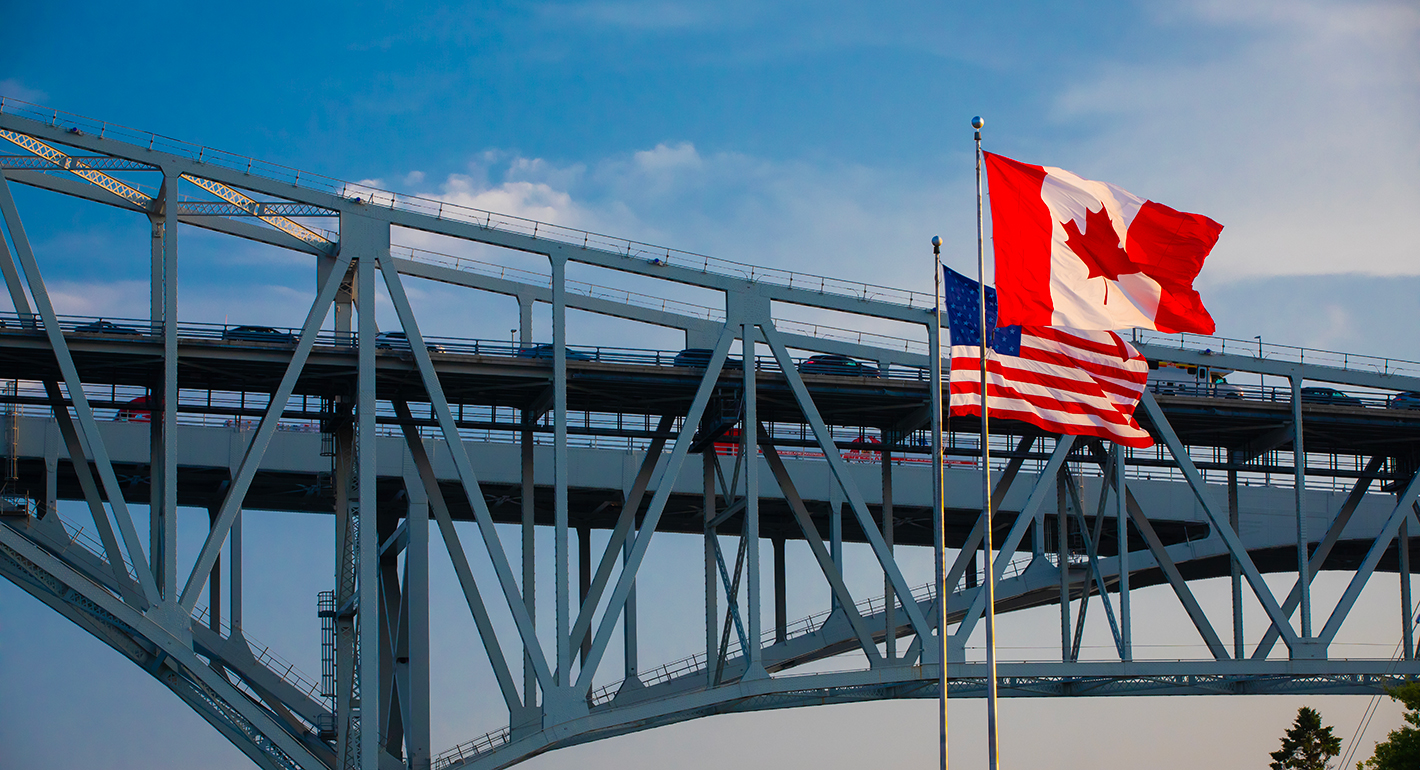
The escalating trade war between Canada and the United States highlights a central tension in their relationship: decades of economic integration have generated extraordinary prosperity for Canada, but the intertwining of its economic, security, and technological systems with those of its neighbor has also left it exposed to enormous U.S. leverage. Canada has developed dependences and vulnerabilities as important production capabilities, infrastructure, and regulatory authority have shifted to the United States.
American pressure has been present in some form for most of Canada’s history. Washington has threatened Canadian territory, limited access to its market, interfered in Canada’s nuclear-defense debates, imposed tariffs on steel and aluminum, asserted extraterritorial jurisdiction, and quietly threatened consequences for Ottawa’s foreign-policy choices that did not align with U.S. ones. U.S. President Donald Trump’s administration is now making privileged access to the American market and technology conditional on alignment with its strategic priorities. Canada is far from the only target of this type of statecraft, but its situation is unique given the power that Washington wields over it due to their deep economic and security integration. Beyond the realities of economic integration, the fact that powerful technologies fundamental to Canada’s national security and economic competitiveness are American-owned further skews the power dynamics against it.
Canada’s long experience with America can give an indication of how the latter’s relationships with other allies will play out, especially as the form and scope of American power evolves through control over the new operating infrastructure of modern economies, including data architectures, financial payment rails, digital platforms, and artificial intelligence (AI) systems. The criticality of connections through these new technology infrastructures offers the United States network power and potential for weaponization.1 This growing form of power has been building in the United States since at least the Barack Obama administration, when the State Department recognized that network technologies were changing the “modes of international relations and the conditions for statecraft” and becoming an important source of geopolitical power.2
Increasingly powerful AI and other emerging technologies are central to the United States’ geostrategy and are becoming more important in its relations with Canada and other allies,3 including when it comes to international coordination on their risks and sharing their benefits. Washington considers the most powerful AI models to be of vital national interest, and it has subjected them to export controls.4 The probability of further export controls and other restrictive actions is high, which raises concerns for American companies and U.S. allies. There is a fundamental question as to whether the United States can identify a strategic interest in not subjecting its allies to the same restrictions as adversaries.
This paper considers three questions. First, what can earlier America First moments and phases of restraint in Washington tell us about how the application of U.S. power may evolve? Second, do the characteristics of crucial emerging technologies introduce novel forms of dependence and leverage within allied relationships? Third, might the United States’ strategic rivalry with China reshape how it exercises power not only toward its adversaries but also its allies?
Get more news and analysis from Carnegie This Week
Understand the world with the latest from our scholars around the world.
America First Viewed From the North
Fear of an American invasion or annexation was palpable for much of early Canadian history—Britain kept troops on the border until well into the nineteenth century—but this eventually gave way to a concern over economic integration and the consequent risk that Canada’s sovereignty would be eroded by its more powerful neighbor.5 Over the years, there have been many examples of America First U.S. policies, just as there have been important examples of strategic restraint by Washington, in which its power was used to support interests shared with other nations.
Different historical periods show similarities. In 1864, the U.S. Congress activated the termination clause in the Canadian-American Reciprocity Treaty of 1854, on the grounds that it was no longer in the national interest.6 This was replicated by the United States-Mexico-Canada (USMCA) trade agreement in 2018. On the heels of its global tariffs that included Canada and Mexico (in violation of the agreement), in July 2026 the Trump administration deemed USMCA to not be in the national interest and did not renew it.7 Later that month, the administration threatened a broad set of new tariffs if Canada did not put American alcohol back on shelves, modify dairy tariff-rate quotas and remove retaliatory tariffs on autos.8 The negotiations failed shortly after, each side blamed the other, and the dispute further escalated, with more tariffs, political rhetoric, and the unilateral renaming of Lake Ontario to Lake America. As of the time of writing in September 2026, no new negotiations between the two countries are scheduled, and tensions continue. Canada has accelerated diversification efforts, including closer ties to the EU.
Canada has long debated how much economic integration with the United States is desirable. In the 1911 elections, for example, the incumbent Liberal Party lost heavily as a result of its proposal for a reciprocal trade agreement, which some members of the U.S. Congress undiplomatically portrayed as a step toward annexation.9 Trade grew between the two countries steadily until the United States adopted the 1930 Smoot-Hawley Tariff Act, which, given the law’s objective to protect American farmers’ income, had a major impact on Canada whose agricultural and natural-resource exports were dependent on the U.S. market.10 (The Trump administration used Section 338 of the 1930 Act as the basis for imposing a 50 percent tariff on Canada in July 2026.11) Although then president Franklin Roosevelt rolled back the Smoot-Hawley tariffs, the idea of a free trade deal with the United States remained unpopular in Canada.
In 1971, then U.S. president Richard Nixon’s sudden 10 percent global import surcharge and ending of the gold-dollar convertibility made Canada wary of America First policies adopted without consultation, coordination, or exceptions. It was a shock for the country that it was not exempted despite its special relationship with its neighbor. At the time, treasury secretary John Connally reportedly dismissed protests by U.S. allies with a line that distilled American power at its most unapologetic: “The dollar is our currency, but it’s your problem.”12
Elements of U.S. protectionism lingered on in the 1980s, in the form of steel import restrictions, textile quotas, automobile import limits, and increasingly aggressive trade-remedy laws. Canada’s hesitancy to liberalize trade with the United States continued up to the 1988 elections, which the Progressive Conservative Party narrowly won on a free-trade platform, while the other two major parties opposed a negotiated trade deal. Negotiations led to the North American Free Trade Agreement (NAFTA) in 1992. Opposition to trade and closer economic integration with the United States faded as a mainstream political issue in Canada. Canadians assumed NAFTA would last forever and that any wrinkles that might arise would be worked out, including regarding shared oil and gas pipelines and integrated electrical grids. Canadian dependence continued to grow.
Canadians assumed NAFTA would last forever and that any wrinkles would be worked out, including regarding shared oil and gas pipelines and integrated electrical grids. Canadian dependence continued to grow.
Meanwhile, however, a countervailing political movement was gaining strength in the United States. As NAFTA was being negotiated and adopted, Republican presidential candidate Pat Buchanan was assembling voter constituencies with economic grievances into a coalition in favor of protectionism and opposed to immigration and global elites, with policies he labeled “America first, second and third.”13 In the run-up to the 1992 election, Ross Perot warned that trade deals were a bad idea and would create a “giant sucking sound.”14
As NAFTA was being negotiated, Pat Buchanan was assembling voter constituencies with economic grievances into a coalition in favor of protectionism and opposed to immigration and global elites, with policies he labeled “America first, second and third.”
Cooperation, Restraint, and Challenges
Relations between Canada and the United States have seen periods of protectionism and unilateralism as well as of strategic restraint and cooperation by the latter. A key element of the modern era of restraint began with the Roosevelt administration’s adoption of reciprocal trade policies in the 1930s, which was driven by the view that the United States would gain more from market opening on both sides than from exploiting the size of its domestic market to impose one-sided trade conditions. In the decades that followed, this remained generally the model for economic cooperation between the two countries, which worked out their differences and found accommodation in the interests of both.
In the 1930s, the growing threat of a new world war provided a new opportunity for bilateral cooperation in security and defense too. In 1938, in a first in U.S. history, Roosevelt declared that the United States would defend Canada if it was threatened by another country.15 Continental defense became a permanent shared responsibility through the Permanent Joint Board on Defense (PJBD), which established habits of joint planning, consultation, and military coordination, including through the North American Aerospace Defense Command (NORAD). This built the continental pillar on which the wider Atlantic security system would come to rest.
A significant new phase of sharing in defense production came in the 1960s, after the cancellation in 1959 of Canada’s highly effective interceptor aircraft, the Avro Arrow. By the late 1950s, modern combat aircraft and missile systems were becoming too expensive for the country to bear their costs its own, while the United States had the greater procurement budget and production scale as well as, arguably, better technology. At the same time, the U.S. Defense Department knew that simply buying American systems would decimate Canadian aerospace production, so Canadian firms were granted meaningful participation in its procurement.16
Defense cooperation has been a cornerstone of cooperation ever since, with the PJBD operating as a highly integrated institution. However, U.S. Under Secretary of War for Policy Elbridge Colby abruptly announced in May 2026 that the United States would pause its participation in it on the grounds that Canada had failed to make credible progress on its defense commitments.17
In the decades after the Second World War, the development, led by the United States, of an international rules-based order through the establishment of the United Nations, the Bretton Woods institutions, the General Agreement on Tariffs and Trade, and the North Atlantic Treaty Organization (NATO) enabled Canada—with its smaller and open trading economy—to thrive. Washington was also willing to reach compromise on specific issues in the interest of broader cooperation, as in the cases of the 1988 Arctic Cooperation Agreement to manage their disagreements over the use of the Northwest Passage and of the establishment of bilateral trade-dispute panels.18
There were many multilateral and bilateral examples of the United States recognizing that durable power requires more than the capacity to compel others on specific issues.
There were many multilateral and bilateral examples of the United States recognizing that durable power requires more than the capacity to compel others on specific issues. In many cases, it realized that influence would be furthered through consultation, reciprocal rules, and some limits on its own freedom of action. The contrast between this tradition and the America First one is not between idealism and realism, but between power that converts dominance into more durable leadership through strategic restraint and power that seeks immediate advantage through leverage.
Trump’s first term brought significant friction to Canada–U.S. economic relations. Tariffs on Canadian steel and aluminum were imposed in 2018, prompting retaliation from Ottawa, but the two governments ultimately signed the USMCA and put the continental trade relationship on a newly negotiated footing.
The Joe Biden administration’s Inflation Reduction Act of 2022 included provisions for domestic-production subsidies, domestic-content rules, reshoring, and the use of access to tax incentives to redirect private investment into the United States. It was a major shift from nondiscriminatory trade liberalization toward industrial policy and economic nationalism. The act’s electric-vehicle provisions would have largely shut out Canadian producers, despite decades of integration between the two economies, were it not for then senator Joe Manchin conditioning his decisive vote on the use of North American supply chains to compete against China.19 Other U.S. allies were left out and the act showed that access to the American market was no longer guaranteedeven under an alliance-minded administration.
In the lead-up to the latest resurgence of America First, U.S. policymakers consistently said that Canada was not meeting its defense spending commitments under NATO and more specifically in North America, while low military spending continued to have strong political support in Canada. The 2023 Wall Street Journal headline “Canada Is a Military Free-Rider In NATO”20 exemplified growing frustration in the United States. In 2024, Canada’s defense spending was below the NATO commitment of 2 percent of GDP at 1.38 percent, compared to 3.3 percent for the United States. The government led by Prime Minister Mark Carney since 2025 understood that a course correction was needed. Defense spending became a clear example of where Canada had to act to have traction with the Trump administration and any influence on the future of NATO and NORAD. As a result, the government moved to reach defense spending of 2 percent in 2026 and it has committed to the joint NATO target of 5 percent by 2035.
Defense spending at 5 percent of GDP—a level not seen since the 1950s—will be an enormous stretch for Canada (see figure 1). Defense procurement, which will be a large part of the spending, will be challenging. As large amounts will have to be spent relatively quickly, this will include costly purchases like marine vessels, aircraft and armored vehicles. Given the integration of Canadian and U.S. forces, Ottawa will need to walk a fine line between purchasing American equipment and pursuing diversification to increase options. This has already become an issue for its fighter-jet acquisition program where it is considering the Swedish Gripen in addition to the U.S. F-35A.21 Over time, Canada may purchase both, in line with its defense integration with the United States while establishing leverage through an alternative.
Network Power Augmented by Data and Digital Technologies
The importance of network power is increasing due to several emerging technologies, including AI, quantum, biotechnology, and blockchain.22 These infrastructure systems have distinctive characteristics. In many cases, access to them can be remotely administered, continuously updated, selectively restricted, and governed significantly by private firms. In this context, American power enters a new realm that goes beyond shaping the external environment in which its allies operate and begins to affect their internal systems and governance through which governments exercise economic, administrative, and security authority.
AI might prove to be the most important element in the future the United States’ power, and to have the highest potential to change the nature of its power relationships with allies such as Canada. And, if the power of AI goes to the level of artificial super intelligence with the U.S. leading the way, this could further augment the superiority of American miliary capability and power. While several scenarios are possible, American control and power over access to AI and the international rules that apply to it, if any, are likely to remain dominant in many respects. This is illustrated by the fact that in 2025 there were over ten times more newly funded AI companies launched in the United States than in the next two countries, the United Kingdom and China (see figure 2).
The future of international rules and coordination for AI could follow a similar path to that of the proposal for an international digital services tax. In that case, many countries saw a pressing need to share some of the revenue from the operations of the (mostly American) digital platform companies. However, the United States never signed on to the framework negotiated by the Organisation for Economic Co-operation and Development, which languished and effectively died during the Biden administration. In 2025, the Trump administration threatened countries that planned to implement a domestic version with new tariffs or other retaliatory measures.23 It singled out Canada, which, under threat of a suspension of ongoing trade negotiations, had to repeal its recently approved law for a digital services tax in June 2026.24
The international policy discussion on AI services could evolve in a similar way and lead to a similar dynamic of disagreement. The Trump administration’s Pax Silica initiative is an example of the potential for deeper dependence on the United States in the AI era.25 Its intended purpose is to reduce collective vulnerability to China by organizing trusted supply chains among the United States and its allies that have signed the Pax Silica declaration, including in critical minerals, energy, chips, compute, and AI models. It could also lead to the consolidation of a U.S.-centered technology zone in which allies contribute specialized parts and Washington retains disproportionate power through market access and control over the system architecture.
What If the China–United States Rivalry Intensifies?
Based on traditional elements of power such as share of global GDP and size of defense budget, China and the United States are in a class of their own as superpowers. The rise of AI and other new technologies looks set to increase their power advantage over other countries.
China and the United States control about 90 percent of global computing power and they have the greatest concentrations of leading AI researchers.26 Given the strategic importance that both have placed on leading in AI and their ability to generate investment (see figure 3) they are likely to retain their dominant position if the AI boom continues at its current pace or accelerates. With the emerging importance of network power, the gap between them and the rest of the world may even widen. The depth and dynamism of U.S. capital markets is unmatched, and AI has been a magnet for recent investment flows. In China, private investment is also significant but the figure here does not capture the level and importance of public funding.
The implication for smaller powers like Canada is clear. They will be increasingly dependent on the United States or China for key elements of the AI ecosystem. For U.S. allies, this would increase dependence on American systems. Moreover, the 2018 trade agreement between Canada, Mexico, and the United States limits their trading with “non-market” countries.27 This effectively means that Canada and Mexico are constrained in trading with China, especially in sensitive areas like high technology. Washington’s position on this has further hardened in current trade negotiations with all countries, including its allies.
If the United States concludes that centrality of technology competition with China requires more than diplomatic support from its allies, it could seek to develop formal or de facto trusted technology parameters, like with Pax Silica’s intent to restrict China’s access to advanced chips and to reshore microchip manufacturing. Privileged access to advanced AI, compute, quantum systems, satellite services, and digital-financial infrastructure could become conditional of the alignment of allies with U.S. export controls, investment screening, research-security rules, and restrictions on Chinese technology. This could play out in two ways. Under a coercive approach, the United States would use licensing, market access, and technology denial to compel alignment. This could ensure short-term compliance while accelerating the diversification and political resistance efforts of allies. Under a restrained approach, Washington would still act to protect sensitive technologies but would negotiate rules jointly, apply controls predictably, and take on board its allies’ legitimate differences through consultations.
Dependence, Alignment, and Autonomy
The United States has gone through many protectionist and unilateral phases before the current one under the Trump administration. What is different today is the breadth and precision of the instruments available to it to pursue such an agenda. Washington can now combine tariffs with financial sanctions, export controls, payment restrictions, access to digital platforms and cloud infrastructure, and technological chokepoints. This makes economic pressure faster to apply, more targeted, and potentially more consequential than in the past. And the current America First phase may also outlast the Trump administration, particularly to the extent that economic security, industrial policy and technological competition now command bipartisan support.
Washington can now combine tariffs with financial sanctions, export controls, payment restrictions, access to digital platforms and cloud infrastructure, and technological chokepoints. This makes economic pressure faster to apply, more targeted, and potentially more consequential than in the past.
The power to compel an ally is not the same as the ability to retain its alignment, though. Repeated or excessive use of infrastructural network leverage creates tension and can lead its allies to conclude that the costs of dependence on the United States outweigh the benefits. If Washington exploits its leverage with them excessively, it could encourage great efforts on their part to develop, for example, sovereign cloud and AI capacity, alternative digital currency arrangements, and diversified satellite services, as well as stronger industrial policy and reshoring attempts of their own.
If Washington exploits its leverage with allies excessively, it could encourage great efforts on their part to develop, for example, sovereign cloud and AI capacity.
The United States’ emerging infrastructural and network power appears to be strongest when it is exercised selectively and without aggressive use of leverage. A central strategic danger for the United States is that it can win immediate concessions from even its closest allies while weakening the networks, trust, and voluntary participation on which its broader power depends in part. The current trade war with Canada is a case in point. And, in addition to imposing tariffs, the Trump administration has made threatening comments about Canada’s sovereignty and identity, such as the president referring to the country as the “fifty-first state” and its prime minister as a “governor.”28 This, among other administration actions, has significantly reduced the likelihood of Canada accepting full integration with the American cloud, AI, data infrastructure, digital currency and other system platforms.
The challenge facing the United States’ allies, such as Canada, can be broadly mapped in a matrix covering the combination of levels of dependence and alignment across several key issues (see table 1). In areas where they have a high dependence on the United States, countries need different approaches to manage issues on which they are aligned with Washington and those on which they are not. Similarly, a low dependence will change the strategic implications on issues where there is high or low alignment. Importantly, situations can change over time and the handling of a particular issue can shift accordingly. For example, where the dimension of technological lock-in (say, in AI) or that of the national security urgency for Washington (say, competition with China) of an issue changes, a condition of “coalition by choice” could gradually become one of “constrained dependence.” Conversely, a condition of “constrained dependence” may evolve toward one of “autonomy space” if U.S. allies build their domestic capacity, diversify their dependences, and reduce their vulnerabilities.
Canada’s experience suggests that an ally can accept and manage asymmetric dependence on the United States when this is accompanied by reciprocal benefits, institutional predictability, and some confidence that Washington will not use its power arbitrarily. If it wants to retain the power that flows from close ties with countries like Canada, the United States should distinguish between its allies and its adversaries in the design of policies, consult the former before imposing measures with major consequences for them, create credible notice and appeal mechanisms, and give them a role in governing shared technology-security arrangements. Restraint does not require Washington to surrender its leverage altogether or to not act when it comes to national security risks. It requires it to institutionalize its power so that its allies continue to view participation in U.S.-centered systems as preferable to more costly autonomy or other alliances.
The case of Canada may not be an exception created by neighboring the American superpower; it may instead be a precursor to the condition into which many U.S. allies are moving as technological infrastructure creates new forms of functional proximity to the United States. Many of the examples under the “constrained dependence” condition in the matrix could raise tensions between Washington and its allies in the absence of cooperation, but with sufficient predictability and trust they could become more mutually beneficial and move toward “integrated partnerships.” Conversely, if NATO members neglect defense burden-sharing, as Canada did, their relationship with the United States could move from “integrated partnerships” toward “constrained dependence.”
The future of American network power depends not only on the control of strategic capabilities but on sound political judgment. In the case of AI and other emerging technologies, the way forward needs to include managed interdependence. Smaller powers like Canada cannot do everything exclusively with their own resources, but history shows that integration with the United States will not always be benign and therefore that they need to main sufficient national capacity.
Collection
The Future of American Power
What is the future of American power? The United States commands extraordinary resources across every dimension of national power, yet in recent years it has struggled to achieve many important foreign policy aims. This paradox raises a key question for Americans and the world: What can the United States actually do with the power it has? Our project examines not just the quantity but the qualities of American power, assesses the degree to which it is eroding, and asks how the United States might use the power it has to better effect.
President, Centre for International Governance Innovation
Paul Samson is president of the Centre for International Governance Innovation. He has thirty years of experience across a range of policy issues with partners from around the world. He is a former senior government official and also served for many years as co-chair of the principal G20 working group on the global economy.
Carnegie does not take institutional positions on public policy issues; the views represented herein are those of the author(s) and do not necessarily reflect the views of Carnegie, its staff, or its trustees.
More Work from Carnegie Endowment for International Peace
Soft power on its own is insufficient to meet U.S. national security needs, but hard power also has its limits. Soft power allows for more effective and efficient use of hard power than hard power alone, as it encourages cooperation and compliance which deters the need for hard power.
Washington needs to recognize that influence in the Western Hemisphere comes from presence, delivery, and reliability. It also must recognize that while the United States remains the key external actor, it no longer operates in a permissive environment and cannot presume deference from regional players who have other options, namely China.
Networks—from international payments platforms to key economic sectors—underlie many aspects of U.S. power. But they are suffering under an extractive approach to foreign policy.
American power is entrenched in Europe. Yet the depth of this relationship has become a source of unease in Europe and Europeans are working to reduce their exposure to the vicissitudes of U.S. politics wherever they can.