Paper
AI could hollow out jobs, reshape them gradually, create entirely new ones—or do all three at once. The case for starting to act now doesn’t depend on knowing which.
Teddy Tawil
{
  "authors": [
    "Eduardo Zepeda",
    "James Heintz",
    "Carlos Oya"
  ],
  "type": "other",
  "centerAffiliationAll": "",
  "centers": [
    "Carnegie Endowment for International Peace"
  ],
  "collections": [],
  "englishNewsletterAll": "",
  "nonEnglishNewsletterAll": "",
  "primaryCenter": "Carnegie Endowment for International Peace",
  "programAffiliation": "",
  "programs": [],
  "projects": [],
  "regions": [
    "Southern, Eastern, and Western Africa"
  ],
  "topics": [
    "Economy"
  ]
}
Source: Getty
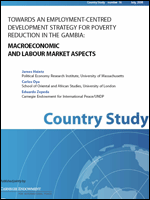
Carnegie's Eduardo Zepeda and James Heintz and Carlos Oya review the growth, employment and poverty record of Gambia. They focus on the macroeconomic environment and the structure and functioning of labor markets. The authors find that the growth pattern of Gambia does not appear to be pro-poor; improvements in the rate of growth appear to have, at best, halted the spread of poverty.
Source: Carnegie Endowment for International Peace and the International Poverty CentreCountry Study

The growth pattern of Gambia does not appear to be pro-poor, as improvements in the rate of growth appear to have at best halted the spread of poverty. Weak productivity performance and the low quality of employment help explain the poverty record. On the macroeconomic side, an excessive emphasis on inflation reduction and reliance on rudimentary monetary policy instruments have helped sustain a high-interest rate environment, which discourages investment and employment creation.
As part of an alternative policy package, Gambia could reformulate macroeconomic policies to target growth instead of inflation, select a more effective mix of policy instruments, and pursue financial reforms to increase the supply of credit to the economy and particularly to employment-intensive activities. In addition, targeted public investments are essential for sustaining more rapid growth and improvements in employment opportunities. A review of the available evidence suggests that labour markets in Gambia do not function in a way conducive to poverty reduction. The employment situation conforms to the typical configuration, whereby traditional activities and informality dominate rural and urban areas.
Gambia also faces high open unemployment rates in cities, particularly among the youth. Measures to increase the labour mobility of the poor are urgently needed. Gambia has benefited from a rapid increase in literacy and basic education, although more progress is needed to improve the quality of education and, particularly, to provide comprehensive training that adequately meets the demand for skilled labour. Finally, there is an urgent need to overhaul labour institutions with the aim of improving labour conditions, reducing labour segmentation and improving knowledge systems.
Former Senior Associate, Trade, Equity and Development Program
Zepeda is inter-regional policy coordinator of the Development Policy and Analysis Division, Department of Economic and Social Affairs at the United Nations General Secretariat. He was previously a senior associate in the Trade, Equity, and Development Program at the Carnegie Endowment for International Peace.
James Heintz
Political Economy Research Institute
Carlos Oya
School of Oriental and African Studies
Carnegie does not take institutional positions on public policy issues; the views represented herein are those of the author(s) and do not necessarily reflect the views of Carnegie, its staff, or its trustees.

AI could hollow out jobs, reshape them gradually, create entirely new ones—or do all three at once. The case for starting to act now doesn’t depend on knowing which.

Teddy Tawil

Powerful lobbyists and inertia led to Russia’s coal-mining sector missing an excellent opportunity to solve its structural problems.
Alexey Gusev

Five problems—and solutions—to make it actually work as a tool of great power competition.

Afreen Akhter
As the war between the United States, Israel, and Iran continues, Carnegie scholars contribute cutting-edge analysis on the events of the war and their wide-reaching implications. From the impact on Iran and its immediate neighbors to the responses from Gulf states to fuel and fertilizer shortages caused by the effective shutdown of the Strait of Hormuz, the war is reshaping Middle East alliances and creating shockwaves around the world. Carnegie experts analyze it all.
The Africa Technology Policy Tracker reveals policymakers’ priorities for the continent’s digital transformation.

Jane Munga