

Paper
James M. Acton, Ankit Panda
{
  "authors": [
    "James M. Acton"
  ],
  "type": "legacyinthemedia",
  "centerAffiliationAll": "dc",
  "centers": [
    "Carnegie Endowment for International Peace"
  ],
  "collections": [],
  "englishNewsletterAll": "ctw",
  "nonEnglishNewsletterAll": "",
  "primaryCenter": "Carnegie Endowment for International Peace",
  "programAffiliation": "NPP",
  "programs": [
    "Nuclear Policy"
  ],
  "projects": [],
  "regions": [
    "East Asia",
    "Japan"
  ],
  "topics": [
    "Nuclear Policy"
  ]
}
Source: Getty
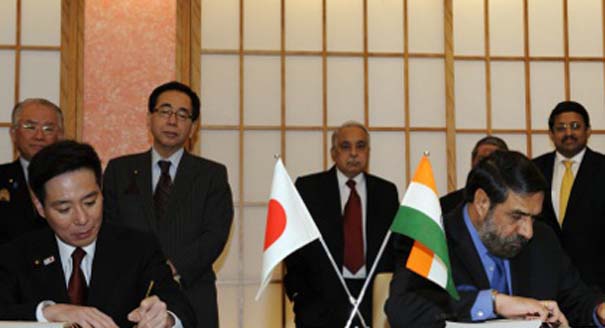
Japan is a key node in the global supply chain for nuclear reactor components. Before Japan can export any such components to India, the two states must reach a bilateral agreement specifying the rules of the road.
Source: The Asahi Shimbun

Nonetheless, under intense pressure from the administration of President George W. Bush, Japan ended up voting for the exemption to the Nuclear Suppliers Group's guidelines that was required for states to start exporting civil nuclear technology to India.
Japan is now faced with a second momentous decision. It is a key node in the global supply chain for nuclear reactor components, especially those used in American and French reactors. Before Japan can export any such components to India, the two states must reach a bilateral agreement specifying the rules of the road. Japan has recently started to negotiate such a deal with India, under yet more pressure from the United States as well as France.
To assuage skeptics at home--as well as his own conscience--Katsuya Okada, who at the time was foreign minister, announced that any agreement must give Japan the right to halt cooperation should India conduct another nuclear test. This condition is, however, not nearly strong enough because it provides no disincentive for India to test after it has acquired all of the Japanese components that it needs. Indeed, Okada's tentative approach seems to reflect the bureaucracy's assumption that Japan is entering negotiations with a weak hand.
They are wrong. Japan has considerable leverage.
Japan has special expertise in manufacturing large and complicated components for both reactor vessels and steam generators (which convert steam into electricity). Indeed, three out of the four modern American and French reactors contain at least one component that can be manufactured in Japan and nowhere else. If India wants to buy any of them, it needs an agreement with Japan.
Of course, Japan's monopoly of supply is unlikely to last forever. But, the very fact that France and United States have been pushing Japan to conclude an agreement is strong evidence that they believe there is no alternative supplier on the horizon.
In contrast, Japan stands to gain little from an agreement. Unless Japanese industries become a major contractor for any Indian reactor projects (which Japanese nuclear analysts seem to think is unlikely), their role will be limited to the supply of components. Profit from the sale of these components is likely to be modest for two reasons. First, heavy components represent a tiny fraction of the total cost of a nuclear power plant. Second, Japan's key forge for nuclear reactor components is already operating at full capacity. A contract with India might displace other business but it would not lead to an overall expansion in Japanese production.
An agreement is, therefore, worth much more to India than it is to Japan. This puts Japan in a position to play hardball.
Japan should insist that, if India tests a nuclear weapon, Japan has the right to request the return of any components it has supplied. There are strong precedents Japan could invoke to support its position. Not only is the right to request the return of components enshrined in all of Japan's supply agreements with other states (except nuclear weapon states recognized by the Nuclear Nonproliferation Treaty), but, in its own talks with India, the United States negotiated this same right, too.
If India refuses to accept this reasonable condition, Japan should approach the United States and France and ask them to provide the nonproliferation guarantees that India could not. Specifically, Japan should reach an agreement with India contingent upon their promise that, if India tests, France and the United States will cease to supply fuel for any Indian reactors which contain Japanese components (and that they will try to persuade any other potential suppliers from replacing them).
To support its case, Japan could make two points to the United States. First, American domestic legislation requires the United States to cease nuclear cooperation with any state, including India, that tests a nuclear weapon. Second, as a senator, President Barack Obama strongly supported cutting off fuel to India in the event it tested. Indeed, thanks to his efforts, domestic legislation states that it is U.S. policy to prevent India from building up large reserves of reactor fuel in advance of a test to insulate itself against a cut-off.
This is not to suggest that the United States--let alone France--will be sympathetic to Japan's position. They won't. However, an Indian nuclear test would be catastrophic to global nonproliferation and disarmament efforts. If the Japanese government wants to prove that its quest to prevent another Hiroshima or Nagasaki is more than empty rhetoric, it must seize the opportunity presented by the India deal.

Jessica T. Mathews Chair, Co-director, Nuclear Policy Program
Acton holds the Jessica T. Mathews Chair and is co-director of the Nuclear Policy Program at the Carnegie Endowment for International Peace.
Recent Work

James M. Acton, Ankit Panda
James M. Acton
Carnegie does not take institutional positions on public policy issues; the views represented herein are those of the author(s) and do not necessarily reflect the views of Carnegie, its staff, or its trustees.

The nuclear relationship between China and the United States is increasingly shaped by widening perception gaps rather than deliberate strategic design.

Tong Zhao

U.S. trading partners in Asia are closely watching the dispute for signs of how it may affect their own interests.

Barbara Weisel
Congress should ask tough questions about the agreement’s more unique features and whether they advance U.S. interests or compromise them.

Jane Darby Menton
Nuclear and maritime communities face a long and challenging journey to deploy commercial nuclear applications at sea.


Jamie Kwong, Toby Dalton
Japan’s revision of its three strategic documents reflects an intention to keep the United States engaged in the region while Japan fills any vacuums of U.S. power to preserve the Indo-Pacific order.

Ryo Sahashi