

Commentary
In an interview, Jim Lamson discusses the ongoing regional conflict and sees an unclear picture when it comes to winners and losers.
Michael Young
{
  "authors": [
    "Toby Dalton",
    "Scott Snyder",
    "Miles Pomper"
  ],
  "type": "legacyinthemedia",
  "centerAffiliationAll": "dc",
  "centers": [
    "Carnegie Endowment for International Peace"
  ],
  "collections": [
    "U.S. Nuclear Policy",
    "Korean Peninsula"
  ],
  "englishNewsletterAll": "ctw",
  "nonEnglishNewsletterAll": "",
  "primaryCenter": "Carnegie Endowment for International Peace",
  "programAffiliation": "NPP",
  "programs": [
    "Nuclear Policy"
  ],
  "projects": [],
  "regions": [
    "North America",
    "United States",
    "East Asia",
    "South Korea"
  ],
  "topics": [
    "Nuclear Policy",
    "Nuclear Energy"
  ]
}
Source: Getty
Any interpretation that pits Washington and Seoul against each other fails to understand the fundamental spirit of cooperation that reaffirms and undergirds the U.S.-ROK nuclear relationship.
Source: Dong-A Ilbo
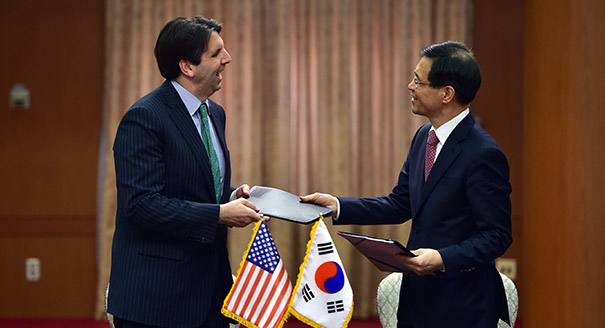
Korean and U.S. officials concluded negotiation today on a new nuclear cooperation agreement to replace the existing, outdated one from 1974. The new agreement is an important inflection point: it marks the transition from an imbalanced relationship built on the model of U.S. as supplier to Korea, to a new partnership based on reciprocity and mutual interest in safe and secure growth of nuclear power. The agreement treasures South Korea’s unique position as the world’s largest nuclear power producer that does not also possess nuclear weapons, while reaffirming the commitment of both countries to the principles of global nonproliferation.
While many in Seoul and Washington insist on seeing the agreement as a struggle by South Korea to win “rights” commensurate with its nuclear status, any interpretation that pits Washington and Seoul against each other fails to understand the fundamental spirit of cooperation that reaffirms and undergirds the U.S.-ROK nuclear relationship. The new agreement reflects a modern nuclear partnership, one which not only allows the standard trade in nuclear technology and equipment between the two countries, but also facilitates a far broader range of cooperation on critical issues such as nuclear safety, science and research, reactor spent fuel management, and nuclear security.This spirit of cooperation is directly reflected in plans the two countries have made to implement the new agreement. The United States and South Korea have reportedly agreed to establish a high-level consultation process to oversee ongoing nuclear cooperation. The commission will be led by the Korean vice minister of foreign affairs and the U.S. deputy secretary of energy. It will comprise four working groups, which will focus on achieving President Park’s three objectives for the nuclear agreement: assured supply of nuclear fuel; management of long-term challenge of spent nuclear reactor fuel; and cooperation to facilitate Korea’s competitiveness as a nuclear exporter. A fourth working group will focus on nuclear security. The commission will also include representatives of both countries’ nuclear regulatory authorities, who cooperate on nuclear safety.
This commission is a unique arrangement, a major upgrade of the existing channels of cooperation that will give the nuclear component of the U.S.-ROK relationship the attention it deserves. Elevating discussion of nuclear issues to a high-level MOFA-DOE channel reflects the serious political commitment of both states to developing all of the elements of a broader nuclear partnership. The establishment of the commission provides ongoing oversight and flexibility to adapt to new circumstances as the relationship and levels of cooperation between the two countries evolves.
The commission vests South Korea’s Ministry of Foreign Affairs (MOFA) with a considerable new responsibility to coordinate and oversee an expansive nuclear agenda in Korea, but the arrangement will only work if South Korea’s career diplomats on the commission are effectively empowered and educated to perform their duties. Effective management and oversight of such an interagency process requires considerable technical, policy and legal expertise on complex nuclear issues, which MOFA does not now possess.
The establishment of the commission thus provides an opportunity for Korea to strengthen its technical expertise and to develop an interagency coordination process that spans nuclear research and development, nuclear power production, spent fuel and nuclear waste management, and nuclear safety and security.
In the past, South Korea’s foreign ministry has always had to borrow experts from other parts of the bureaucracy to conduct technical negotiations on nuclear matters. But now the foreign ministry needs a specialized cadre of experts who are able to interact professionally with technical colleagues domestically and internationally. MOFA might look, for instance, to the model of the Bureau of Arms Control and International Security within the U.S. Department of State, which is staffed primarily by civil servants who spend their careers developing expertise on nuclear policy issues. These experts should be housed in a new technical bureau at MOFA not subject to the regular foreign service rotation, with dedicated funding to recruit, train and then retain highly-skilled professional staff.
To be fair, this problem is not unique to MOFA. Other Korean government agencies also suffer a lack of dedicated technical-policy or legal-policy expertise. Korea’s nascent nuclear regulator, the Nuclear Safety and Security Commission, for instance, has a similar personnel rotation problem. Yet, effective nuclear regulation and the development of a strong nuclear safety culture require an accretion of experience and the building of trust between regulators, industry, utilities and operators. In light of recent safety incidents spanning several industries, Korea is very focused on strengthening regulation and establishing a safety culture. Properly trained and highly-skilled personnel, who gain experience in their jobs over many years, are a prerequisite.
If South Korea and the United States are to reap the full benefits of the new agreement and the high-level commission, both countries need to staff it with top experts committed to building a forward-looking nuclear partnership. For Korea in particular, if it is to take full advantage of the potential benefits on offer through a new nuclear cooperation agreement with the United States and thereby translate its global and domestic nuclear aspirations into practice, the government must bolster its cadre of technical-policy experts who can effectively serve Korea’s national interests.
This article was published in Korean in Dong-A Ilbo.

Senior Fellow and Co-director, Nuclear Policy Program
Toby Dalton is a senior fellow and co-director of the Nuclear Policy Program at the Carnegie Endowment. An expert on nonproliferation and nuclear energy, his work addresses regional security challenges and the evolution of the global nuclear order.
Scott Snyder
The Asia Foundation
Scott Snyder is senior fellow for Korea studies and director of the program on U.S.-Korea policy at the Council on Foreign Relations. His research focuses on South Korea's efforts to contribute on the international stage, its potential influence and contributions in East Asia, and implications of North Korean instability.
Miles Pomper
Carnegie does not take institutional positions on public policy issues; the views represented herein are those of the author(s) and do not necessarily reflect the views of Carnegie, its staff, or its trustees.
In an interview, Jim Lamson discusses the ongoing regional conflict and sees an unclear picture when it comes to winners and losers.

Michael Young

Our new report offers a path forward for local officials and future policymakers.



Joe McCannon, Jenny Keroack, Lauren Jensen, …
Present and future policymakers seeking to address climate-related health challenges can draw lessons from the successes and failures of the Biden administration.
Joe McCannon, Jenny Keroack, Lauren Jensen, …

Unless Beirut lowers expectations, any setbacks will end up bolstering Hezbollah’s narrative.

Mohanad Hage Ali

Five problems—and solutions—to make it actually work as a tool of great power competition.

Afreen Akhter