

Commentary
Judy Dempsey
{
  "authors": [
    "Judy Dempsey"
  ],
  "type": "commentary",
  "blog": "Strategic Europe",
  "centerAffiliationAll": "",
  "centers": [
    "Carnegie Endowment for International Peace",
    "Carnegie Europe"
  ],
  "collections": [
    "EU Integration and Enlargement"
  ],
  "englishNewsletterAll": "",
  "nonEnglishNewsletterAll": "",
  "primaryCenter": "Carnegie Europe",
  "programAffiliation": "",
  "programs": [],
  "projects": [],
  "regions": [
    "Europe",
    "Western Europe"
  ],
  "topics": [
    "EU",
    "Political Reform"
  ]
}
Source: Getty
After Britain’s vote to leave the bloc, the European Union is changing its narrative to emphasize migration, terrorism, and globalization.
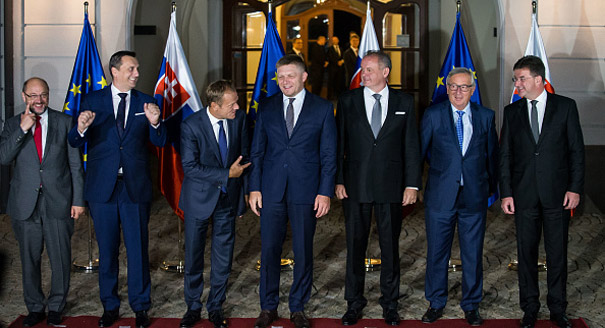
A new chapter for Europe began on September 16, when 27 EU leaders met in a castle overlooking the river Danube in the Slovak capital, Bratislava. It is an important chapter because the bloc’s two most powerful leaders, German Chancellor Angela Merkel and European Council President Donald Tusk, want the union to have written a new narrative by March 2017. That is when EU leaders meet in the Italian capital to celebrate the sixtieth anniversary of the Treaty of Rome, the EU’s founding document.
The narrative being crafted by Tusk and Merkel, who have had many talks with each other and with other EU leaders over the past few weeks, is aimed at rescuing Europe from imploding.
This narrative is not only about how the EU should deal with Britain’s decision on June 23 to leave the union. It is also about coming to terms with a Europe in which, probably for the first time since the EU was established, citizens feel threatened. The peace narrative that so fundamentally shaped the origins, outlook, legitimacy, and direction of the bloc is no longer the narrative that can keep the EU together.
Merkel has never alluded to the eclipse of that narrative. Nor has Tusk. But a close reading of Merkel’s comments in Warsaw on August 26, and of Tusk’s letter to 27 EU leaders (Britain’s prime minister will not be in the castle in Bratislava, confirming that the bloc is dealing with a post-Brexit era), shows what this new narrative consists of. It is about migration, terrorism, and globalization, not about peace, prosperity, or values.
Tusk wrote that the migration crisis was “the tipping point” for the EU. In 2015, he wrote, there was chaos on Europe’s borders. There was no plan to deal with the huge influx of refugees. Citizens felt threatened. There was an urgent need to protect the EU’s external borders. That, argued Tusk, has to be Europe’s immediate goal.
Recent terrorist attacks in France, Belgium, and Germany have fed into this narrative of threats and insecurity. Tusk didn’t dare call for more integration to deal with terrorism. Integration is no longer the automatic part of this new EU narrative—at least, not yet. Instead, Tusk deferred to the “national level” to combat terrorism and deal with internal security. “But we can and must do more together,” he added. He didn’t say how, but there is a wide consensus on the need for more intelligence sharing across the bloc.
On globalization, Tusk made clear that free trade and global competition were in the interests of Europeans and that the EU should press ahead with more trade agreements. But, he wrote, “it is obvious that they pose significant and often unprecedented challenges.” The EU should better protect the economic and social interests of its citizens.
This new narrative of fear, threats, and insecurity is anchored on migration, terrorism, and globalization, as if they are inseparable.
The British who voted to leave the EU believed that they could deal with these issues by going it alone. Other EU governments, such as Poland’s, want the member states, not Brussels, to have more powers. Tusk tapped into that sentiment.
“Giving new powers to European institutions is not the desired recipe. National electorates want more influence on the decisions of the Union,” he wrote. That is Merkel’s view too, as she mentioned during her recent talks in Warsaw with her Czech, Hungarian, Polish, and Slovak counterparts. No mention of integration. No mention of a two-speed Europe. Any ideas about a banking union or further development of economic or monetary union are on hold.
It’s all very well for the member states to want a greater say and to continue, as populists and Euroskeptics do, to bash the EU as if it were the scourge of all of the bloc’s problems and evils. Such bashing “serves as an easy excuse for one’s own failures,” Tusk added. The blame game is no panacea.
This new narrative hardly leaves room for Tusk’s call for “real optimism.” It’s an unsentimental, inward-looking narrative that lacks ambition and lacks confidence. It’s a narrative that does away with visions, that does away with enthusiasm, that does away with slogans. And it’s a narrative based on cold reasoning that might be superseded once Europeans feel secure and economic growth returns. But neither is a given.

Nonresident Senior Fellow, Carnegie Europe
Judy Dempsey is a nonresident senior fellow at Carnegie Europe
Recent Work
Judy Dempsey
Judy Dempsey
Carnegie does not take institutional positions on public policy issues; the views represented herein are those of the author(s) and do not necessarily reflect the views of Carnegie, its staff, or its trustees.

With its public finances in shambles, the far right polling at 35 percent ahead of the 2027 presidential election, and a growing protest movement, is France’s crisis a threat to the EU’s geopolitical awakening?

Rym Momtaz, ed.

Ahead of a tough winter for Ukraine, Donald Trump’s swing back toward Russia bodes ill. But instead of panicking, Kyiv’s European allies are focusing on action.
Rym Momtaz

While the EU and European governments are embracing the much-lauded middle-power moment, this entails three difficult conundrums.

Richard Youngs

Much has been said of the changes Brussels is trying to make to the EU enlargement process. Here’s why gradual integration might—or might not—be the answer.

Dimitar Bechev

The European Commissioner for Trade is headed to China. But after President Xi’s bridge-building visit to Washington, can a more isolated EU overcome Beijing’s stranglehold on critical raw materials? Who will blink first?
Rym Momtaz, ed.