


A Delicate Balance: Africa’s Agency on Full Display and Expanding Conflict in the Horn
As the season of global forums concludes, Africa remains in high demand, but the continent’s economic growth and political influence are threatened by its security challenges.
November 2026
The sun sets on the International Monetary Fund–World Bank annual meetings in Bangkok with firm commitments to private capital mobilization and job creation—opportunities that are central to Africa’s infrastructure, trade, and energy ambitions. Yet even as structural issues were on the agenda in Bangkok, the continent continued to grapple with evolving conflict alliances in the Democratic Republic of the Congo (DRC) and Ethiopia, and with the worsening civil war in Sudan. This month, Africa Program scholars focused their attention on how African states exercise agency in a multipolar world, the challenges and opportunities of AI adoption on the continent, and responses to the evolving and increasingly regionalized conflicts in the Horn of Africa.
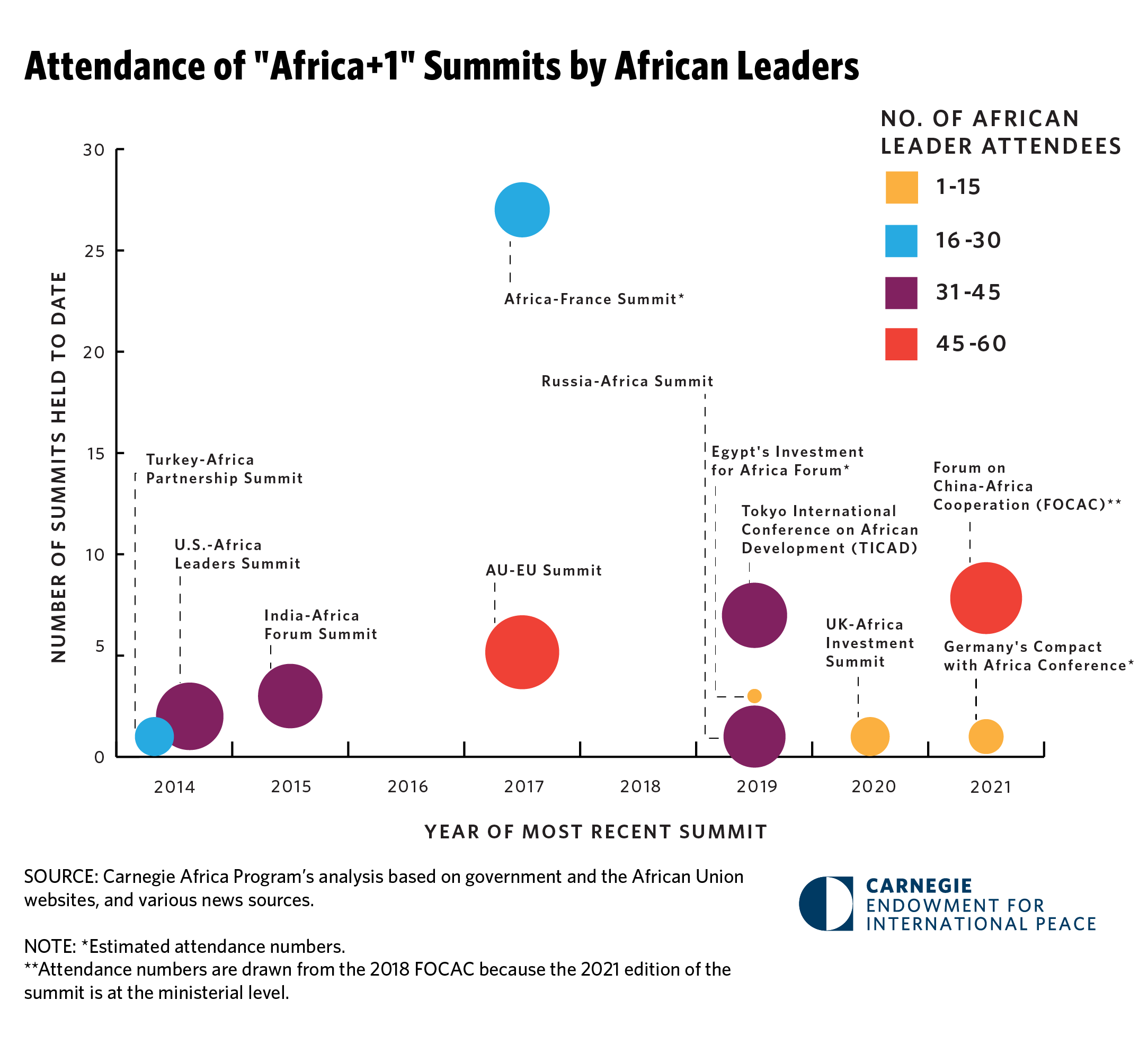
As Africa seeks to play a more prominent role in an international order that is still taking shape, our scholars have been decoding the myriad ways in which African states exercise their agency. In an article for Carnegie, Africa Program Director Fonteh Akum argues that African states are exerting their agency through partnership diversification, illustrated by high-level state visits to the continent, multilateral summits, and commercial diplomacy. Writing for the Hoover Institution, nonresident scholar Judd Devermont argues that the realization of Africa’s strategic value to U.S. national interests requires a recalibration of U.S. engagement on the continent. Meanwhile, on a panel at the Chicago Council on Global Affairs, Vice President for Studies Frances Brown analyzed Africa’s evolving role in global politics and the imperative to effectively manage inevitable political transitions facing the continent. In an article for the China Global South Project, nonresident scholar Christian-Géraud Neema highlights Chinese companies’ persistence when faced with red tape in commercial projects on the continent compared to Western companies’ risk aversion, which he argues will be tested in the DRC by upcoming U.S. mining projects. On emerging technologies, fellow Jane Munga explains why Africa needs its own AI off switch in a piece in Rest of World, where she is also quoted addressing AI’s potential to exacerbate existing inequalities on the continent and the growing concern around the lack of AI guardrails.
Ethiopia is at war again, but this time internal fragmentation has forged unlikely alliances, and tense regional relationships will have outsized ramifications for the already unstable Horn of Africa region. In a piece for Just Security, visiting scholar Lesley Anne Warner examines how Ethiopia’s current conflict differs from the devastating 2020–2022 civil war. She also highlights shifting domestic political and military partnerships and the potential for the conflict to metastasize regionally. Lesley was also quoted in the Washington Post on the limitations of the new coalition of anti-government armed groups. Expanding on this analysis, Lesley spoke on the podcast Pod Save the World, outlining the new coalition’s vulnerabilities, the potential for interstate conflict, and the external proxy dimensions of the war.
Shifting her focus to Sudan, in a World Politics Review column, Lesley explores the U.S. push on the United Nations Security Council to expand the existing Darfur arms embargo, which she argues ignores the lack of enforcement mechanisms for the current embargo and does not effectively constrain external backers. With the Darfur embargo now extended until December, as Lesley highlights in a quote for the Africa Report, Washington must engage meaningfully and diplomatically with African states on the future of the embargo. Additionally, in a Devex article, Judd underscores how regional and global shocks have exacerbated food insecurity on the continent, proposing a return to farmer-driven solutions to food security issues. These conflicts in the Horn of Africa underscore that mediated peace and political dialogue are prerequisites for Africa to expand its footprint in a rapidly reordering international system.
Finally, the Carnegie Africa Program will be tracking news from the Aswan Forum for Sustainable Peace and Development and the United Nations Framework Convention on Climate Change—COP31—at the end of November. As events unfold, we’ll continue to analyze and decode the major happenings affecting the African continent. For more policy-relevant analysis, follow us on LinkedIn and on X @AfricaCarnegie.
Chart of the Month
Features
Africa in Demand: How the Continent Is Advancing Its Interests in a Competitive World
Global and rising powers will need to engage with Africa’s priorities and agency in order to secure the continent’s increasingly attractive partnerships.
By Fonteh Akum
Ethiopia’s Fragile Peace has Broken – But This Is Not the 2020 – 2022 Conflict
The collapse of the 2022 Cessation of Hostilities Agreement signed in Pretoria between the Federal Government of Ethiopia and the Tigray People’s Liberation Front (TPLF) relaunches a different war in northern Ethiopia.
By Lesley Anne Warner
Why the Red Sea Crisis Is Bigger Than Yemen
The ramifications of the Red Sea crisis extend across the Bab al-Mandeb with important implications for the Horn of Africa and beyond.
With Lesley Anne Warner and Andrew Leber on Preston Stewart’s YouTube Channel
In the Sudan, the U.N. Fights to Expand an Arms Embargo That It Doesn’t Enforce
A wider arms embargo in Sudan, if enforced, could reduce the flow of weapons into the region and dent some fuel to the regional conflagration many fear is on the horizon.
By Lesley Anne Warner
Why Africa Needs Its Own AI Off Switch
Africa must develop AI systems with local control to protect critical infrastructure such as mobile money networks from growing AI-powered cyberthreats.
By Jane Munga
Removing Red Tape Won’t Erase China’s Mining Advantage in Africa
Red tape frustrates all, but Chinese companies have adapted to operate despite delays and uncertainty, giving them a clear advantage over Western companies.
By Christian-Géraud Neema
Governance Compared: Autocracy and Democracy in Africa
Today’s global democratic recession is partly rooted in a common perception that democracies have a delivery problem, but a study of four countries in Africa disrupts that theory.
By Sarah Yerkes, Natalie Triche, and Amr Hamzawy
The Debt Toll Booth: A Modular Solution to Addressing Sovereign Debt Crises
Policy proposals on sovereign debt must both match the scale of the challenge and be implementable within existing political constraints.
By David McNair
The End of Primacy Without Pain: Why the Domestic Foundation of American Power Is Crumbling
America’s foreign-policy objectives have grown more demanding while Americans have demanded greater focus on their own affairs.
By Stephen Wertheim
From the Archive
The Third Russia-Africa Summit and the Russia-Africa Women’s Forum on nuclear energy both took place at the end of October, alongside recent reports of the Russian Africa Corps’s indiscriminate use of force in the Sahel and Russia’s myriad other engagements on the continent. Russian engagement in Africa, while evolving in strategy and scale, is not a new phenomenon. In collaboration with several scholars from the Russia and Eurasia Program and experts on the continent, Frances examined Russia’s growing footprint on the continent in a research compendium for Carnegie.
Carnegie does not take institutional positions on public policy issues; the views represented herein are those of the author(s) and do not necessarily reflect the views of Carnegie, its staff, or its trustees.