

Commentary
- +8
Sophia Besch, Eric Ciaramella, Steve Feldstein, …
{
  "authors": [
    "Sophia Besch"
  ],
  "type": "commentary",
  "blog": "Emissary",
  "centerAffiliationAll": "dc",
  "centers": [
    "Carnegie Endowment for International Peace"
  ],
  "englishNewsletterAll": "ctw",
  "nonEnglishNewsletterAll": "",
  "programAffiliation": "EP",
  "programs": [
    "Europe"
  ],
  "regions": [
    "Europe"
  ],
  "topics": [
    "EU",
    "EU Foreign Policy",
    "NATO"
  ]
}
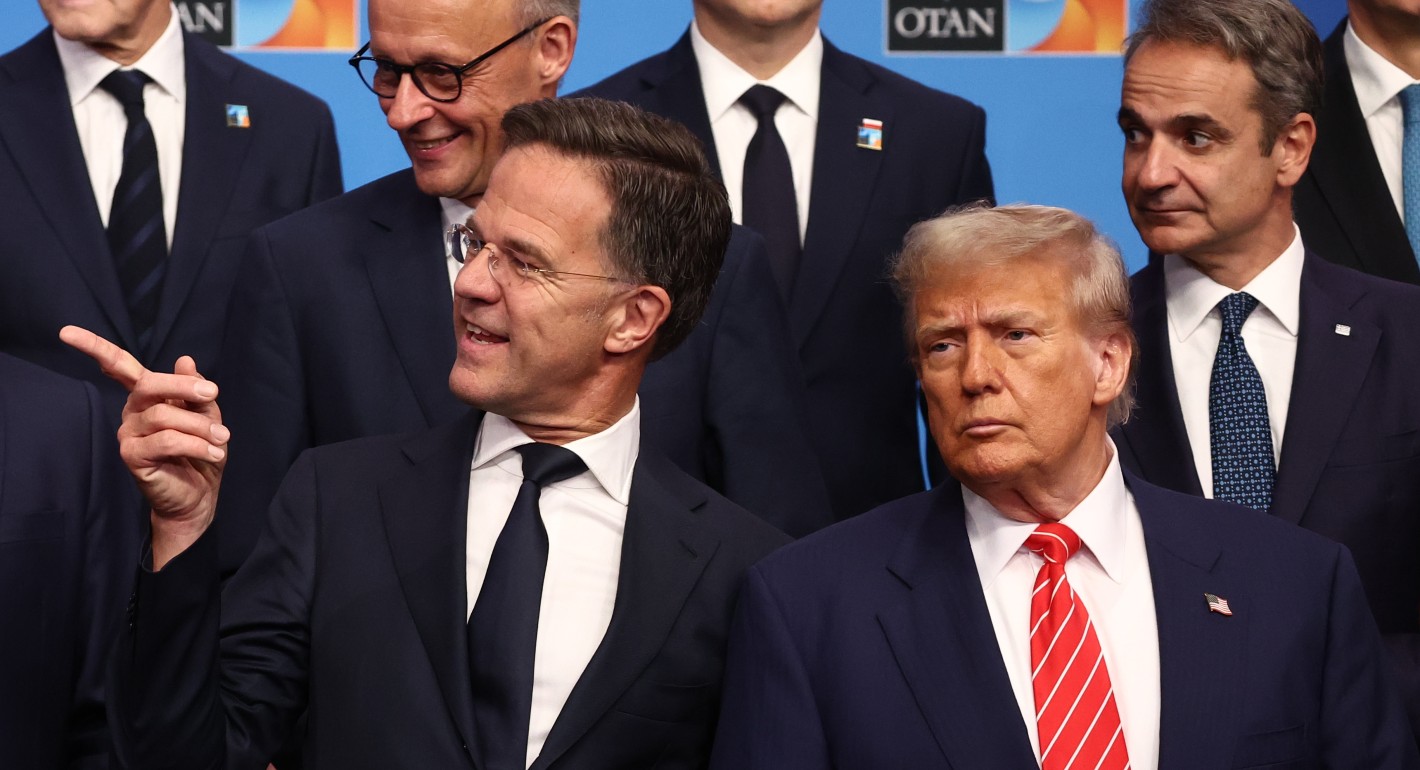
NATO Secretary General Mark Rutte and U.S. President Donald Trump during the NATO Summit in The Hague, Netherlands, on June 25, 2025. (Photo by Jakub Porzycki/NurPhoto via Getty Images)
The Greenland crisis taught Europe to push back against Washington. In Iran, it must learn how to engage without falling in line.
The United States has gone to war with Iran without consulting Europe. Yet President Donald Trump and his administration have sought to deflect blame for a faltering campaign by lashing out at NATO and accusing European leaders of shirking their alliance responsibilities by refusing to offer support. The charge does not hold. NATO imposes no obligation to back a war of choice, and Europe lacks any realistic means of reopening the Strait of Hormuz by force while hostilities continue.
At the same time, Europe cannot afford to stand aside. The war is already reshaping its security and economic outlook. Within days of the U.S.-Israeli strikes, an Iranian drone hit a UK Royal Air Force base in Cyprus, prompting coordinated European deployments; NATO intercepted missiles over Turkey, while European officials warned of rising terrorism risks and renewed refugee pressures. Disruptions to the Strait of Hormuz have raised the prospect of fuel shortages and rising costs across sectors from agriculture to aviation. Inflation has climbed to 2.5 percent, growth forecasts are being revised downward across Europe, and interest rates might be driven up. Slower growth, higher prices, and mounting migration pressures together risk fueling political instability across the continent.
Europe’s response to the United States in the Iran war is informed by the lessons European officials took from the Greenland crisis earlier this year. In Greenland, after a year of failed accommodation, European leaders discovered that unity and credible pressure could shift Washington’s calculus. In Iran, after initial hesitation, governments have hardened their stance, criticized the U.S. campaign, and begun to withhold support. The question now is whether they can sustain that unity under pressure and engage in the conflict on their own terms—without drifting into alignment with a U.S.-led war. Their credibility is on the line, both at home and abroad.
The U.S.-Europe clash over the war in Iran is the second major crisis in the transatlantic relationship this year. Only three months ago, Trump threatened to “take” Greenland. European governments initially offered far-reaching concessions. But accommodation did not succeed in getting the president to moderate his claims. In response, for the first time since Trump took office in 2025, European policymakers began discussing their own leverage in earnest. They arrived in Washington as a united front, warning lawmakers that the president was putting NATO at risk, while in Brussels officials examined retaliatory tools, including tariffs and the EU’s anti-coercion trade instrument. The political and market backlash that followed clarified the costs of confronting Europe and helped force a retreat in the White House.
While Washington swiftly moved on to other things, Europe felt an overwhelming sense that things had changed. Washington had crossed a redline. Europeans had held firm, and won.
When, only weeks later, the United States first launched the war against Iran, it took European leaders a few days to arrive at a joint assessment of what they were witnessing. While some were quick to condemn the strikes, others initially struck a more cautious tone. Many countries in Europe have a long history of aligning themselves with U.S. strategic thinking: In 2025, European governments tried for months to engage with spurious U.S. arguments regarding the strategic importance of Greenland for U.S. national security objectives. But as the lack of U.S. planning and strategic objectives for its war with Iran became clear, positions hardened. European governments across the continent have now criticized the U.S. attacks and insisted that “this is not our war.” Symbolic of this change in mindset, NATO Secretary General Mark Rutte—the Trump whisperer-in-chief for the first year of the administration—was widely rebuked for his attempt to mollify the U.S. president by implicating NATO in the war.
The crisis over Greenland clarified both the scope and the limits of European leverage with Washington. Europeans had limited military sway; they prevailed only when the confrontation shifted toward the risk of an economic standoff and U.S. domestic audiences understood the stakes. Similarly, in the Iran war, European officials can attempt to put pressure on the Trump administration by making the costs of escalation visible to U.S. domestic audiences. They can highlight the war’s economic consequences in the form of higher energy prices, inflationary pressure, and market instability. They should also make clear the political consequences for U.S. credibility and power of a war that is widely condemned. And they should make their strategic case against the war: Most European leaders do not believe that striking Iran will result in destroying the country’s nuclear program.
In the military domain, European governments’ leverage is limited. The United States relies on Europe’s military bases and logistical hubs, and the drone defense expertise won in the Ukraine war is now crucial to protect against Iranian attacks. Europeans can withhold operational support—which they are currently still providing—and link any cooperation to clear demands for restraint. A growing number of European countries are already refusing to open their airspace to the U.S. operations or grant access to bases on their territory. European leaders have also held a common line on the Strait of Hormuz, declining to take on a role in securing maritime routes while the conflict continues. At the same time, they are preparing for the next phase. Led by France and the United Kingdom, European governments are working to assemble a coalition that could reopen the strait once hostilities de-escalate. Planning this operation without the United States allows Europe to define the terms of its engagement more clearly.
In deploying its leverage, Europe should not be intimidated by Trump’s threats. Trump and others in his administration have lashed out against NATO, suggesting the United States could withdraw from the alliance. The president has called NATO a “paper tiger” and “one way street.” U.S. Secretary of Defense Pete Hegseth has matched Trump’s aggressive tone, describing Europeans as “ungrateful” and warning it might be time for them to “start learning how to fight on [their] own.” Secretary of State Marco Rubio said the United States would have to “re-examine the value of NATO for our country.”
The United States still holds the upper hand in any standoff with Europe, given its crucial role in NATO and support for Ukraine. But the actions of the Trump administration point in another direction. After over a year in power, U.S. force posture in Europe remains largely unchanged, reflecting enduring military interests. Congress is still broadly supportive of NATO membership. Withdrawing great numbers of troops from Europe is a bureaucratic challenge and an uphill battle for the U.S. defense policy apparatus, which is distracted and hollowed out. Moreover, Trump appears to value the leverage that threatening NATO provides and is reluctant to surrender it through withdrawal. After repeated threats to NATO and personal attacks on European leaders—first over Greenland and now in the context of the Iran war—a sense of fatigue has set in across European capitals.
There are no guarantees: The president is erratic and not bound by a clear sense of U.S. national interest. Europeans will never be able to trust this administration’s commitment to NATO, and the constant threats hollow out any sense of alliance solidarity. But the United States depends on Europe even as it pressures it, and leaving the alliance would be harder than some initially thought. That interdependence does not eliminate risk, but it does give Europe some room to maneuver.
European leaders will be able to use that room only if they can stay united—at least in public. Sustaining this unity will be difficult because underlying disagreements—especially over Europe’s relationship with the Gulf countries, and how far to deepen defense commitments there—are likely to resurface once immediate pressures ease. But European officials must be careful not to show these divisions when dealing with the United States, in order not to weaken their hand. And as the Trump administration increasingly moves to single out individual governments—such as threatening an embargo on Spain after it refused to let the United States use its bases—their European neighbors must show unconditional solidarity in the face of the bully across the Atlantic. So far so good: The war has already led to a rapprochement between Brexit Britain and the EU.
Greenland showed that Europe can shift Washington’s calculus when it acts in concert and makes the costs of escalation unmistakable. That muscle memory has, for now, helped European governments hold the line in the early weeks of the Iran war. The harder phase lies ahead. Leaders will feel the pull to de-escalate tensions with Trump and revert to business as usual; in doing so, they risk convincing themselves that the outcome in Iran is not their responsibility to shape.
Arguments are gathering force—in parts of the Gulf, Israel, and Washington—that only a sustained campaign of strikes can deter a nuclearizing Iran. Europe should challenge that logic. A strategy built around continued escalation would implicate Europeans in a war not of their choosing, with uncertain ends and significant regional spillovers. Going forward, European leaders should engage, but on their own terms. They should define redlines and coordinate pressure, while resisting alignment with a U.S.-led military approach that they neither control nor fully support. Their audiences extend beyond the U.S. president to the international community, European voters, and the wider U.S. foreign policy establishment.
First, the international community is watching how Europe responds in this moment. At the height of the Greenland crisis, Canadian Prime Minister Mark Carney used the World Economic Forum’s Davos summit to urge middle powers to sustain a rules-based order without the United States. Many European countries at the time emphatically agreed. Those calls will ring hollow, however, if Europe fails to act on them now. In Greenland, European officials effectively drew a single redline: territorial integrity. In Iran, they need to demonstrate that their commitment to international law applies beyond Europe’s borders.
Recent precedent has raised doubts. When American forces intervened in Venezuela, European governments did not mount sustained pushback in multilateral forums and made no meaningful attempt to constrain U.S. behavior. The United States and Europe have repeatedly called on others to condemn illegal wars and uphold international norms, for instance by mobilizing the UN General Assembly in defense of Ukraine. Governments around the world will note who speaks out now and who remains silent. Silence signals that Europe has abandoned the current system at the moment it is being tested. This would seriously damage its credibility on the global stage. Many European leaders have already condemned the war as illegal—they must now urgently speak up against Trump’s threat to commit war crimes in Iran and deploy all the leverage they have to stop him.
Second, European voters are watching closely. European leaders must distance themselves from U.S. military adventurism in the eyes of their publics if they want to sustain support for Europe’s defense efforts. Over the past year, European governments have built a fragile domestic consensus around higher defense spending. That consensus rests on a clear argument: Europe must respond to Russian aggression and hedge against American unpredictability. It is a difficult case, but it has held. It becomes harder to sustain if rearmament is tied to conflicts that the public sees as unnecessary or destabilizing.
And those defense resources will be needed now more than ever, as the Pentagon is considering diverting military equipment intended for Ukraine to the Iran war even as Kyiv faces acute shortages of critical systems such as Patriot air defenses. Europe must find the money to fill those gaps. Europe’s militaries will eventually need to engage in the Strait of Hormuz. Once active fighting subsides, they will need to contribute to freedom of navigation efforts to protect their own shipping interests. But they must carefully separate their own defense priorities and objectives from those of the U.S. administration, both in substance and in perception. Otherwise, they risk losing the public support on which their rearmament ultimately depends.
Third are U.S. political elites. Europe often underestimates how closely Washington’s foreign policy establishment watches its behavior—well beyond the president’s inner circle. Over the first year of Trump’s second term, European leaders showed how far they could be pushed: Tariff threats and hints at withdrawing U.S. security guarantees extracted concessions that years of careful consultation between allies had failed to secure, including higher defense spending. Democrats and Republicans from previous administrations have taken note. What Europeans framed as tactical realism read in Washington as acquiescence. Europe should now act to ensure that this does not become the enduring lesson.
In any relationship, once respect erodes, it is difficult to restore. This matters because Trump will not be the last president European leaders have to deal with. At some point, his successor will want to negotiate a new transatlantic bargain, and it will not resemble the one Europeans have known. As the old guard of transatlanticists fade, the new alliance will be more interest-based and less sentimental. The U.S. officials who will shape that bargain—regardless of whether the next president is Republican or Democrat—are forming their expectations of Europe now. European diplomats still have time to reshape their image in Washington as an economically and politically powerful bloc. It is in this context, too, that their response to this war matters.
Europe cannot sit this one out. The war will shape its security, its economy, and its relationship with the United States whether it engages or not. The question is not whether Europe gets involved, but how. If it stays united, uses its leverage, and acts on its own terms, it can attempt to shape the course of the conflict—while maintaining credibility with international partners and sustaining support at home. If it drifts, accommodates, or fractures, it will not only reinforce the wrong lesson in Washington; it will also erode its credibility on the global stage and weaken the fragile domestic consensus behind Europe’s defense efforts.
The latest from Carnegie scholars on the world’s most pressing challenges, delivered to your inbox.

Former Senior Fellow, Europe Program
Sophia Besch was a senior fellow in the Europe Program at the Carnegie Endowment for International Peace. Her research focuses on European foreign and defense policy.
Recent Work


Sophia Besch, Eric Ciaramella, Steve Feldstein, …

Sophia Besch, Tara Varma
Carnegie does not take institutional positions on public policy issues; the views represented herein are those of the author(s) and do not necessarily reflect the views of Carnegie, its staff, or its trustees.

Over the past decade, China has moved from marginal player to major producer of all things batteries. The United States, Europe, and others are aiming to balance the market.

Milo McBride
Most migrants may have left Ceuta, but the effects may linger.


Alejandro Martin Rodriguez, Sarah Yerkes
European allies are less focused on appeasing Trump and more focused on smoothing the transition to a Europe-led alliance.


Sophia Besch, Alper Coşkun, Nate Reynolds, …
Regardless of the outcome, there’s another path to ensuring that progress doesn’t stall.

Zaur Shiriyev
Why the Iran ceasefire isn’t a quick fix to the Strait of Hormuz energy crisis.


Helima Croft, Aaron David Miller