

Commentary
They face an uphill climb, but they could draw on a strategy that other diplomats have used in the past.
Shana Tabak, Alejandro Martin Rodriguez
{
  "authors": [
    "Stewart Patrick",
    "Theodore Zaritsky"
  ],
  "type": "commentary",
  "blog": "Emissary",
  "centerAffiliationAll": "dc",
  "centers": [
    "Carnegie Endowment for International Peace"
  ],
  "englishNewsletterAll": "ctw",
  "nonEnglishNewsletterAll": "",
  "programAffiliation": "GOI",
  "programs": [
    "Global Order and Institutions"
  ],
  "regions": [
    "United States"
  ],
  "topics": [
    "United Nations",
    "Foreign Policy",
    "Domestic Politics",
    "Global Governance"
  ]
}
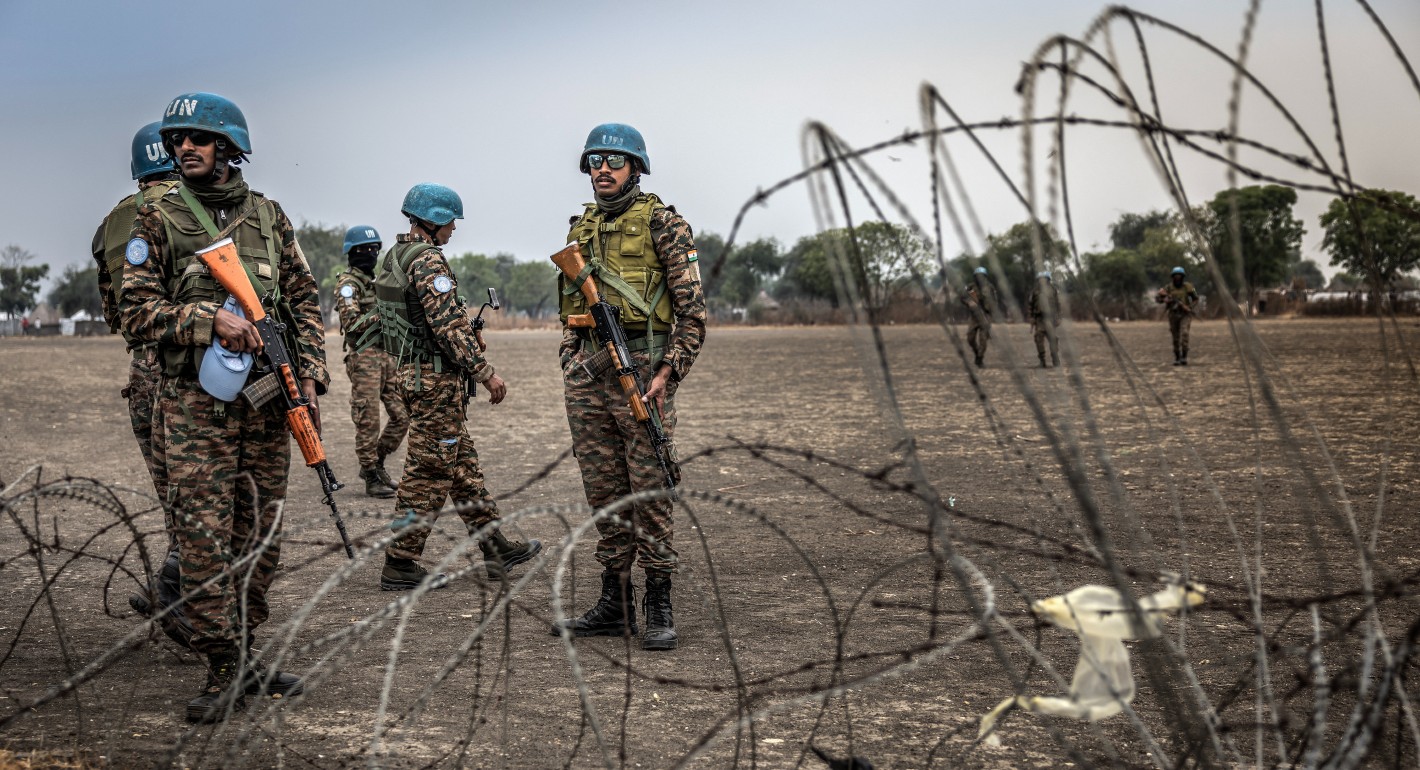
United Nations peacekeepers in South Sudan on February 12, 2026. (Photo by Luis Tato/AFP via Getty Images)
Washington’s decision to support some UN functions while letting others wither is pulling the organization apart at the seams.
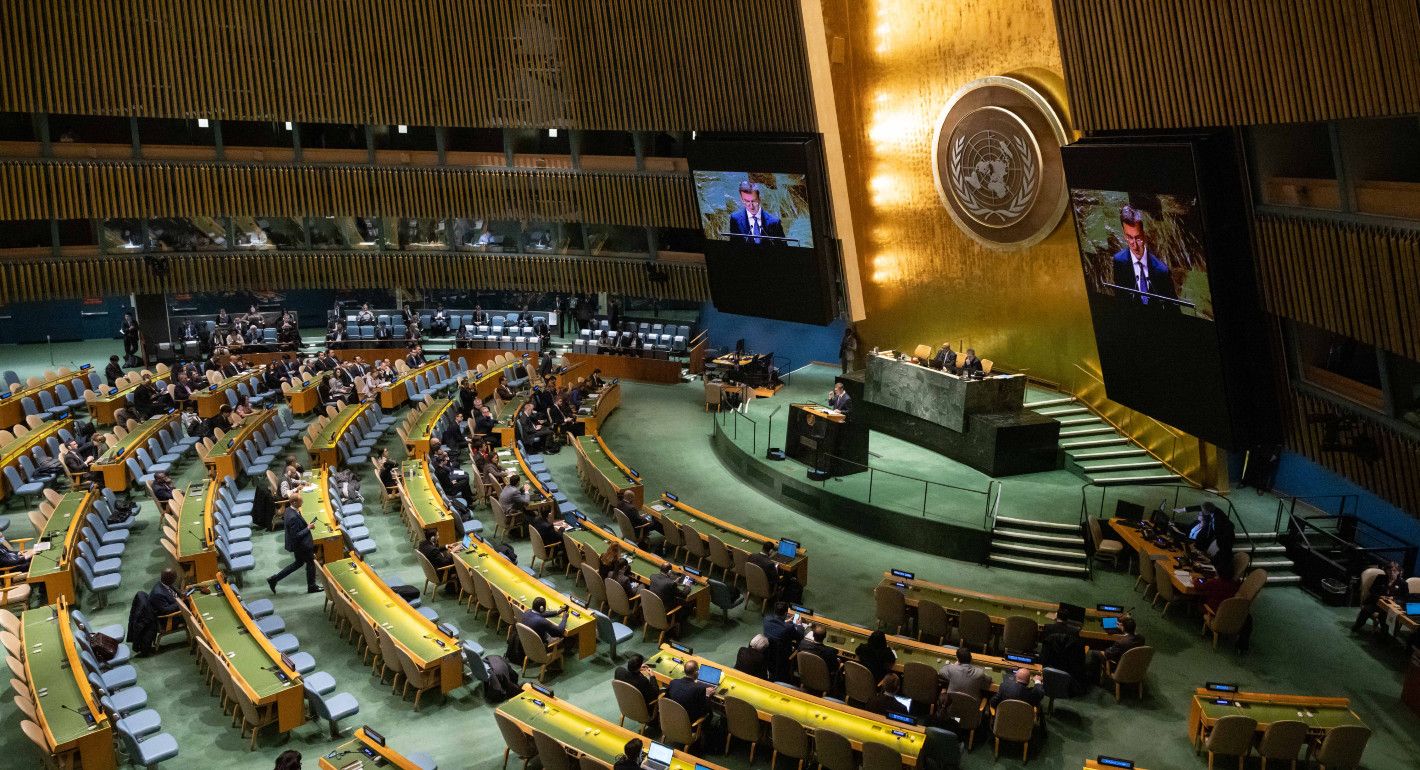
On September 22, the United Nations General Assembly begins its annual debate, and António Guterres will give his last opening remarks as secretary-general. He speaks as steward of a Security Council divided among its five permanent members, two of them waging wars of aggression. With interstate conflict at an eighty-year high, even Guterres seems to doubt whether the UN is fit to carry out its founding mandate: “We cannot keep peace when there is no peace to keep.”
Sharing the mottled green podium with Guterres that morning will be U.S. President Donald Trump, who returns to that grand hall for the sixth time. Last September, Trump gave a largely self-congratulatory speech remembered less for solemnity than for pandering to the minority of Americans who balk at deferring to the UN. Despite Trump’s assurance to Guterres that he stands “behind the United Nations 100%” and the remarkably disciplined messaging from U.S. representatives on getting the organization “back to basics,” the administration lacks a compelling plan for how to do so. Trump has lamented that he “never even received a phone call from the United Nations offering to help” with his peacemaking, saying the “United Nations wasn’t there for us.”
As the Security Council prepares to select Guterres’s successor, the United States must be ready not only to pick up the phone, but to actually work with whoever is on the other end of the line. The president’s current, selective approach toward engaging the UN is hastening the destruction of its peace-and-security functions. Salvaging this situation will require senior administration officials to coalesce around a strategy to revive the UN’s mission, both at its core and its periphery.
Maintaining international peace and security is not the charge of Guterres alone, nor the tens of thousands of UN peacekeepers stationed across a dozen countries. The job is spread across the UN’s organs, each with its own function: the Security Council, the Secretariat, the General Assembly, and others. These pieces of the postwar order, battered by austerity and bruised by derision, are still pressed into service by those who believe peace can only be maintained by keeping them together. The problem today is that great powers are straining these organs past the limit of their design, and the body is decomposing around them.
The Security Council bears primary responsibility for maintaining peace and security but asserts its authority only as its members allow. Last year, the council passed the fewest resolutions in thirty-five years, partially due to four vetoes—two cast by the United States, which has refused even modest restraints on the veto, as France and the United Kingdom now observe in the case of mass atrocities. Increasingly, selective obstruction defines how the council exercises its power to make binding decisions and authorize force.
The Trump administration is also wielding its permanent seat to move UN peacekeeping missions toward closure, not success. For example, in South Sudan, the United States insisted upon political benchmarks as a condition for renewal, producing the first fight over the mission’s continuation in fifteen years. At the same time, the United States backs sanctions regimes such as arms embargoes and asset freezes while building around, not repairing, their weakening oversight—as when the Biden administration launched a substitute for the Panel of Experts on North Korea sanctions in 2024, after Russia vetoed the panel’s routine renewal. This selectivity extends to command itself, as the council increasingly hands authority off to regional coalitions. For example, the United States voted to let the African Union lead its own forces with UN financial backing in 2023, but then blocked adequate funding for the mission in Somalia in 2025. It now champions another form of outsourcing in Haiti, where the U.S. has lobbied other council members to airlift troops for the Gang Suppression Force, which is not run by the UN.
The Security Council has not authorized a new peacekeeping operation since 2014—a result of the fewest conflicts ending in negotiated settlements in decades—which leaves the Secretariat to maintain legacy mandates. Peacekeeping remains remarkably effective and cheap, yet it has been the most direct target of American cuts. The Trump administration looked to zero out its mandatory contribution and rescinded roughly $800 million already appropriated, driving the drawdown of one in every four peacekeepers. More recently, the administration released about a thirtieth of its peacekeeping arrears, tying the rest to a “10% cut in long-standing, ineffective peacekeeping missions,” and as well as a third of what it owes the UN’s regular budget—enough to secure its vote in the General Assembly.
Special UN political missions in Somalia, Yemen, and elsewhere are funded piecemeal and left exposed to cuts, even as predictable financing is possible. Washington talks of stabilizing them but has resisted expanding models such as the Peacebuilding Fund’s newly assessed contributions. The absurdity sharpens as the work becomes more humble but still life-saving, such as with the UN mine-removal service: The United States has been an architect of global mine clearance since 1993, only to end such leadership overnight in January 2025 when no one thought to exempt it from the blanket freeze on foreign aid.
Further from the core, the UN’s ostensibly apolitical humanitarian machinery is doing the work politics has failed to do. Guterres’s infrequent use of his “good offices” to prevent and mediate conflict has been a major disappointment of his tenure. Instead, the secretary-general has devoted more of his attention to mitigating human suffering in war, marshaling the organization’s myriad agencies to coordinate aid, secure food, provide healthcare and shelter, and protect the displaced. In the absence of true peace processes, humanitarian aid workers are increasingly called upon to fill the breach, holding the pieces together.
The Trump administration’s support for emergency relief, however, remains uneven and unpredictable. U.S. humanitarian funding to the UN has fallen by roughly four-fifths in three years, even as the United States routes $3.8 billion through the Office for the Coordination of Humanitarian Affairs under an agreement that excludes Gaza, Yemen, and Afghanistan. The United States nominated an “America First” official to lead the World Food Programme, even as Washington cuts roughly half of its former support ($2.6 billion) and despite having backed the 2018 Security Council resolution classifying starvation, when used as a tool of war, as a peace-and-security concern. The Office of the High Commissioner for Refugees, which coordinates protection and returns alongside peacekeeping missions in every major displacement crisis, has had to slash a third of its costs—but even that pales beside the U.S. funding ban (likely to become permanent) to the Relief and Works Agency for Palestine Refugees, the backbone of aid delivery in Gaza.
This selectivity—feeding some functions while letting others wither—undermines the UN’s ability to carry out its basics, in effect pulling it apart at the seams. Administration officials have all but admitted this inconsistency. Secretary of State Marco Rubio says the United States aims to make the UN “an effective tool for advancing peace.” Yet the administration’s flagship initiative, the Gaza peace plan, was run in parallel through the Board of Peace, with Rubio unable to say whether it would ever be routed through Security Council authority: “We haven’t decided. Maybe. We don’t know.”
To be sure, Trump is hardly breaking precedent in seeking the Security Council’s blessing when convenient. Every administration since President Harry S. Truman has sought the council’s stamp of legitimacy at least once. In his first term, Trump brought the Doha Agreement with the Taliban before the council, which adopted a resolution welcoming it. In his second term, even while chairing his own Board of Peace, Trump returned for the Security Council’s endorsement of his twenty-point Gaza plan.
Few states are as well positioned as the United States to extract the Security Council’s imprimatur. This is what makes the administration’s strategy toward the UN so self-defeating. Credibility is a depletable asset, slower to amass than to spend, and collecting the stamp of legitimacy without reinvesting in the institution that issues it leaves less for the United States to draw on in the future.
The United States has seen what happens when that credibility lapses. In 2020, having lost a vote to extend the arms embargo on Iran, U.S. diplomats tried to trigger a snapback mechanism the Trump administration had already forfeited by quitting the Iran nuclear deal two years earlier, and thirteen of fifteen Security Council members refused to treat its claim as legitimate. The Iran deal itself is the counter-case—a text co-authored by Russia and China, adopted unanimously within a week—and the standard against which any future Iran deal will be measured.
Trump’s candor lies in refusing to subsidize what he does not want while keeping council-conferred legitimacy. His error is treating that stamp of approval as separable from the system backing it.
Selectivity is not a uniquely American habit—Russia’s 2022 invasion of Ukraine remains perhaps the starkest case of an aggressor sitting at the head of the body meant to stop it—but U.S. disregard for the same prohibition normalizes the sense that it binds no one. In this permissive environment of impunity and violence, a new cast of middle power peacemakers is emerging (among them Turkey and Pakistan), and they are picking which parts of the UN to contract for their own diplomatic purposes and leaving the rest to fend for themselves. In parallel, other countries are picking which peace efforts to bolster. For example, Lebanon is already courting bilateral deployments from Italy, France, and Spain to backfill the longstanding peacekeeping mission, which the council voted, under sustained U.S. pressure, to start winding down.
The UN is not declining so much as decomposing—what was a one-stop shop for peace and security is becoming a bundle of boutiques. This is not the first time this has happened. The League of Nations’ machinery for both refugees and health outlived its own irrelevance, absorbed wholesale into the UN before the league had even dissolved. The question today is not whether selectivity and instrumentalism will be fatal to the UN, but which pieces can outlast the whole, as demand for each survives independently of the bundle.
The General Assembly, empowered since 1950 at the urging of the United States to backstop a receding Security Council, may assume more of this strain—its 2023 resolution demanding a humanitarian truce in Gaza being the clearest recent case of it stepping up where the council fell down. Certainly the Veto Initiative—spearheaded by tiny Liechtenstein to require any permanent member that wields its veto to explain itself to the plenary chamber—suggests a General Assembly that still draws breath.
Restoring the UN’s promise of peace means treating it as more than the sum of its shiniest parts, and seeking the Security Council’s stamp of approval alone means presiding over an empty UN. The tell will be which functions Trump admits are worth paying for, if any. The United States owes the UN roughly $4 billion, arrears that Guterres warns have brought the organization to the brink of “imminent financial collapse.” Getting “back to basics” is a slogan that does not substitute for strategy. Agreeing that the UN should maintain peace and security still requires those at the State Department, and U.S. diplomats posted in New York and Geneva, to do a real accounting of which levers of engagement serve that end and merit U.S. support. Indiscriminate cuts will cost Trump more than they will save before he leaves office—and he’s already paying for them, in lost allies, lost trust, and lost leverage.

Senior Fellow and Director, Global Order and Institutions Program
Stewart Patrick is a senior fellow and director of the Global Order and Institutions Program at the Carnegie Endowment for International Peace. His primary areas of research focus are the shifting foundations of world order, the future of American internationalism, and the requirements for effective multilateral cooperation on transnational challenges.
Theodore Zaritsky
James C. Gaither Junior Fellow, Global Order and Institutions Program
Theodore Zaritsky is a James C. Gaither Junior Fellow in the Carnegie Global Order and Institutions Program.
Carnegie does not take institutional positions on public policy issues; the views represented herein are those of the author(s) and do not necessarily reflect the views of Carnegie, its staff, or its trustees.
They face an uphill climb, but they could draw on a strategy that other diplomats have used in the past.


Shana Tabak, Alejandro Martin Rodriguez
Regardless, it took the wind out of the sails of broader efforts grounded in international law.
Zaha Hassan
Donald Trump’s war on multilateralism is misguided and dangerous.
Stewart Patrick
Where it stands, and how to move forward.
Scott Anderson, Jeremy Konyndyk, Ambassador David M. Satterfield, …
The vast majority of UN member states still support multilateral cooperation, but disagreement over the scope of reform has been a major flashpoint.
Stewart Patrick, Minh-Thu Pham