

Commentary
Mariano-Florentino (Tino) Cuéllar, Corey Hinderstein, David Relman
{
  "authors": [
    "Mariano-Florentino (Tino) Cuéllar"
  ],
  "type": "commentary",
  "blog": "Emissary",
  "centerAffiliationAll": "",
  "centers": [
    "Carnegie Endowment for International Peace"
  ],
  "englishNewsletterAll": "",
  "nonEnglishNewsletterAll": "",
  "programAffiliation": "",
  "regions": [
    "United States"
  ],
  "topics": [
    "Democracy",
    "Subnational Affairs"
  ]
}
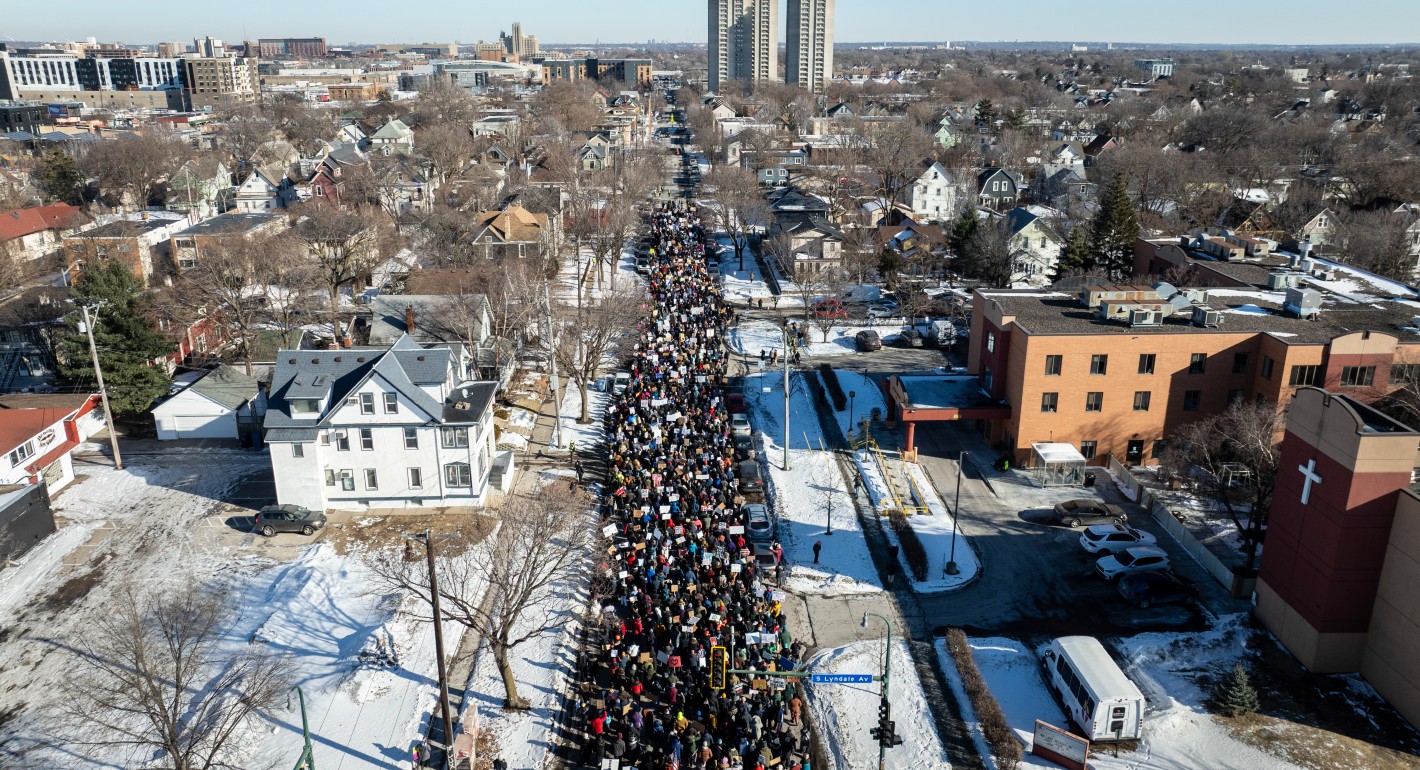
Anti-ICE protests on January 31, 2026, in Minneapolis. (Photo by John Moore/Getty Images)
What happens next can lessen the damage or compound it.
Much of the world has been shocked by the recent scenes from Minneapolis: two Americans shot by government agents acting with no clear justification and then subject to federal investigations of at best questionable credibility, provoking massive protests in freezing weather. German Chancellor Friedrich Merz expressed alarm at “this level of violence in the United States,” and the Italian foreign minister responded to public concerns about the role of Immigration and Customs Enforcement (ICE) agents in providing security for the U.S. Olympic team. These events have damaged American credibility, recalling the impact of the brutality in the South in the 1960s as Washington sought to win the Cold War. What happens next can lessen the damage or compound it. Even as the administration begins to backtrack and admits to some uncertainty about what happened and lawmakers from the president’s own party begin to raise questions, what kind of accountability can we expect as the world watches?
To answer that question, we need to think about how American institutions work in practice and learn from their history. Federalism is part of the answer: When local police and state officials brutalized Black Americans and their allies who challenged Jim Crow laws, the images reached the whole world and damaged the American brand at a key point in the Cold War. Alarmed, American leaders from Dwight Eisenhower to John F. Kennedy to Lyndon Johnson mobilized the federal government to rein in the states.
Today, federalism remains profoundly relevant to the American story—but the script has flipped 180 degrees: As federal agents in Minneapolis with limited training aggressively dispense force without sufficient justification, the states retain a measure of sovereign power to investigate, indict, and prosecute. Other mechanisms of accountability—from Congress to federal investigations—also exist, and ultimately, shifting public opinion writes much of the ultimate accountability story. Yet as the American public and their counterparts abroad wonder how this story will play out, it’s worth remembering how much power is lodged in American states under the laws and historical traditions of the United States—indeed, for the explicit purpose of stopping Washington from using armed or fiscal coercion to force states into submission.
Congress plainly has a role to play: It can use its subpoena power to investigate, and it can condition funds for the Department of Homeland Security (DHS) or its units on rules to limit stark aggression. Hearings can explore how the gun rights that the modern U.S. Supreme Court has so steadfastly defended mesh with federal agents targeting an individual who was lawfully carrying a weapon. Nevertheless, even as lawmakers from both major parties raise the alarm about recent events, the federal legislature is replete with limitations as a locus for realistic accountability, particularly when controlled by the president’s party. It cannot criminally punish individuals for wrongdoing, and all its levers are subject to the difficulties of coordinating action among self-interested, highly polarized members. Individual members can block confirmation of the president’s political nominees for key positions, but this lever requires the member to withstand significant political pressure, with no guarantee of changing executive branch conduct. At least it can bring attention to the broader structural problems and perhaps offer a platform for more members with backbone from either major party to call out federal efforts to hide the truth.
Given the extent of deception and tighter presidential control of federal law enforcement, it’s doubtful Americans can expect a serious investigation and thorough action from the federal government itself. Senior administration officials have been the very ones calling for immigration authorities to pursue their mission aggressively and implying they will have immunity for doing so. DHS rushed to demonize the shooting victims and absolve itself of guilt even when the facts plainly showed its narrative to be false. And even if agents were convicted of federal civil rights offenses, they could be pardoned by a president who has shown little restraint when it comes to using force and even less when it comes to using the pardon power.
State and local prosecutors are a different story. Where federal authorities once ensured that wayward public officials weren’t engaging in wanton corruption or callously enforcing Jim Crow, the states are now poised to check federal power. Even after the recent massive increase in funding for ICE, the bulk of police and prosecutorial power remains with the states. Local prosecutors and police are acting on behalf of a separate sovereign—the state—and have the role of prosecuting murder and other crimes afflicting their people.
Under the American legal system, law enforcement officers can be criminally punished and are subject to civil liability for using excessive force. Although the principles governing the precise scope of liability and the interplay of federal and state power can sometimes lead courts to write complicated opinions, federal agents acting beyond their lawful authority are not categorically immune from state prosecution. Under any administration, the federal government can engage in reasonable actions across the country to implement laws addressing issues from food safety to immigration to civil rights. Many Americans rightly expect national authorities to ensure these laws are taken seriously.
Yet states also serve as a counterweight to the federal government. Following the 1992 Ruby Ridge siege in Idaho, an Idaho prosecutor brought charges against one of the FBI employees after the Justice Department declined to bring charges against senior FBI officials for their conduct. Although the charges were ultimately dropped, the state prosecution was upheld by a federal appellate court, and the threat of state prosecution plus civil liability strengthened the rationale for changes in FBI rules of engagement.
State investigations and potential prosecution for federal misconduct matter because under existing law, federal agents can be shielded from state prosecution in certain specific situations: when acting to advance a legitimate mission in a way that is “objectively reasonable,” as one well-respected conservative jurist put it. That description fits what the FBI was doing in the South to advance civil rights in the 1960s, but it may prove far harder to square with the shooting of Alex Pretti by two federal agents in Minneapolis.
Ultimately, the laws governing the balance of power between states and the federal government tend to place limits on Washington’s ability to constrain states in their areas of traditional competence. The administration could press strained arguments in court implying that federal personnel should be able to evade state liability even when they were engaging in objectively unreasonable conduct or freeze at will the investigations and prosecutions of perpetrators acting under federal authority. But as American law is tested by federal actions with little or no precedent, fair-minded observers will find it exceedingly difficult to defend the administration without upending longstanding federal norms about the role of the states that have been championed by conservative judges for years.
The White House and its team can try to frustrate state efforts by denying access to relevant information or threatening to withhold federal funding from states that pursue investigations. But the U.S. Supreme Court has long distinguished between “pressure” and “compulsion” and repeatedly ruled that federal action amounting to the latter contravenes the principles of federalism. What’s more, every cellphone camera held by someone on the street is a source of evidence, and threats to squelch a legitimate investigation of an officer whose actions have proven so troubling to the public are best met with some backbone, along with litigation to stop Washington from using the power of the purse as a weapon to enable unaccountable aggression. Progressives who previously decried state-level policy variation on matters ranging from education to reproductive rights should take note.
Americans shouldn’t fool themselves into thinking that local officials can single-handedly restore all depleted U.S. credibility. Much of the damage to the American brand is already done, and even urgent state investigations take time and don’t guarantee a just outcome. Nevertheless, at least the United States is more than the White House or even all the branches of the federal government. Americans and the world will benefit from a reminder that the United States is imbued with a federal structure under which a choice made in Washington about what matters most to the public is rarely the last word: States are pursuing their own climate action consistent with the Paris Agreement as the federal government withdraws, and they are playing up their own science-based vaccine guidance as the federal government waters down its own.
Yet nowhere is the role of state governments more important than protecting the physical safety of the public, for which they’ve had the lion’s share of responsibility for the entire history of the United States. As when images of water cannons deployed on civil rights protesters were broadcast around the world in the 1960s, the aggressive law enforcement tactics and protests in Minnesota remind us that the balance of power between states and the national government remains a core theme of the American story. The world is reacting to a changing America where some communities are under siege from their own federal government. At this fraught and imperfect moment in the history of the world’s most powerful country, local prosecutors and state authorities are equipped to serve as a crucial backstop when it comes to ensuring that federal agents are held accountable if they use force without lawful reasons.

President, Carnegie Endowment for International Peace
Mariano-Florentino (Tino) Cuéllar is the tenth president of the Carnegie Endowment for International Peace. A former justice of the Supreme Court of California, he has served three U.S. presidential administrations at the White House and in federal agencies, and was the Stanley Morrison Professor at Stanford University, where he held appointments in law, political science, and international affairs and led the university’s Freeman Spogli Institute for International Studies.
Recent Work
Mariano-Florentino (Tino) Cuéllar, Corey Hinderstein, David Relman

Mariano-Florentino (Tino) Cuéllar, Micah Weinberg
Carnegie does not take institutional positions on public policy issues; the views represented herein are those of the author(s) and do not necessarily reflect the views of Carnegie, its staff, or its trustees.
Neither the Abraham Accords nor the presence of large U.S. bases are enough to protect Arab Gulf states.

Marwan Muasher
A conflict launched in the name of American security is producing the opposite effect.

Sarah Yerkes
Restoring competence and trust to the anemic, neglected disaster recovery agency is a matter of national security.


Sarah Labowitz, Debbra Goh

Although the IAA often differs from the IRA, European policymakers can still take note of the U.S. act’s shortcomings.

Milo McBride
Going to war was the U.S. president’s decision, for which he alone is responsible.

Daniel C. Kurtzer, Aaron David Miller