

Commentary
Despite public disputes over trade and immigration, the strategic partnership’s foundations remain sturdy.
Sameer Lalwani
{
  "authors": [
    "Jon Bateman",
    "Steve Feldstein"
  ],
  "type": "questionAnswer",
  "blog": "Emissary",
  "centerAffiliationAll": "dc",
  "centers": [
    "Carnegie Endowment for International Peace"
  ],
  "collections": [
    "Tech and Democracy",
    "Conflict, Security, and Peacemaking "
  ],
  "englishNewsletterAll": "ctw",
  "nonEnglishNewsletterAll": "",
  "primaryCenter": "Carnegie Endowment for International Peace",
  "programAffiliation": "TIA",
  "programs": [
    "Technology and International Affairs",
    "Democracy, Conflict, and Governance"
  ],
  "projects": [],
  "regions": [
    "United States",
    "Sudan",
    "Russia",
    "Ukraine",
    "Israel"
  ],
  "topics": [
    "Military",
    "Defense",
    "Security"
  ]
}
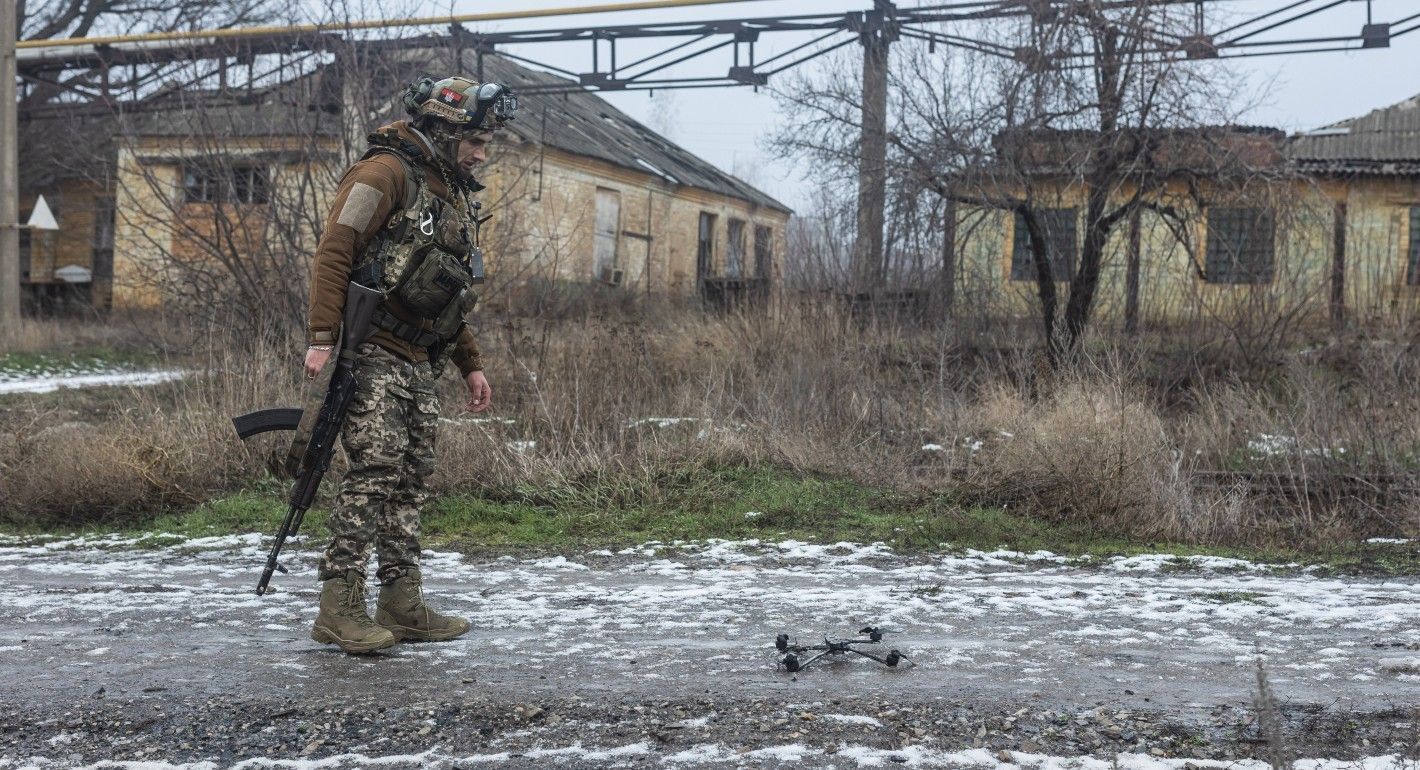
A Ukrainian soldier examines a Russian drone on January 7, 2026. (Photo by Diego Herrera Carcedo/Anadolu via Getty Images)
From Sudan to Ukraine, UAVs have upended warfighting tactics and become one of the most destructive weapons of conflict.
On a recent episode of The World Unpacked, host Jon Bateman talked with Steve Feldstein, a senior fellow at the Carnegie Endowment and author of a forthcoming book on drones and other technologies that are upending global competition. They discussed how drones have become a defining weapon of modern wars—an estimated 70 percent of casualties in the Russia-Ukraine war are linked to drones—and how the United States and others should respond to this shift.
A portion of their conversation, which has been edited and condensed for clarity, is below.
Jon Bateman: We’re going to talk a lot about Ukraine, but first let’s talk about Sudan. This is a conflict that is not as much in the headlines, but it’s another area where drones are making perhaps a decisive difference.
Steve Feldstein: The situation in Sudan has been pretty grim and has gotten even worse in recent months. Essentially, the country has been locked in a civil war that is taking place between two large military factions: the Sudanese army and an insurgent militant force, the RSF [Rapid Support Forces].
But one of the game-changing weapons has been the import of military-grade drones on both sides. Initially, there was a greater proportion of high-end drones that came from Egypt and Türkiye to support the Sudanese Armed Forces. There were also some Iranian drones that they had in their arsenal as well. And many people believe that those drones in particular were responsible for helping the Sudanese Armed Forces recapture the capital city, Khartoum, earlier this year and drive the RSF out of that area of the country.
One of the responses that came from the RSF, which is backed by the UAE, was for the UAE to provide its own set of sophisticated military-grade drones imported via China. And these Chinese Wing Loong II drones have been particularly useful for the RSF to push back the Sudanese Armed Forces in another theater—El Fasher, in the Darfur region. That city has now fallen to the RSF in part due to relentless strikes by these Chinese military-grade drones.
Jon Bateman: Is there something inherently worrisome about the transition into this new phase of war?
Steve Feldstein: It’s not that drones have become a substitute, at least in that conflict, from traditional weaponry, but they have more capabilities. They’re allowing a greater amount of devastation to occur over a larger area.
For example, one of the things the RSF has been able to do with their drones is to strike port cities such as Port Sudan, which is more than 1,000 kilometers away from any area that they actually hold. They’re able to have an extensive reach that goes beyond what they otherwise would be able to do. That brings the war to many corners that otherwise might be less touched by the conflict.
A second aspect is that we’re seeing this really big proliferation of these weapons in different forms. Anytime that you see that kind of massive increase and the type of lethal weaponry available, especially to unaccountable armies, I think that is problematic. And the cost is going down as well.
Invalid video URL
Jon Bateman: I sometimes think about kind of two eras of military drone technology. There was the initial era, pioneered by the United States, where UAVs [unmanned aerial vehicles] were flown over Iraq, Afghanistan, and others. These were fixed-wing drones. They would fly very high over long distances and for long amounts of time. They were equipped with missiles, and we would use them to execute precision strikes. My sense is those are still around, and it’s not just the United States operating them.
But now we’ve entered into this second era, defined in many ways by quadcopters. They’re very light and don’t fly very high or fast. They can also be used for surveillance or in a kind of kamikaze-style attack we’ve seen throughout the Ukraine conflict. What’s your sense of the strategic importance of these two broad categories of drones?
Steve Feldstein: The way the Pentagon classifies it is that there is a third category of drone, which is a really interesting type—the Bayraktar TB2 models from Türkiye, the Shahed drones from Iran. These are the kamikaze drones.
On a nightly basis in Ukraine, they have caused tremendous amounts of havoc. A lot of them get shot down, but many go through, in part because they are cheap enough that if you use an expensive missile battery to shoot them down, you’re losing the battle of asymmetry when it comes to cost. You’re using $1 million or $500,000 missiles to shoot down $20,000 or $30,000 drones. You can’t sustain that.
They’re also good enough. They have enough munitions associated with them, and they’re able to fly longer and higher and have some radar elevation compared to category one or two, so they are able to get through these defenses and cause a lot of harm.
Jon Bateman: Four million (or more) drones being manufactured by Ukraine this year, and I’ve seen similar estimates from Russian manufacturers of drones. How was it possible to go from manufacturing very few drones to millions?
Steve Feldstein: Ukraine has had a real innovation and adaptation drive. They have had a very strong industrial base anyway, which in the past has been used for manufacturing tanks, other vehicles, and so forth. Part of what they were forced to do very quickly in the war was to think about how you then repurpose what you have. We’re seeing very quickly the Russians falling behind, then doing pretty much the same type of things that Ukrainians are doing with drones. So now there’s a battle of manufacturing as much as a battle of tactics.
Jon Bateman: Any future war that the United States, China, Russia, others might fight—if it’s going to last more than a few weeks, the ability to sustain at scale becomes critical.
Steve Feldstein: It reflects a real mindset shift in the Pentagon. You’re saying that instead of trying to manufacture exquisite weaponry that costs in the hundreds of millions of dollars—whether it’s F-35s or something else—you’re instead going to refocus part of your purchasing toward low-cost, high-bulk items, like the drones that we’re talking about that essentially are disposable. It’s a real change in tactics and strategy.
Jon Bateman: I worked in the Pentagon ten years ago now, and already at that time, this was a common trope throughout the building. Everyone knew that this is where things were headed. And yet the United States is still so far behind in making this a reality. It’s probably a mixture of the culture, but also the vested interests of the members of Congress who want to continue funneling money toward some higher-end asset that’s manufactured in their districts. And at the end, the industrial base may not be there yet to manufacture at scale in the United States, but I think Ukraine has been a huge mindset shift for many.
Steve Feldstein: I think what has changed from when you were at the Pentagon to where we are today is that for a long time it was abstract, this idea of we need to think about ways to fight a longer war. But until you actually see it in practice, it’s hard to take that and say, Well, let’s change everything. It’s much easier to follow along a path dependency to say that we have another way of fighting, and it’s worked pretty well so far. We use small groups of special operators, expensive weaponry, precise missiles. And even though it’s expensive, it works, and it ends conflicts quickly.
But a prospective conflict with China may not end quickly. The ways in which battles are being fought are shifting pretty rapidly. And this embrace of drones at the tactical level is something that’s new. I think all of that is contributing—I hope—to a bit of a paradigm shift when it comes to saying, Wait a second, the character of war is changing in pretty significant ways, and we may not be totally ready for that.
Jon Bateman: Electronic warfare seems to be one of the top threats to effective use of drones. You’re trying to pilot a drone, and you’re trying to maintain continuous connectivity with it in order to operate it. Your adversary can be jamming or manipulating those signals. You mentioned one incredibly creative response, which is to have the drone drop a cable after it as it’s flying, so there’s a kind of electronic tether that allows it to continue to operate. Once we get past electronic warfare, the adversary can do all kinds of other things, from shooting down the drone to just shooting a net at it or putting a net on some kind of target.
Steve Feldstein: Yes, you’re seeing a cat and mouse game. This is just what you see anywhere, even going back centuries before. You had the invention of gunpowder that for a minute made obsolete fortifications. And then you had the development of reinforced stone fortifications that were able to negate to some extent the ability of gunpowder to pierce through.
Lots of resources and money are coming in to find ways to intercept drones, to adapt and hide from drones, to scramble the signaling for autonomous drones and pixel lock so that they glom onto incorrect targets and explode. I’m also seeing something else that’s interesting: unmanned ground vehicles—drones that are wheeled on the ground. What those have been used for primarily has been to shuttle logistics back and forth, as well as for health and evacuation of individuals. There was a really interesting report about a month ago in The New York Times by a reporter talking about how essentially these autonomous vehicles have been a lifesaver for soldiers who are wounded on the front lines who need to be evacuated. Normally you’d have rescuers who would risk their own lives and would have to withstand drones in order to evacuate the wounded. But instead, even if one of these ground vehicles is destroyed by a mine or something else, you still have a much higher ability to get the wounded over to a safe area. So here’s another example where you have drone versus drone, ground drone versus surveillance and attack drones, and a human’s life in the balance.
Jon Bateman: I feel like I’m building a case for drone warfare being maybe not a bad way to fight wars. We all know war is hell—civilians are killed, war crimes occur, there’s famine, there’s destruction of infrastructure—any way you fight it, whether it’s with machetes, arrows, drones, or even nuclear weapons.
If you had to design a favorable weapon system, one that maybe a humanitarian could be made the least uncomfortable by, you’d want it to be very precise, minimal collateral damage, have everything recorded. Can we welcome the drone era? Does it have to be something that feels dangerous and dehumanizing?
Steve Feldstein: The counterargument is Gaza.
I think you’re making an assumption that you’re going to have two evenly matched armies fighting it out and that essentially you’ll get a defensive stalemate. That sometimes is the case. Most often it’s not. Most often there’s asymmetry, where you have a much more powerful military against a much less powerful adversary, and that’s what you see in Gaza. So in Gaza, it is not a defensive stalemate. It’s an offensive slaughter.
I think what is novel there is that in prior conflicts, even when you had asymmetry, the amount of targets that could be generated and then used for strikes was limited by the humans who were able to process the information and the tools they had at hand with which to deploy missile strikes. Now, what you saw in that conflict is that the target generation capacity is ten times what it was before, in part because of AI systems that are able to collect bulk information, process it, and then generate lists of suspects for targeting. Then when you have different types of drones that can fire missiles, and you have less of a risk of losing individual soldiers as opposed to unmanned systems, there’s a higher propensity for militaries to take advantage and use those. War is hell, but war is particularly hellish when you have access to these systems at a bulk rate and when your adversaries don’t.
Jon Bateman: And just because you have a weapon that’s capable of being very precise (while also being quite destructive) doesn’t mean that the military will use it in precise ways.
My hunch is that Israel would have been able to level Gaza without the use of drones. But if we go to a place like Sudan, maybe it’s less clear that the militant groups and armed forces fighting there would have been able to achieve the same level of destruction that they’ve achieved without the use of drones.
Steve Feldstein: That’s right. Proliferation really matters. And I think what’s proliferating in terms of drones is not precision drones.
Look at what the Houthis or HTS [Hay’at Tahrir al-Sham] or the Islamic State were using. The fact that irregular forces or militant groups can essentially set up 3D printers in their garages, build quadcopters to spec, use them in indiscriminate ways—sometimes discriminately, oftentimes indiscriminately—against all manner of civilians. This proliferation issue also adds a dimension that I think is pretty frightening.
Jon Bateman: A small kamikaze quadcopter is essentially a micro-cruise missile. So if any number of armed groups can acquire a micro-cruise missile for a few hundred dollars, that’s a brave new world. And it’s not necessarily one that’s good for the targets of those groups.
Steve Feldstein: That’s right.
Jon Bateman: We’re not going to unwind this drone revolution. We’re going to be living in an era of drone warfare, perhaps our entire lives, or at least until some very effective counter has developed. What’s the version of this world that you want to live in?
Steve Feldstein: We should be dedicating as many resources as possible toward electronic warfare and other means to counter drones. The more we can find ways to blunt their effects, the less of a destructive tool they will be, period.
The second thing is that—as we talked about—drones come in all matters of size, shapes, and destructiveness. It is very hard to find ways to counter, say, quadcopters that are holding grenades and explode. On the other hand, their level of destructiveness is simply not the same as some of the more advanced models. So, in some ways, you can focus on the advanced models first—the long-range, highly destructive ones, or even medium-range drones that potentially can have autonomy built into them. And let’s come up with some basic rules for responsible use, in terms of parameters for how they’ll work. It’s not that everyone will buy into that. [We could] get major militaries to come to an agreement, whether it’s equivalent to the kinds of agreements countries came to on chemical weapons, or something else, to have some basic responsible-use parameters around those drones, that could be a viable and good thing.
Jon Bateman: The United States pioneered and really almost became culturally identified on the global stage with the use of drones—the Predators, the Reapers. These were iconic symbols of the global war on terror. Has the United States lost the edge in this era of drone warfare?
Steve Feldstein: I think the U.S. remains an innovation leader, particularly when it comes to high-end drones. What naturally happens over time, no matter what technology field you’re looking at, is that eventually fast followers will catch up. There’s no way to stop that. This is the process of technological diffusion. You come up with something. For a while, it is the cutting edge, and it gives you advantage. But over time, that advantage erodes, and you have to come up with other ways to seek new advantages.
So we can’t rest on our laurels. We have to keep pushing forward. And we have to also think about ways to balance the need for more firepower, more precision, and more strategy alongside the idea of adhering to important rules and principles when it comes to protecting civilians—and living in a world that won’t be ravaged by the destructiveness of these weapons. And accomplishing that balance in the best of times is hard. When you’re feeling vulnerable or you’re feeling that there’s a prospective war at hand, that tends to get pushed down even further. But I don’t think we can afford as a global community to take our eye off the ball when it comes to that question.
Subscribe to The World Unpacked on YouTube or your favorite podcast provider.

Senior Fellow and Co-Director, Technology and International Affairs Program
Jon Bateman is a senior fellow and co-director of the Technology and International Affairs Program at the Carnegie Endowment for International Peace.

Director and Senior Fellow, Democracy, Conflict, and Governance Program
Steve Feldstein is a senior fellow and director of the Democracy, Conflict, and Governance Program at the Carnegie Endowment for International Peace. His research focuses on technology, national security, the global context for democracy, and U.S. foreign policy. His new book, Bytes and Bullets: Global Rivalry, Private Tech, and the New Shape of Modern Warfare, is now available from St. Martin’s Press.

Despite public disputes over trade and immigration, the strategic partnership’s foundations remain sturdy.

Sameer Lalwani
It signals a new era of tech diffusion and warfare.
Steve Feldstein

Despite its flop at the box office, the film raises important questions for the climate community to answer.

Leonardo Martinez-Diaz

The acknowledgment has sparked fears of a new arms race with China and Russia.

Chris O’Meara

The summit may be remembered as a fatal blunder, when Washington, Beijing, and the AI industry collectively chose ceremony over action.

Jeffrey Prescott