

Commentary
Alper Coşkun, Garo Paylan
{
  "authors": [
    "Garo Paylan"
  ],
  "type": "commentary",
  "blog": "Emissary",
  "centerAffiliationAll": "dc",
  "centers": [
    "Carnegie Endowment for International Peace"
  ],
  "collections": [
    "European Politics",
    "Transatlantic Cooperation"
  ],
  "englishNewsletterAll": "ctw",
  "nonEnglishNewsletterAll": "",
  "programAffiliation": "EP",
  "programs": [
    "Europe"
  ],
  "regions": [
    "Armenia",
    "Azerbaijan",
    "United States",
    "Türkiye"
  ],
  "topics": [
    "Foreign Policy",
    "Domestic Politics",
    "Economy"
  ]
}
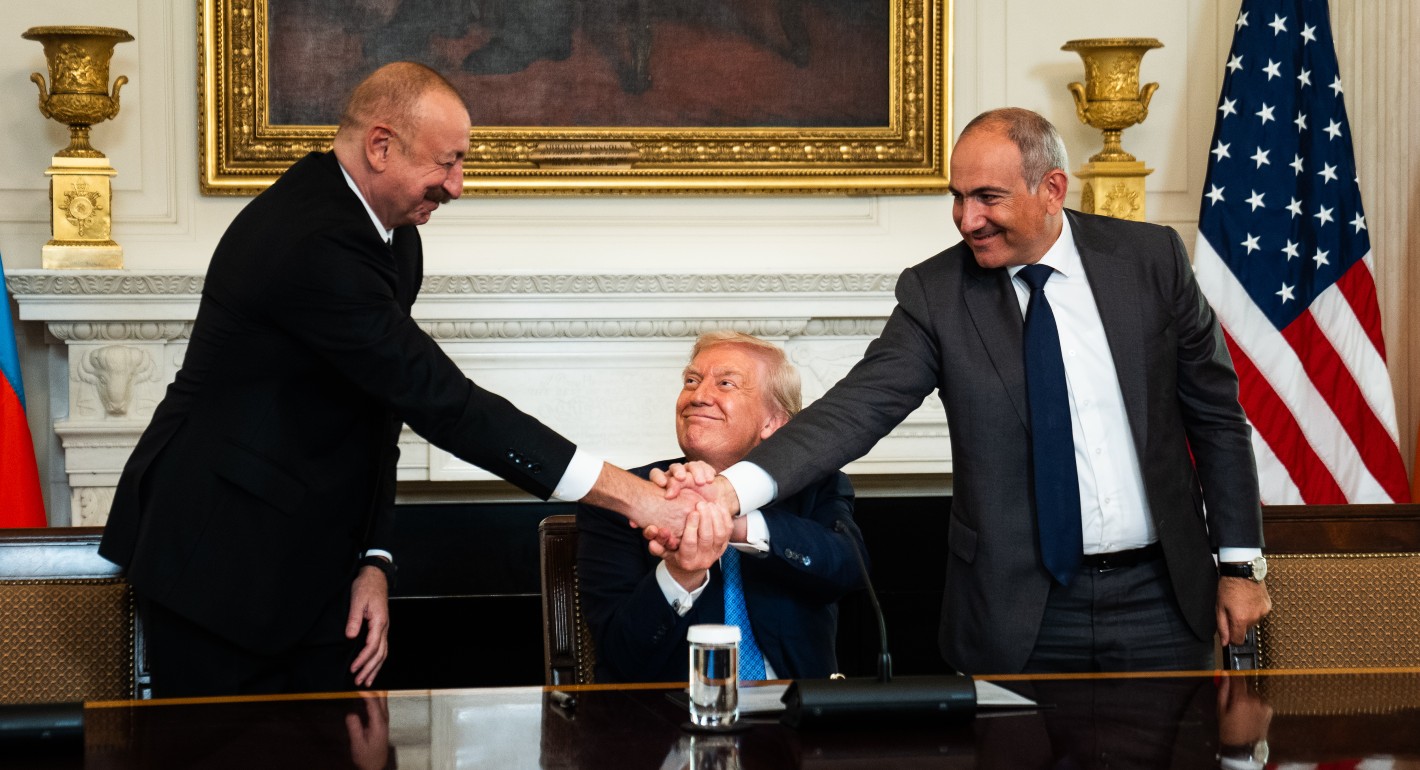
Trump, Pashinyan, and Aliyev shake hands at the White House on August 8, 2025. (Photo by Demetrius Freeman/The Washington Post via Getty Images)
An Armenia-Azerbaijan settlement may be the only realistic test case for making glossy promises a reality.
President Donald Trump likes to say he is ending wars. To be fair, in 2025, American diplomacy did help pause several conflicts—most notably in Gaza—and prevent others from spiraling further out of control. But most of the eight wars Trump claims credit for ending remain frozen conflicts. Ceasefires have stopped the bullets, but they have not yet produced stable political settlements or durable regional orders.
Trump’s preferred answer to this gap is what might be called “peace through construction”: the idea that economic incentives, infrastructure, and business logic can succeed where traditional diplomacy has stalled. It is a strikingly Trumpian theory of peace, carried not by diplomats and institutions but by trusted business-minded envoys such as Jared Kushner, Steven Witkoff, and Thomas Barrack. Versions of this idea have been floated for Gaza, Ukraine, and Syria. So far, these have remained glossy promises and PowerPoint presentations of boulevards, data centers, and airports.
There is, however, one place where this approach could actually work—and where U.S. leverage could turn a frozen conflict into a lasting peace: the South Caucasus. An Armenia–Azerbaijan settlement, anchored in construction and regional connectivity, may be the only realistic test case for Trump’s economic vision of peace to move from slogan to legacy.
Among the conflicts Trump cites as successes, Armenia–Azerbaijan stands apart because the core territorial dispute has already been tragically resolved. Azerbaijan’s 2023 reconquest of Nagorno-Karabakh, accompanied by the ethnic cleansing of its Armenian population, closed a chapter that had fueled decades of war.
For the first time since the collapse of the Soviet Union, Armenia and Azerbaijan are closer to institutionalized peace than renewed war. Last August, Armenian Prime Minister Nikol Pashinyan and Azerbaijani President Ilham Aliyev came to the White House to sign a U.S.-brokered declaration with Trump that moved the parties closer to a comprehensive peace treaty. This was a historic breakthrough, with both governments now formally recognizing each other’s territorial integrity based on Soviet-era borders and committing to ending the use of force. The remaining issues—border delimitation, connectivity, and confidence-building mechanisms—are solvable and tied to already agreed-upon roadmaps.
Diplomacy has also been slowly progressing. Armenia wants to pivot to the West, and Foreign Minister Ararat Mirzoyan’s recent visit to Washington underscored Yerevan’s continued bet on U.S. engagement. During the visit, Secretary of State Marco Rubio said peace would be “great for Armenia, great for the United States, great for everyone involved, but ultimately a model for the world.” That may be too bold, but Washington remains committed to the peace accord. Vice President JD Vance is scheduled to visit Armenia and Azerbaijan in February—a signal that the region remains on Washington’s radar.
The international environment also reinforces this moment. Russia’s credibility as a security guarantor in the South Caucasus has eroded dramatically following the 2020 war between Armenia and Azerbaijan and its assault on Ukraine. Neither Armenia nor Azerbaijan wants to see Moscow reassert itself once that war winds down. The European Union, meanwhile, is eager to support reconciliation and post-conflict development. Turkey—despite its unwavering alliance with Azerbaijan—is supportive of peace and keen to reopen east–west trade routes through Armenia toward Central Asia.
What makes this moment truly different, however, is that the United States now has a clear economic and strategic stake in the outcome.
Trump wants American firms, rather than American troops, in critical geographic hubs. His administration has shown little interest in traditional peacekeeping or multilateral guarantees—but a strong appetite for projects that promise visibility, leverage, and returns. That instinct has led to the idea of the Trump Road for International Peace and Prosperity (TRIPP), which was referenced in the August declaration. The route runs through Armenia, connecting Azerbaijan to its exclave Nakhichevan and then Turkey.
TRIPP is unmistakably Trumpian in style: transactional, branding-heavy, and unapologetically focused on U.S. gain. But stripped of its marketing, it could become something real—a geoeconomic framework linking Europe to Central Asia through the South Caucasus via rail, road, energy, and digital infrastructure.
Unlike previous mediation efforts focused narrowly on crisis management, this approach embeds peace in transportation and connectivity. Stability becomes the price of admission to new investments and growth. Peace would make Armenia and Azerbaijan matter geoeconomically and geopolitically in a way they haven’t before. For Washington, it offers influence through integration rather than coercion.
The South Caucasus sits amid the emerging Middle Corridor linking Europe to Central Asia. As the United States seeks to diversify supply chains away from China and Russia, access to Central Asia’s energy resources and critical minerals has become increasingly important. But those resources only matter if they can reach global markets through stable and predictable routes.
A durable Armenia–Azerbaijan peace would transform the region from a geopolitical chokepoint into a transit hub. Railways, roads, pipelines, and digital networks could connect Central Asia to Europe without constant risk of disruption. This way, the United States gains a reliable east–west corridor that reduces Russian leverage, complements European energy diversification efforts, and anchors Turkey—as opposed to Russia—as the protector of a new regional economic order.
This is precisely the kind of outcome Trump claims to favor: economic gains without permanent military commitments.
Turkey is the key to making any of this work, but it is still not fully on board. Ankara’s alliance with Baku, built on the principle of “one nation, two states,” has been the bedrock of its foreign and defense policy. Ankara says it will only open the border with Armenia once there is a final Armenia–Azerbaijan peace treaty—seeing this as a bargaining chip in relations with Baku and Washington. Erdoğan recently promised “symbolic steps” toward normalization with Armenia. Nevertheless, Ankara is expected to open the border to Armenia for third-party citizens and diplomatic passport holders in March.
But Turkey has its own incentives to support normalization with Armenia. Opening borders and restoring transit routes through Armenia would reinforce Turkey’s role as a regional trade, energy, and logistics hub. Here the relationship between Trump and Turkish President Recep Tayyip Erdoğan could be helpful, and Trump has demonstrated a willingness to deal pragmatically with Ankara on Syria and other regional issues. If Washington wants this peace to hold, it must bring Turkey into the process and urge Ankara to fully open the border sooner rather than later.
Meanwhile in Armenia, domestic pressure is building. Azerbaijan demands changes to Armenia’s constitution before signing a final peace treaty, which is not an easy act for any elected leader. Armenia will hold parliamentary elections in June, and Pashinyan has staked his political future on the peace agenda. He has already taken risks that would have been unthinkable a decade ago, including recognizing Azerbaijan’s territorial integrity, reframing Armenia’s national narrative, and arguing that security lies in normalization with neighbors rather than perpetual confrontation.
But peace must deliver. Hardline and pro-Russian opposition forces are mobilizing to portray the process as capitulation without compensation. Without visible economic and security dividends, the political space for compromise in Yerevan will narrow quickly.
If the Trump administration wants to turn its peace claims into a legacy, early 2026 is the critical window. A diplomatic breakthrough has already happened. But what usually fails in Trump’s peace efforts is the post-agreement phase. To overcome this pattern, Washington should quickly introduce the idea of a regional economic compact—from trade to joint ventures, data centers, energy, tourism, and more—between Turkey, Armenia, and Azerbaijan as the core driver of stability.
As a first step, the United States should establish a South Caucasus stability fund that brings together U.S., EU, Armenian, Azerbaijani, Turkish, and Gulf resources alongside international financial institutions. Such a fund could pool financing, synchronize projects, and ensure that peace dividends are visible to ordinary citizens.
In the meantime, Washington can coordinate with Baku, Yerevan, and Ankara on the restoration of Soviet-era railways to jump-start cross-border trade and transportation. Rather than waiting years for new railway projects, which would erode public trust in peacemaking, the two can rehabilitate existing rail links and operationalize TRIPP in 2027.
The Trump administration can also push Armenia and Azerbaijan to formally sign the peace agreement before Armenia’s June elections, creating political space for Turkey to begin opening its border. A normalization with Turkey would strengthen the peace camp in Armenia and send a powerful signal across the region that peace brings tangible benefits.
Along the way, Washington should encourage and follow-through on other confidence-building measures, including the return of all Armenian prisoners of war, clarification of the fate of missing persons, and steady border demarcation. These steps matter deeply to public opinion on both sides and make peace politically sustainable.
Trump is right that stopping wars matters, but he has not yet demonstrated that economic interdependence is the key to stabilizing geopolitical flashpoints. Among the conflicts Trump points to, Armenia–Azerbaijan is the clearest case where modest, sustained American engagement could determine the final outcome. The war has ended. The framework exists. The incentives align for a new economic order in the South Caucasus. If “peace through construction” is really a new theory in international relations and can contribute to world peace, the South Caucasus can be where it proves itself.

Visiting Scholar, Europe Program
Garo Paylan is a visiting scholar with the Europe Program at the Carnegie Endowment for International Peace in Washington, DC. His research focuses on the South Caucasus and Türkiye.
Recent Work

Alper Coşkun, Garo Paylan
Garo Paylan
Carnegie does not take institutional positions on public policy issues; the views represented herein are those of the author(s) and do not necessarily reflect the views of Carnegie, its staff, or its trustees.

Rubio’s recent visit brought welcome attention, but more capital requires governance changes that may be a hard sell for regional governments.

Jennifer B. Murtazashvili
Why Pakistan, Saudi Arabia, and Turkey are joining forces on regional security.

Alper Coşkun, Amr Hamzawy

Despite public disputes over trade and immigration, the strategic partnership’s foundations remain sturdy.

Sameer Lalwani

It signals a new era of tech diffusion and warfare.

Steve Feldstein

Despite its flop at the box office, the film raises important questions for the climate community to answer.

Leonardo Martinez-Diaz