

Commentary
Judy Dempsey
{
  "authors": [
    "Judy Dempsey"
  ],
  "type": "commentary",
  "blog": "Strategic Europe",
  "centerAffiliationAll": "",
  "centers": [
    "Carnegie Endowment for International Peace",
    "Carnegie Europe"
  ],
  "collections": [
    "Transatlantic Cooperation"
  ],
  "englishNewsletterAll": "",
  "nonEnglishNewsletterAll": "",
  "primaryCenter": "Carnegie Europe",
  "programAffiliation": "",
  "programs": [],
  "projects": [],
  "regions": [
    "Europe",
    "Eastern Europe",
    "Western Europe"
  ],
  "topics": [
    "Security",
    "Military",
    "EU"
  ]
}
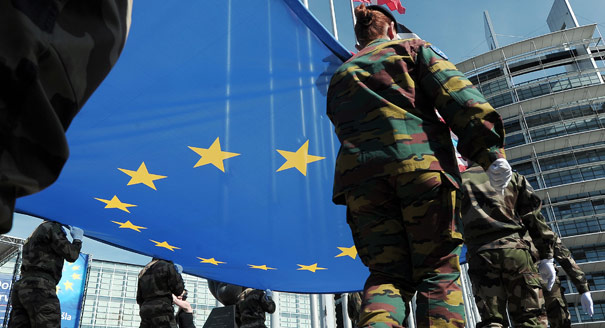
Source: Getty
Despite the serious implications of the Ukraine crisis, Cyprus and Turkey have imposed persistent obstacles to EU-NATO cooperation. It is time to break the deadlock.
The standoff between NATO and the European Union is one of the most debilitating and shortsighted disputes between the two organizations, whose headquarters are but a twenty-minute bus ride from each other in Brussels.
The uneasy situation has been going on ever since Cyprus joined the EU on May 1, 2004. It is absurd, dangerous, and costly for both the EU and NATO.
The two organizations cannot openly discuss security and intelligence issues. Nor can they cooperate by pooling their hard- and soft-power attributes, as the standoff means that the EU and NATO cannot exploit the Berlin Plus arrangements for sharing assets. That hinders both organizations’ thinking about any long-term strategic cooperation. It is time for the standoff to end.
Times were different back then. The level of trust between the two organizations was so low it was surprising that Berlin Plus was agreed to at all.
The EU and NATO had both become bitterly divided over the U.S.-led invasion of Iraq in 2003. France, Germany, Belgium, and Luxembourg (along with Russia) had opposed the invasion and had vetoed any NATO support for it. These countries also believed that the EU could go it alone by setting up its own military planning headquarters while the Europeans beefed up their own defense capabilities.
The reality was—and still is—that Europe cannot go it alone. It lacks the military capabilities and the political will to take on more of the burden sharing that the United States has long been asking of its European allies.
The United States and the Atlanticist members of the EU were staunchly against the Franco-German plan for an EU military planning headquarters. They did not relish the idea of France and Germany, then under the Social Democrat and pro-Russian chancellor Gerhard Schröder, setting up European defense structures that would be not only independent from NATO but also competing with it—and hence with the United States.
Such competition would have been a coup for Russia, which has long worked for the decoupling of the transatlantic relationship.
Much has changed in that relationship over the past decade, and in Europe’s relations with Russia. If anything, the Ukraine crisis should surely be the catalyst for the EU and NATO to reinforce the ties between them by finding ways to complement each other’s strengths. If only that were the case.
Despite the Ukraine crisis, Cyprus and Turkey undermine #EU-#NATO cooperation.Tweet This
Even though the EU and NATO together understand the enormity of the Ukraine crisis and its implications for both organizations, Cyprus and Turkey are undermining EU-NATO cooperation. Both countries are using the division of Cyprus, whose northern part Turkey invaded forty years ago, as a bargaining chip in NATO and the EU.
In doing so, the two states hinder the ability of the union and of the alliance to complement their military and civilian capabilities. Cyprus, a member of the EU but not of NATO, and Turkey, a member of NATO but not of the EU, are jeopardizing a rare opportunity for hard and soft power to cooperate.
Not only has Cyprus done much to prevent the EU from working more closely with NATO. It has also done everything possible to block the European Commission from opening more chapters of Turkey’s EU accession negotiations. In short, EU-NATO relations have been held hostage to Cyprus ever since this divided island joined the EU in 2004.
Turkey isn’t blameless either. It has frequently thwarted NATO’s attempts to work with the EU. Since 2003, there have been only two EU missions that could call on Berlin Plus, in Bosnia and Herzegovina and in Macedonia.
What this means in practice is that Cyprus can block any EU proposal to use Berlin Plus, while Turkey can block the provision of NATO assets to the EU.
Successive NATO secretaries-general and EU foreign policy chiefs have tried to find ways to circumvent the Cypriot and Turkish obstacles, with limited results. Now, with new leaders heading all the EU institutions and NATO, there could be a chance to break this deadlock.
With new EU and NATO leaders, there could be a chance to break the deadlock.Tweet This
NATO has a new secretary general, Jens Stoltenberg. Federica Mogherini is the recently installed head of the European External Action Service. Donald Tusk has become the president of the European Council, which represents EU leaders. And the president of the European Commission is new, too: Jean-Claude Juncker.
All four could spell out to Cyprus and Turkey what is at stake in this debilitating standoff. The Ukraine crisis makes closer cooperation between NATO and the EU all the more necessary.
It is not only about improving the EU’s security and the stability of its Eastern neighbors. It is also about sharing increasingly scarce military and civilian capabilities at a time when the tools of hard and soft power are needed more than ever.

Nonresident Senior Fellow, Carnegie Europe
Dempsey is a nonresident senior fellow at Carnegie Europe
Recent Work
Judy Dempsey
Judy Dempsey
Carnegie does not take institutional positions on public policy issues; the views represented herein are those of the author(s) and do not necessarily reflect the views of Carnegie, its staff, or its trustees.

French President Emmanuel Macron has unveiled his country’s new nuclear doctrine. Are the changes he has made enough to reassure France’s European partners in the current geopolitical context?

Rym Momtaz, ed.
European reactions to the war in Iran have lost sight of wider political dynamics. The EU must position itself for the next phase of the crisis without giving up on its principles.

Richard Youngs
Europe isn’t as weak in the new geopolitics of power as many would believe. But to leverage its assets and claim a sphere of influence, Brussels must stop undercutting itself.

Dimitar Bechev
Europe’s reaction to the war in Iran has been disunited and meek, a far cry from its previously leading role in diplomacy with Tehran. To avoid being condemned to the sidelines while escalation continues, Brussels needs to stand up for international law.

Pierre Vimont
France and Germany’s failure to agree on the Future Combat Air System (FCAS) raises questions about European defense. Amid industrial rivalries and competing strategic cultures, what does the future of European military industrial projects look like?
Rym Momtaz, ed.