• Research
  • Emissary
  • About
  • Experts
Carnegie Global logoCarnegie lettermark logo
Democracy
  • Donate
Podcast Episode
Carnegie India

Madhumita Murgia on Addressing Unintended Harms of AI

In this episode of Interpreting India, Anirudh Suri is joined by Madhumita Murgia, author and AI editor of the Financial Times, to examine the profound impacts of artificial intelligence on society in her new book, Code Dependent: Living in the Shadows of AI.

Link Copied
By Anirudh Suri and Madhumita Murgia
Published on May 23, 2024

Subscribe on

SpotifyApple PodcastsAmazon MusicYoutube
Project hero Image

Project

Technology and Society

This program focuses on five sets of imperatives: data, strategic technologies, emerging technologies, digital public infrastructure, and strategic partnerships.

Learn More

EPISODE SUMMARY

In this episode of Interpreting India, Anirudh Suri is joined by Madhumita Murgia, author and AI editor of the Financial Times, to examine the profound impacts of artificial intelligence on society in her new book, Code Dependent: Living in the Shadows of AI. Their conversation centers around the human stories behind AI, spotlighting the inequalities and unintended harms its implementation can catalyze.

How is AI changing what it means to be human? How is AI altering the human experience and societal structures? What are some of the policy implications arising out of these unintended consequences?

EPISODE NOTES

In the past two years, artificial intelligence (AI) has rapidly evolved from a burgeoning technology to a transformative force, reshaping industries and everyday life. Enthralled by AI's promises and potential, the tech world and society at large have surged ahead, often without pausing to consider the technology's broader implications. In her book, Code Dependent: Living in the Shadows of AI, Madhumita Murgia talks about the crucial gap in the discourse—the unintended consequences of AI. As AI redefines what it means to be human, it poses profound questions about its impact on individuals, families, societies, and cultures worldwide. A key concern is the concentration of power within a few large tech companies that control extensive data, capital, and infrastructure. The discussion extends to the impact of AI on labor, emphasizing the importance of ethical labor practices and fair wages for data workers, the challenges of biases in AI systems, and the inclusion of diverse voices in AI development to mitigate potential harms and ensure equitable advancements in technology. 

What are the unintended consequences of AI on global societies and cultures? Will AI deepen existing inequalities or serve as a tool for greater equity? Will it centralize power among a few or democratize access to resources and opportunities? How does the concentration of AI power affect global politics and economics?

In this episode of Interpreting India, Madhumita Murgia joins Anirudh Suri to answer these pressing questions and discuss the ever-evolving nature of AI and its implications.

Hosted by

Anirudh Suri
Nonresident Scholar, Technology and Society Program
Anirudh Suri

Featuring

Madhumita Murgia

AI Editor, Financial Times

Carnegie does not take institutional positions on public policy issues; the views represented herein are those of the author(s) and do not necessarily reflect the views of Carnegie, its staff, or its trustees.

More Work from Interpreting India

  • Podcast Episode
    Scarcity, Sovereignty, Strategy: Mapping the Political Geography of AI Compute

    In this episode of Interpreting India, Adarsh Ranjan is joined by Zoe Jay Hawkins, co-founder and deputy executive director of the Tech Policy Design Institute. They explore the evolving idea of AI sovereignty, the geopolitics of compute, and how countries are navigating access to the foundational infrastructure that powers artificial intelligence. Drawing from her research at the Oxford Internet Institute, Zoe unpacks the political geography of AI compute, the rising concentration of AI chips and data centers, and what this means for both developed and developing economies.

      Adarsh Ranjan, Zoe Jay Hawkins

  • Podcast Episode
    Cybersecurity in Outer Space: A Growing Concern

    In this episode of Interpreting India, host Tejas Bharadwaj is joined by P. J. Blount, an assistant professor of space law at Durham University. Together, they delve into the critical topic of cybersecurity in outer space, exploring the challenges and implications of protecting space-based assets amidst rising geopolitical tensions and technological advancements. Blount shares insights from his extensive research in international space law and cyberspace governance, highlighting the complexities of legal attribution and the evolving landscape of space security.

      Tejas Bharadwaj, P. J. Blount

  • Podcast Episode
    Unbundling AI Openness: Beyond the Binary

    In this episode of Interpreting India, host Shruti Mittal speaks with Chinmayi Sharma, associate professor of law at Fordham Law School. Together, they explore the evolving and often misunderstood debate on openness in artificial intelligence. Drawing from her forthcoming paper, Unbundling AI Openness, in the Wisconsin Law Review, Sharma explains why the traditional “open versus closed” framing oversimplifies the reality of modern AI development.

      Shruti Mittal, Chinmayi Sharma

  • Podcast Episode
    India’s Air Defense After Operation Sindoor: Lessons and the Road Ahead

    In this episode of Interpreting India, host Dinakar Peri is joined by Air Marshal Diptendu Choudhury, former Commandant of the National Defence College. Together, they unpack the evolution of India’s multilayered air defense network, tracing their journey from limited radar coverage in the 1960s to today’s multilayered, integrated network capable of projecting power into adversarial airspace.

      Dinakar Peri, Diptendu Choudhury

  • Podcast Episode
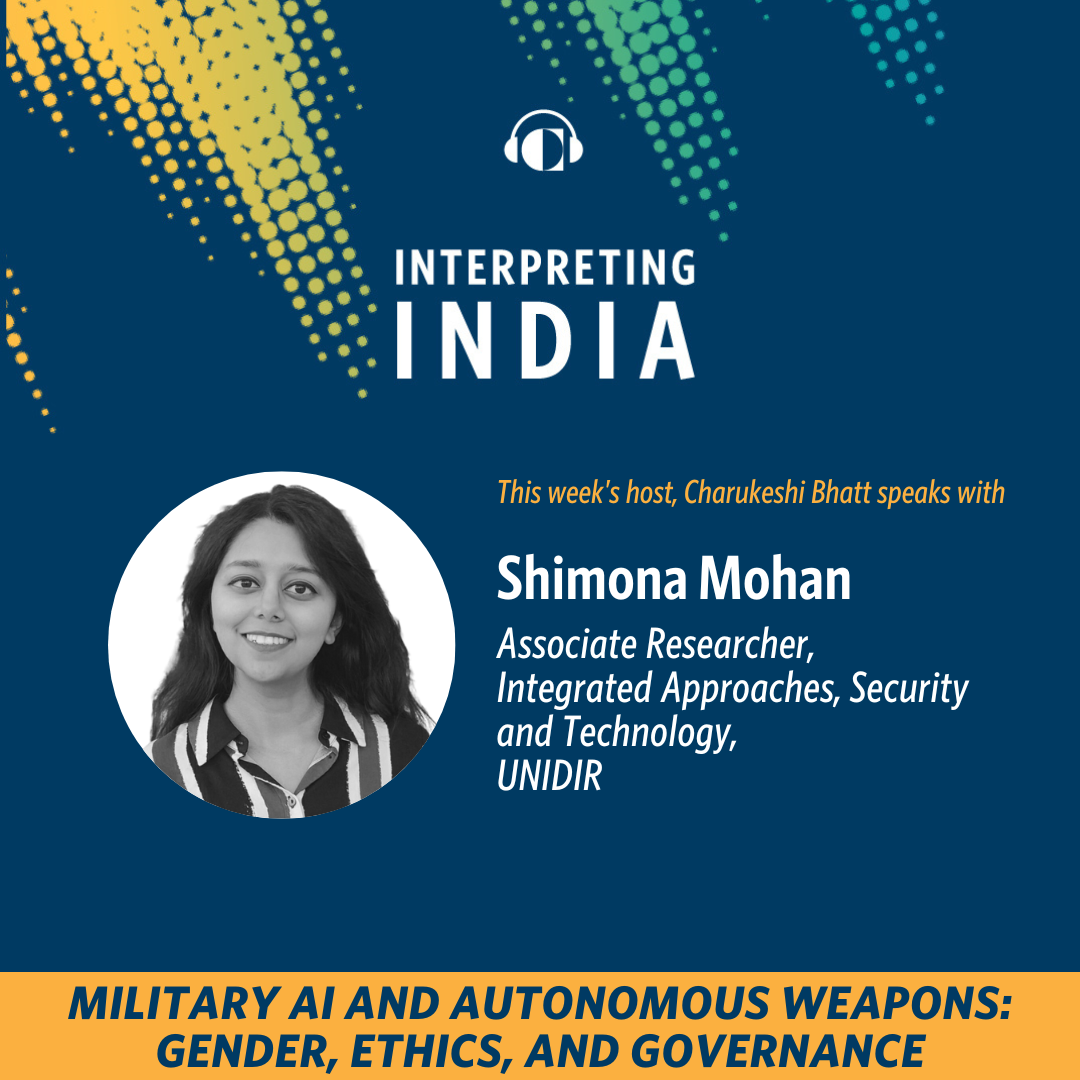
    Military AI and Autonomous Weapons: Gender, Ethics, and Governance

    In this episode of Interpreting India, host Charukeshi Bhatt is joined by Shimona Mohan, associate researcher at the United Nations Institute for Disarmament Research (UNIDIR). Together, they unpack the rapidly evolving landscape of artificial intelligence in the military domain, with a special focus on lethal autonomous weapons systems (LAWS).

      Charukeshi Bhatt, Shimona Mohan

Get more news and analysis from
Carnegie Endowment for International Peace
Carnegie global logo, stacked
1779 Massachusetts Avenue NWWashington, DC, 20036-2103Phone: 202 483 7600Fax: 202 483 1840
  • Research
  • Emissary
  • About
  • Experts
  • Donate
  • Programs
  • Events
  • Blogs
  • Podcasts
  • Contact
  • Annual Reports
  • Careers
  • Privacy
  • For Media
  • Government Resources
Get more news and analysis from
Carnegie Endowment for International Peace
© 2026 Carnegie Endowment for International Peace. All rights reserved.