• Research
  • Emissary
  • About
  • Experts
Carnegie Global logoCarnegie lettermark logo
Democracy
  • Donate
Podcast Episode
Carnegie India

Unbundling AI Openness: Beyond the Binary

In this episode of Interpreting India, host Shruti Mittal speaks with Chinmayi Sharma, associate professor of law at Fordham Law School. Together, they explore the evolving and often misunderstood debate on openness in artificial intelligence. Drawing from her forthcoming paper, Unbundling AI Openness, in the Wisconsin Law Review, Sharma explains why the traditional “open versus closed” framing oversimplifies the reality of modern AI development.

Link Copied
By Shruti Mittal and Chinmayi Sharma
Published on Oct 16, 2025

Subscribe on

SpotifyApple PodcastsAmazon MusicYoutube
Project hero Image

Project

Technology and Society

This program focuses on five sets of imperatives: data, strategic technologies, emerging technologies, digital public infrastructure, and strategic partnerships.

Learn More

In this episode of Interpreting India, host Shruti Mittal, research analyst in the Technology and Society Program at Carnegie India, speaks with Chinmayi Sharma, associate professor of law at Fordham Law School and nonresident fellow at the Stoss Center, the Center for Democracy and Technology, and the Atlantic Council. Together, they explore the evolving and often misunderstood debate on openness in artificial intelligence. Drawing from her forthcoming paper, Unbundling AI Openness, in the Wisconsin Law Review, Sharma explains why the traditional “open versus closed” framing oversimplifies the reality of modern AI development. She introduces the concept of “differential openness,” a framework that views AI systems as composed of multiple interdependent components—each existing along its own spectrum of openness and carrying distinct implications for innovation, safety, democratic accountability, and national security.

Episode Notes

The episode challenges the familiar “open versus closed” framing of AI systems. Sharma argues that openness is not inherently good or bad—it is an instrumental choice that should align with specific policy goals. She introduces a seven-part taxonomy of AI—compute, data, source code, model weights, system prompts, operational records and controls, and labor—to show how each component interacts differently with innovation, safety, and governance. Her central idea, differential openness, suggests that each component can exist along a spectrum rather than being entirely open or closed. For instance, a company might keep its training data private while making its system prompts partially accessible, allowing transparency without compromising competitive or national interests. Using the example of companion bots, Sharma highlights how tailored openness across components can enhance safety and oversight while protecting user privacy. She urges policymakers to adopt this nuanced approach, applying varying levels of openness based on context—whether in public services, healthcare, or defense. The episode concludes by emphasizing that understanding these layers is vital for shaping balanced AI governance that safeguards public interest while supporting innovation.

How can regulators determine optimal openness levels for different components of AI systems? Can greater transparency coexist with innovation and competitive advantage? What governance structures can ensure that openness strengthens democratic accountability without undermining safety or national security?

Episode Contributors

Chinmayi Sharma is an associate professor of law at Fordham Law School in New York. She is a nonresident fellow at the Stoss Center, the Center for Democracy and Technology, and the Atlantic Council. She serves on Microsoft’s Responsible AI Committee and the program committees for the ACM Symposium on Computer Science and Law and the ACM Conference on Fairness, Accountability, and Transparency.

Shruti Mittal is a research analyst at Carnegie India. Her current research interests include artificial intelligence, semiconductors, compute, and data governance. She is also interested in studying the potential socio-economic value that open development and diffusion of technologies can create in the Global South.

Suggested Readings 

Unbundling AI Openness by Parth Nobel, Alan Z. Rozenshtein, and Chinmayi Sharma. 

Tragedy of the Digital Commons by Chinmayi Sharma. 

Hosted by

Shruti Mittal
Research Analyst, Technology and Society Program
Shruti Mittal

Featuring

Chinmayi Sharma

Carnegie does not take institutional positions on public policy issues; the views represented herein are those of the author(s) and do not necessarily reflect the views of Carnegie, its staff, or its trustees.

More Work from Interpreting India

  • Podcast Episode
    Scarcity, Sovereignty, Strategy: Mapping the Political Geography of AI Compute

    In this episode of Interpreting India, Adarsh Ranjan is joined by Zoe Jay Hawkins, co-founder and deputy executive director of the Tech Policy Design Institute. They explore the evolving idea of AI sovereignty, the geopolitics of compute, and how countries are navigating access to the foundational infrastructure that powers artificial intelligence. Drawing from her research at the Oxford Internet Institute, Zoe unpacks the political geography of AI compute, the rising concentration of AI chips and data centers, and what this means for both developed and developing economies.

      Adarsh Ranjan, Zoe Jay Hawkins

  • Podcast Episode
    Cybersecurity in Outer Space: A Growing Concern

    In this episode of Interpreting India, host Tejas Bharadwaj is joined by P. J. Blount, an assistant professor of space law at Durham University. Together, they delve into the critical topic of cybersecurity in outer space, exploring the challenges and implications of protecting space-based assets amidst rising geopolitical tensions and technological advancements. Blount shares insights from his extensive research in international space law and cyberspace governance, highlighting the complexities of legal attribution and the evolving landscape of space security.

      Tejas Bharadwaj, P. J. Blount

  • Podcast Episode
    India’s Air Defense After Operation Sindoor: Lessons and the Road Ahead

    In this episode of Interpreting India, host Dinakar Peri is joined by Air Marshal Diptendu Choudhury, former Commandant of the National Defence College. Together, they unpack the evolution of India’s multilayered air defense network, tracing their journey from limited radar coverage in the 1960s to today’s multilayered, integrated network capable of projecting power into adversarial airspace.

      Dinakar Peri, Diptendu Choudhury

  • Podcast Episode
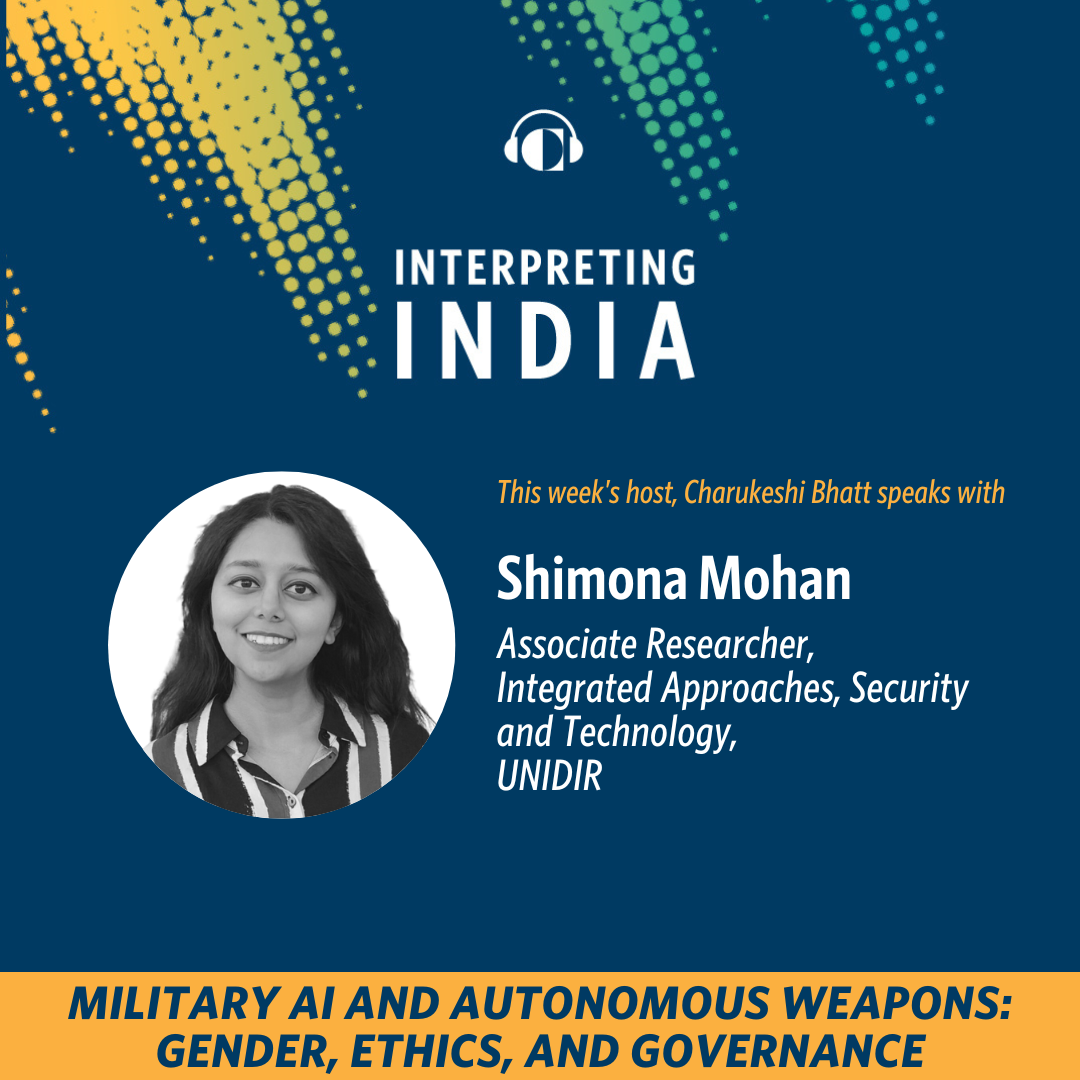
    Military AI and Autonomous Weapons: Gender, Ethics, and Governance

    In this episode of Interpreting India, host Charukeshi Bhatt is joined by Shimona Mohan, associate researcher at the United Nations Institute for Disarmament Research (UNIDIR). Together, they unpack the rapidly evolving landscape of artificial intelligence in the military domain, with a special focus on lethal autonomous weapons systems (LAWS).

      Charukeshi Bhatt, Shimona Mohan

  • Podcast Episode
    Beyond Superintelligence: A Realist's Guide to AI

    In this episode of Interpreting India, host Nidhi Singh is joined by Sayash Kapoor, co-author of AI Snake Oil, to unpack the myths, misconceptions, and exaggerated expectations around artificial intelligence. Kapoor challenges the dominant narratives of both utopian and dystopian AI futures and advocates instead for a more grounded perspective, viewing AI as a “normal technology,” akin to electricity or the internet, whose impact will unfold gradually over decades.

      Nidhi Singh, Sayash Kapoor

Get more news and analysis from
Carnegie Endowment for International Peace
Carnegie global logo, stacked
1779 Massachusetts Avenue NWWashington, DC, 20036-2103Phone: 202 483 7600Fax: 202 483 1840
  • Research
  • Emissary
  • About
  • Experts
  • Donate
  • Programs
  • Events
  • Blogs
  • Podcasts
  • Contact
  • Annual Reports
  • Careers
  • Privacy
  • For Media
  • Government Resources
Get more news and analysis from
Carnegie Endowment for International Peace
© 2026 Carnegie Endowment for International Peace. All rights reserved.