

Commentary
When democracies and autocracies are seen as interchangeable targets, the language of democracy becomes hollow, and the incentives for democratic governance erode.
Sarah Yerkes, Amr Hamzawy
{
  "authors": [
    "Nikolay Petrov"
  ],
  "type": "legacyinthemedia",
  "centerAffiliationAll": "",
  "centers": [
    "Carnegie Endowment for International Peace",
    "Carnegie Europe",
    "Carnegie Russia Eurasia Center"
  ],
  "collections": [],
  "englishNewsletterAll": "",
  "nonEnglishNewsletterAll": "",
  "primaryCenter": "Carnegie Russia Eurasia Center",
  "programAffiliation": "",
  "programs": [],
  "projects": [],
  "regions": [],
  "topics": []
}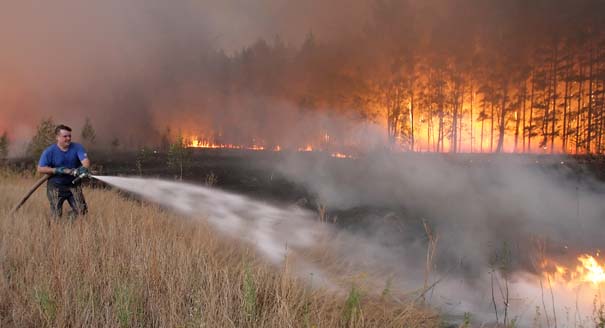
The inadequate response to Russia's forest fires illustrates Moscow’s inability to respond to large scale disasters and how Russia’s vertical power structure undermines the ability of local authorities to respond to crises.
Source: The Moscow Times

This summer’s wildfires differ from the ones in previous years in at least two ways. First, they are much more widespread and more visible — especially in Moscow. Second, the fires have burned for several weeks now with no end in sight.
Forest fires are usually classified as natural disasters. This is true in the sense that fires have occurred as the result of an abnormally intense heat wave. But nature is not solely to blame for the extensive damage the blazes have caused or for the loss of dozens of human lives.
Although most forest fires are natural disasters, the extent of damage is largely dependent on the government’s ability to fight fires and other calamities. This is where Russia has a big problem, despite the heroic efforts of many of its firefighters. The problem is that heroic self-sacrifice is the price individuals end up having to pay for the inactivity and mistakes of others, just as it was during Soviet times.
This summer’s fires clearly demonstrated that the country as a whole was woefully unprepared for such a calamity. When villages burn in a particular region, that is the responsibility of the governor — and those in Moscow who appointed him. But who is responsible for fires that rage throughout the country?
Media coverage by state-controlled television is designed to inspire confidence among viewers that Medvedev and Prime Minister Vladimir Putin are in control of the situation. The goal is to depict both leaders as being vigilant, particularly when they fire officials for their negligence.
There were, however, stylistic difference between the two: Putin addressed victims at disaster sites trying to show that the state is taking care of them, while Medvedev addressed high-ranking officials from his ornate office.
The problem, however, is that the usual form of government control with Putin and Medvedev calling all the shots does not work in a crisis. Firing officials and providing aid to fire victims might help cope with the immediate emergency, but these measures do not improve the underlying, systemic problem. The longer the fires continue, the more people will start asking themselves whether all of Medvedev’s “tough responses” were just an attempt to increase their popularity ratings.
What lessons can Russia learn from this summer’s fires and the government’s reactions to them? First, the country needs to improve techniques for putting out fires. Second, it needs to re-examine the Forest Code and whether the number of firefighters is sufficient for a country that has the world’s largest forest reserves. Third and most important, it needs to address the problem of the country’s overly centralized and highly ineffective government institutions.
Most of the public discussion has been devoted to the need for modernizing firefighting equipment and pre-treating peat bogs so that they do not burn in such huge numbers. Much less has been said about the fact that the state failed to fulfill its function as guardian and protector of the country’s woodlands with the new Forest Code that it pushed through three years ago despite the objections of many experts and representatives of heavily forested regions.
To make matters worse, regional governments have insufficient autonomy, responsibility and resources to respond adequately when fires break out without first getting approval from Moscow at every stage. Municipal administrations have even fewer opportunities to act independently, and this is particularly damaging because most of the fires are being fought at the local level. As long as the country’s management structure remains so top-heavy and “vertical,” there will be no improvement in the country’s ability to manage crises.
Putin understands that his vertical power structure is highly ineffective. If it were effective, he would not have ordered to have video cameras set up to monitor the government’s program to rebuild houses that were burned down by forest fires.
To thoroughly understand where the lapses were in fire prevention and firefighting and to learn lessons from the gross mistakes that were made, public hearings and an independent parliamentary investigation need to be carried out.
Unfortunately, Russia has shown so many times throughout its history that it is incapable of learning from its mistakes, and this summer’s fires will unlikely be an exception to the rule. If all goes according to Russian tradition, the government will attempt to sweep its negligence under the carpet, and it will forget as soon as possible about the latest fires — until the next one occurs.
Carnegie does not take institutional positions on public policy issues; the views represented herein are those of the author(s) and do not necessarily reflect the views of Carnegie, its staff, or its trustees.
When democracies and autocracies are seen as interchangeable targets, the language of democracy becomes hollow, and the incentives for democratic governance erode.

Sarah Yerkes, Amr Hamzawy

German manufacturing firms in Africa add value, jobs, and skills, while benefiting from demand and a diversification of trade and investment partners. It is in the interest of both African economies and Germany to deepen economic relations.
Hannah Grupp, Paul M. Lubeck
Unexpectedly, Trump’s America appears to have replaced Putin’s Russia’s as the world’s biggest disruptor.
Alexander Baunov
From Sudan to Ukraine, UAVs have upended warfighting tactics and become one of the most destructive weapons of conflict.
Jon Bateman, Steve Feldstein
And how they can respond.

Sophia Besch, Steve Feldstein, Stewart Patrick, …