

Commentary
Venezuelans deserve to participate in collective decisionmaking and determine their own futures.
Jennifer McCoy
{
  "authors": [
    "Olga Romanova"
  ],
  "type": "commentary",
  "centerAffiliationAll": "",
  "centers": [
    "Carnegie Endowment for International Peace",
    "Carnegie Russia Eurasia Center"
  ],
  "collections": [
    "Inside Russia"
  ],
  "englishNewsletterAll": "",
  "nonEnglishNewsletterAll": "",
  "primaryCenter": "Carnegie Russia Eurasia Center",
  "programAffiliation": "",
  "programs": [],
  "projects": [],
  "regions": [],
  "topics": [
    "Economy"
  ]
}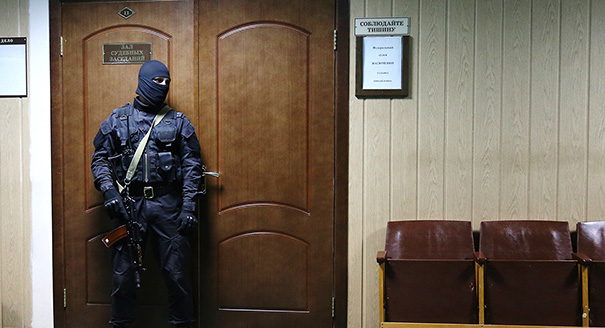
The Russian court system paralyzed itself a long time ago. It doesn’t need outside experience; it doesn’t need experienced lawyers. It needs efficient personnel who know how to follow orders. The average judge renders a not-guilty verdict once every seven years. Judges understand that such a verdict will always be repealed and the repeal of a sentence is a stain on a judge’s record that could lead to penalties and even dismissal.
Recently, I observed a curious trial that garnered little news coverage. An important bureaucrat, Dmitry Amunts, was being tried for embezzlement in front of a courtroom packed with young people in business suits, taking notes on the proceedings.
During the proceedings, the judge read a series of FSB reports naming bank representatives, bureaucrats, and even a judge, who all had some connection to the case. The note-takers appeared concentrated but apathetic. As the judge switched from reading a report on one person to another, one note-taker would stop and another would frantically start. These observers were representatives of those mentioned in the FSB reports. One of the final reports was on the defendant, Dmitry Amunts, who was sentenced to seven years and found responsible for 28 billion rubles in damages.
Despite his importance within the state, Amunts turned out to be possibly the most harmless of the characters included in the FSB investigation of the International Industrial Bank, Mezhprombank, and the banker Sergey Pugachev. Of all the people mentioned in the proceedings, Amunts was also the least involved with the bank. In fining Amunts, the court essentially lessened Pugachev’s share of the financial burden—his damages were found to be 75 billion rubles. Additionally, the court essentially pardoned several dozen high-ranking individuals, for whom law enforcement might have had serious questions.
Why did the court act this way? The answer can be found in the tangled web that is Russia’s judicial system, specifically its judges.
Galina Avanesova, a former Mezhprombank lawyer, is now a judge in the Moscow City Court and a member of the judicial board of civil affairs. For a time, she personally controlled all of Mezhprombank’s legal agreements and procedures. When the bank and Pugachev started having problems, she left the company to become a judge.
At Mezhprombank, Avanesova supervised the work of lawyer Anna Sergeevna Golovenko, daughter of Moscow City Court chairwoman Olga Yegorova. After her time at Mezhprombank, Golovenko worked for Sergey Pugachev as the head of Oboronprom Corporation’s legal department. After Pugachev left Russia, Anna Sergeevna started working (unsurprisingly) at Rosneft.
Bearing in mind Russia’s incestuous judicial system, could Amunts have escaped his seven-year sentence? Or could Alexei Ulyukayev, who was taken to court by Rosneft, have avoided his eight-year sentence? Their fate was predetermined long before they appeared in court. These cases are important lessons in our fight against corruption and for a fair judicial system in Russia.
The Russian court system paralyzed itself a long time ago. “If we track which terms we use when we discuss the problems of the courts and justice system, we’ll notice that recently the term ‘judicial system’ prevails over the term ‘judicial authority,’” explains Vadim Klyuvgant, the vice president of the Moscow Bar Association. “The main challenge is restoring the court’s authority.”
In 2013, the Institute for the Rule of Law at the European University in St. Petersburg conducted a study on the biographies of Russian judges, which shed light on the structure of the judiciary. Thirty percent of judges come from the court administration, 21 percent from the public prosecutor’s office, and 17 percent from investigative agencies. This explains why judges consider themselves an extension of law enforcement and aides to the police.
Recently, the Institute for the Rule of Law analyzed 2,369 evaluations of applications for judgeships during 2014–2015. Among first-time applicants, only 44 percent had held more than one prior position, and 56 percent had experience exclusively within the court administration. In 2015, 73 percent of new judges had once been employed in the administration. The head of the Moscow City Court, Olga Yegorova, announced that she supports this practice, which isn’t surprising as she began her own career as a clerk of the court.
According to Supreme Court records, the average judge renders a not-guilty verdict once every seven years. Judges understand that such a verdict will always be appealed and often repealed. The repeal of a sentence is a stain on a judge’s record that could lead to penalties and even dismissal.
Vadim Volkov, academic director of the Institute for the Rule of Law, says, “When we look at career tracks of Russian judges, a few truths emerge. We learn about the prestige of judgeships in comparison to other professions. We see the staffing politics of the judicial system. And we learn about the presidential administration’s relationship to the justice system.”
In short, we see that the system doesn’t need outside experience; it doesn’t need experienced lawyers. It needs efficient personnel who know how to follow orders.
The heartfelt analysis of the anonymous judge who runs the Telegram channel, “Just the Judge” (as a longtime reader, I am sure the writer really is a judge), confirms these conclusions:
“Judges are the same rabble that fill police stations, investigating small-time corruption, drug addicts, thieves, murderers, and robbers. In general, nobody has a need for judges. Not the chairman of the Supreme Court or anyone else. … I think a district police officer has more individuality than [judges] do.”
Carnegie does not take institutional positions on public policy issues; the views represented herein are those of the author(s) and do not necessarily reflect the views of Carnegie, its staff, or its trustees.

Venezuelans deserve to participate in collective decisionmaking and determine their own futures.

Jennifer McCoy

German manufacturing firms in Africa add value, jobs, and skills, while benefiting from demand and a diversification of trade and investment partners. It is in the interest of both African economies and Germany to deepen economic relations.
Hannah Grupp, Paul M. Lubeck

As European leadership prepares for the sixteenth EU-India Summit, both sides must reckon with trade-offs in order to secure a mutually beneficial Free Trade Agreement.

Dinakar Peri

Global development needs imagination to update the purposes, structures, and systems of outmoded institutions to make them fit for today’s world.
David McNair

African countries need to adapt to a new era of U.S. trade relations.

Kholofelo Kugler, Georgia Schaefer-Brown