Jordan’s Stubborn Insistence on “Business As Usual”
The decision to hold parliamentary elections reflects Amman’s insistence on applying a dated paradigm to manage Jordan’s political and socioeconomic challenges.
Link Copied
By Abdul-Wahab Kayyali
Published on Nov 13, 2020
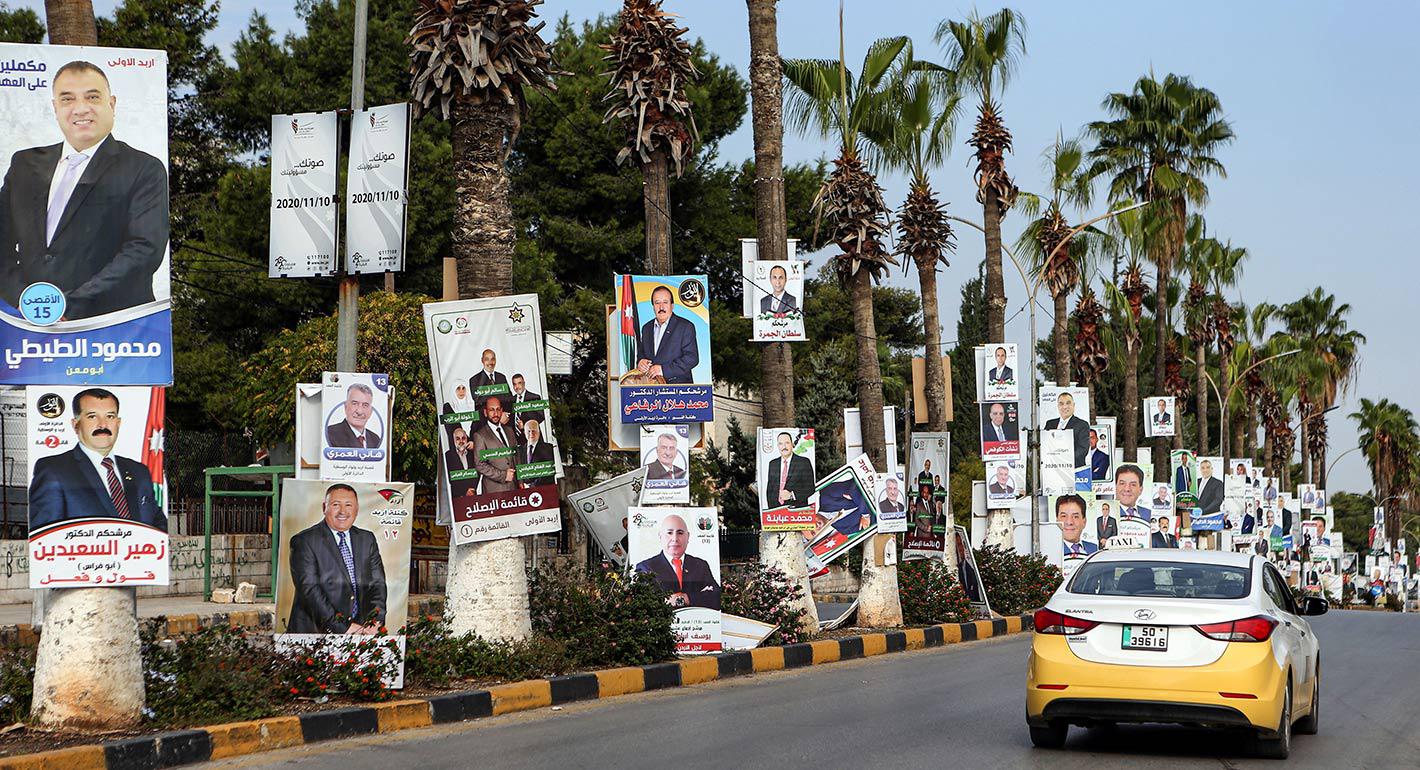
Jordan, like much of the rest of the world, has struggled to manage the challenges and difficulties 2020 delivered. The country’s reeling economy was dealt a crippling blow by the closures and restrictions related to the spread of the COVID-19 pandemic. The tradeoff between economic prosperity and public health seemed to have initially been worthwhile, as Jordan’s performance in combatting COVID-19 was stellar from March until early September. However, the country’s stamina was expended during those six months, and soon enough public efforts to combat the disease waned. October and November saw Jordan’s case count and daily death toll from COVID-19 shoot up, amidst one government’s literal resignation and the other’s figurative one. It is against this backdrop that less than thirty percent of Jordanians headed to the polls to elect members of the nineteenth parliament, a historically low participation rate that matched the predicted voter turnout.
For Jordanians and international observers alike, the government’s failure to battle the second wave of COVID-19 was swift—but in hindsight should not have been surprising. The previous Jordanian minister of health declared in June that COVID-19 “shriveled up and died,” thus reflecting the government’s shortcomings in communicating and managing expectations all at once. Moreover, the Jordanian government’s efforts were not squarely placed on combatting the disease. Like most authoritarian states, Jordan declared a state of emergency to pass defense laws that, while ostensibly aimed at addressing the COVID-19 challenge, significantly curtailed expression and dissent. With its political and social capacity overstretched, and in a hostile local and global political and public health climate, why did Amman insist on holding general elections for its lower house of parliament that were bound to entice less than a third of the electorate to vote?
Jordan’s Recent Institutional Malaise
The lower house of the Jordanian parliament has historically been a theater of fervent political activity. When the country resumed normal political life in the late 1980s and early 1990s, parliament was one of the main arenas of oppositional political activity. Since 1993, the state has sought to curtail that by using electoral laws designed to make parliament home to the “services representative”—the type of candidate who campaigns on delivering government services to their narrow constituency—rather than a “political representative” representing a broader political constituency on the national (rather than the local) level.
Since the Arab Spring wave of protests hit Jordan in 2011, new electoral laws were introduced that, in principle, encourage party lists to campaign and obtain a select number of seats. Yet this has not altered the makeup of parliament significantly, and it remains to be seen as an arena for Jordanians to access state patronage rather than a home of legislators with the necessary political and intellectual acumen to legislate on the national level. As a result, meaningful political activity has been waged in other arenas—in the public sphere, the press, and the street.
This institutional malaise served as a background for the massive wave of protests that hit Amman in 2018 and brought down the government of Hani Al-Mulqi. The protests had erupted in response to an unpopular income tax law that Al-Mulqi was adamant on passing. The primary instigators of this wave of protest were Amman’s middle class, mobilizing through professional syndicates—which have a historical role of oppositional activity and ideological contestation. Soon enough, the professional syndicates’ council became the representative entity embodying the popular protests demanding the resignation of the Al-Mulqi government. Moreover, there were no illusions that the Al-Mulqi government could be brought down in parliament. Jordanians knew they had to take to the streets.
The protests brought down the Al-Mulqi government and King Abdullah assigned an exceptional figure to form the next cabinet. Omar Razzaz was an internationally renowned technocrat and Jordanian public figure with a large personal and familial cache of integrity. Razzaz immediately began talk of a “new social contract,” promising to reform the quality with which Jordanian decisions were made. Razzaz went so far as to go on record talking about the possibility of reforming the electoral law and having a government that derives from a parliamentary majority within two years, after the next parliamentary elections.
Razzaz was an eloquent speaker, a capable yet cautious communicator who constantly acknowledged his limitations. Ultimately though, his government failed to live up to expectations, and under-delivered on a majority of its promises—including a reformed electoral law and a government deriving from a parliamentary majority. Whether or not this was due to infighting within the “decisionmakers kitchen,” as Jordanian public commentators call it, is unclear. Regardless of the reasons, Razzaz’s disappointing performance—specifically in handling the dispute with the Jordanian Teachers’ Syndicate—may have dealt a critical blow to Jordanian confidence in state institutions, which parliamentary elections will not salvage.
“Business As Usual” in Unusual Times
This is uncharted territory for the Jordanian polity, and Jordanians’ declining confidence in state institutions is reflected in the survey data. According to Arab Barometer Wave 5 data, Jordanian trust in government in late 2018 reached its lowest level on record at 38 percent (See graphs below). Similarly, Jordanian trust in parliament in 2018 reached a staggering 14 percent. With 6 out of 7 Jordanians lacking trust in the institution of parliament, the rush to replace it in a global pandemic seems misguided at best. If the Jordanian state views parliamentary elections as a “safety valve,” or a public concession in its “sticks and carrots” approach, the data suggests that Jordanians see otherwise. Parliamentary elections are no longer viewed as a carrot. As such, insisting on holding them while Jordan is pummeled by COVID-19 is a radically reactionary decision.
The survey data also suggests that Jordanians are increasingly giving up on their country. According to Arab Barometer Wave 5 data, Jordan leads the Arab world in the proportion of citizens considering immigration at 45 percent (second only to Sudan at 50 percent). The trend data suggests that this proportion has more than doubled since the Arab Barometer held its Fourth Wave survey (see below graph). Of those 45 percent, an Arab world high of 83 percent wish to migrate for economic reasons—and this predates COVID-19 and 2020 turbulence. Thus, the Jordanian state cannot possibly create enough government (or private sector) jobs to pacify the restless population. Jordanians have little faith that the government will create jobs in the economy as a whole, as only 1 in 7 Jordanians, or 14 percent, are satisfied with the government’s job creation (see below graph). Parliamentary elections are hardly a distraction from this bleak reality, as these figures should explain the low participation rates.
In sum, Jordan’s paradigm of managing dissent through limited institutional openings is outdated. A parliamentary election, albeit with minimal integrity and political party buy in, will not change that. Jordan can only restore the credibility of its legislative and executive institutions through a reform process that gives way to a truly representative electoral law and public participation in the selection of the executive branch. Anything less will be cosmetic, and may well be too little, too late.
Abdul-Wahab Kayyali is a research associate at the Arab Barometer. His research interests are in political parties, social movements and general political agency in the Arab World. Follow him on Twitter @awkayyali.
Carnegie does not take institutional positions on public policy issues; the views represented herein are those of the author(s) and do not necessarily reflect the views of Carnegie, its staff, or its trustees.
Iraq’s foreign policy is being shaped by its own internal battles—fractured elites, competing militias, and a state struggling to speak with one voice. The article asks: How do these divisions affect Iraq’s ability to balance between the U.S. and Iran? Can Baghdad use its “good neighbor” approach to reduce regional tensions? And what will it take for Iraq to turn regional investments into real stability at home? It explores potential solutions, including strengthening state institutions, curbing rogue militias, improving governance, and using regional partnerships to address core economic and security weaknesses so Iraq can finally build a unified and sustainable foreign policy.
How can Saudi Arabia turn its booming e-commerce sector into a real engine of economic empowerment for women amid persistent gaps in capital access, digital training, and workplace inclusion? This piece explores the policy fixes, from data-center integration to gender-responsive regulation, that could unlock women’s full potential in the kingdom’s digital economy.
Hate speech has spread across Sudan and become a key factor in worsening the war between the army and the Rapid Support Forces. The article provides expert analysis and historical background to show how hateful rhetoric has fueled violence, justified atrocities, and weakened national unity, while also suggesting ways to counter it through justice, education, and promoting a culture of peace.
The August 2025 government decision to restrict weapons to the Lebanese state, starting with Palestinian arms in the camps, marked a major test of Lebanon’s ability to turn a long-standing slogan into practical policy. Yet the experiment quickly exposed political hesitation, social gaps, and factional divisions, raising the question of whether it can become a model for addressing more sensitive files such as Hezbollah’s weapons.
Kuwait’s government has repeatedly launched ambitious reforms under Kuwait Vision 2035, yet bureaucratic inefficiency, siloed institutions, and weak feedback mechanisms continue to stall progress. Adopting government analytics—real-time monitoring and evidence-based decision-making—can transform reform from repetitive announcements into measurable outcomes.