

In The Media
Michele Dunne, Robert Kagan
{
  "authors": [
    "Robert Kagan"
  ],
  "type": "legacyinthemedia",
  "centerAffiliationAll": "dc",
  "centers": [
    "Carnegie Endowment for International Peace"
  ],
  "collections": [],
  "englishNewsletterAll": "menaTransitions",
  "nonEnglishNewsletterAll": "",
  "primaryCenter": "Carnegie Endowment for International Peace",
  "programAffiliation": "MEP",
  "programs": [
    "Middle East"
  ],
  "projects": [],
  "regions": [
    "North America",
    "United States",
    "Middle East",
    "Iran"
  ],
  "topics": [
    "Political Reform",
    "Democracy",
    "Foreign Policy",
    "Nuclear Policy",
    "Nuclear Energy"
  ]
}
Source: Getty
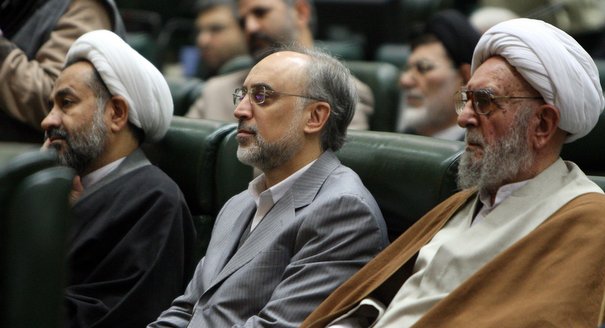
Proposed economic sanctions on Iran should focus on undermining the Islamic regime rather than stopping its nuclear program.
Source: The Washington Post

You have to give the clerics credit for keeping this grave matter off Western agendas. The fraudulent presidential election in June and the subsequent mass demonstrations produced the biggest regime crisis in years. President Mahmoud Ahmadinejad and Ayatollah Ali Khamenei must have been panicked at the prospect of losing control -- and with reason. Western democrats, not knowing what it is like to rule by fear and force, generally underestimate what a scary and uncertain business it can be, how a single wrong move, usually a too-timid response, can spell catastrophe. Even the masterful Deng Xiaoping, faced with much smaller opposition demonstrations in 1989, believed his Communist oligarchy could lose power absent a decisive show of force followed by a thorough purge of unreliable figures in the regime. In Iran, the regime's violent crackdown, its mass arrests of opposition figures -- including the children of high-ranking clerics -- and all the farcical show trials have been signs of weakness and anxiety, not confidence.
In such situations, an autocratic regime's biggest fear, well-grounded in history, is that domestic opponents may gain the support of powerful foreign patrons. The toppling of dictators -- Ferdinand Marcos in the Philippines, Anastasio Somoza in Nicaragua, the Polish Communists -- has frequently been aided, sometimes decisively, by foreign involvement, through support to opposition forces or sanctions against the government. One of the main fears of Chinese leaders in 1989 was that students carrying replicas of the Statue of Liberty might gather support from abroad. It is obvious from the show trials in Iran, where the accused have "admitted" being part of various American plots to overthrow the regime in a "velvet revolution," that this is the clerics' principal fixation.
The regime's overriding goal since the election, therefore, has been to buy time and try to reestablish and consolidate control without any foreign interference in its internal affairs. In this Tehran has succeeded admirably.
But it has also had help. The Obama administration has, perhaps unwittingly, been a most cooperative partner. It has refused to make the question of regime survival part of its strategy. Indeed, it doesn't even treat Iran as if it were in the throes of a political crisis. President Obama seems to regard the ongoing turmoil as a distraction from the main business of stopping Iran's nuclear program. And this is exactly what the rulers in Tehran want him to do: focus on the nukes and ignore the regime's instability.
It would be better if the administration focused on the regime's instability and ignored the nukes.
This ought to be the goal of the "crippling" sanctions the Obama administration has threatened. Sanctions will not persuade the present Iranian government to give up its nuclear weapons program. Ahmadinejad and Khamenei see the nuclear program and their own survival as intimately linked. But the right kinds of sanctions could help the Iranian opposition topple these still-vulnerable rulers.
Critics of this idea still draw on pre-June 12 logic. A year ago, in the absence of any serious opposition to the clerics, it did seem hopeless to imagine that sanctions could have any effect on the clerics' rule. One could speculate, as some administration officials and French Foreign Minister Bernard Kouchner still do, that sanctions would only strengthen popular support for the regime.
This analysis, however, no longer fits in Iran. The government's behavior during and after the election has opened an irreparable breach between the regime and large elements of Iranian society, and even within the clerical ranks. The government may succeed in clamping down on the opposition and driving it underground. But the notion that the Iranian opposition will suddenly rally around Ahmadinejad and Khamenei if the West imposes sanctions is absurd. The opposition leadership is engaged in a struggle to the death with the regime. When sanctions begin to cause hardships, the opposition will press its case that the regime is leading Iran to ruin.
That is the case for moving ahead with crippling sanctions as soon as possible and not waiting months for Iran's leaders to drag out talks. Will crippling sanctions topple the regime? Not necessarily. But the odds that the regime might fall given the right mix of internal opposition and foreign pressure are higher than the odds that it will give up its nuclear program voluntarily -- probably much higher. The Obama administration prides itself on pragmatic realism. It ought to pursue the policy that has the higher chance of success.
Americans have a fundamental strategic interest in seeing a change of leadership in Iran. There is good reason to believe that a democratic Iran might forgo a nuclear weapon -- just as a democratizing Russia abandoned long-standing Soviet foreign and defense strategies -- or at least be more amenable to serious negotiations. Even if it is not, we have much less to fear from a nuclear weapon in the hands of a democratic Iran integrated into the liberal democratic world than from a weapon in the hands of Ahmadinejad.
Former Senior Associate
Kagan, author of the recent book, The Return of History and the End of Dreams (Knopf 2008), writes a monthly column on world affairs for the Washington Post and is a contributing editor at both the Weekly Standard and the New Republic.
Recent Work

Michele Dunne, Robert Kagan
Robert Kagan, Michele Dunne
Carnegie does not take institutional positions on public policy issues; the views represented herein are those of the author(s) and do not necessarily reflect the views of Carnegie, its staff, or its trustees.

Are Germany’s economic, industrial, and political struggles becoming a liability for the EU’s ability to rise to the geopolitical moment?

Rym Momtaz, ed.

European Commission President Ursula von der Leyen is about to give her annual address on the state of the EU. Here’s what she won’t—but should—say.
Rym Momtaz

Radical-right parties are expected to do well in upcoming elections in four of the EU's biggest member states. If successful, they could prevent the union from addressing key challenges ahead.

Stefan Lehne

The aftermath of the Ceuta crisis shows Europe has drawn the wrong lessons. Rather than doubling down on failed migration policies, the EU needs to address the underlying roots of such episodes.

Richard Youngs

An overwhelming victory by a far-right-wing party in a small state in eastern Germany will have major repercussions for Chancellor Friedrich Merz’s coalition.

Judy Dempsey