

Commentary
Dmitri Trenin
{
  "authors": [
    "Dmitri Trenin"
  ],
  "type": "legacyinthemedia",
  "centerAffiliationAll": "",
  "centers": [
    "Carnegie Endowment for International Peace",
    "Carnegie Russia Eurasia Center"
  ],
  "collections": [],
  "englishNewsletterAll": "",
  "nonEnglishNewsletterAll": "",
  "primaryCenter": "Carnegie Russia Eurasia Center",
  "programAffiliation": "",
  "programs": [],
  "projects": [],
  "regions": [
    "North America",
    "United States",
    "Middle East",
    "Iran",
    "South Asia",
    "Afghanistan",
    "East Asia",
    "China",
    "Central Asia",
    "Caucasus",
    "Russia",
    "Georgia",
    "Eastern Europe",
    "Ukraine",
    "Western Europe"
  ],
  "topics": [
    "Political Reform",
    "Security",
    "Foreign Policy"
  ]
}
Source: Getty
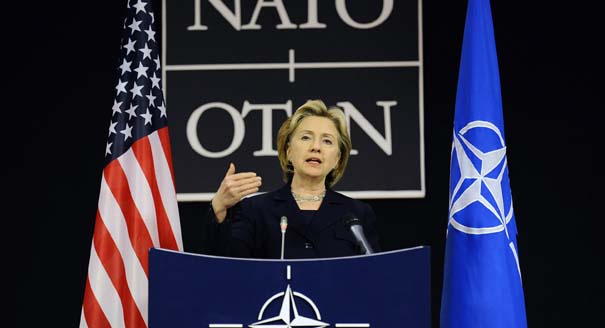
The West and Russia need to embark on a long and potentially rocky path toward creating a security community in Europe that would include both NATO members and nonmembers.
Source: Current History

Since the end of the Western-Soviet confrontation, NATO has not withered away—it has evolved, alongside the European Union, into a premier pillar of European security. The transatlantic link has withstood both the loss of a common adversary and divisions among the allies. The alliance has demonstrated, in the Balkans, a resolve for military action on its periphery and, with its involvement in Afghanistan, a capability to project power into the heart of another continent. Meanwhile, NATO membership has expanded to almost double its level at the end of the cold war.
Twenty years after the fall of the Berlin Wall, however, one major piece of unfinished post–cold war business remains: fitting the former Soviet lands into a pan-European security framework. The heart of the issue is Russia’s absence from the European and Euro-Atlantic security structures. Moscow’s one-time favorite among intergovernmental bodies, the Organization for Security and Cooperation in Europe (OSCE), has ceased to be an ongoing dialogue platform and has failed to live up to its title. This institutional deficiency affects not only Russia, but also its neighbors, such as Ukraine and Georgia. The brief war in the Caucasus in August 2008 and the tensions it produced in Crimea—which continue to linger and may produce another crisis in the future—point to the reality and potential severity of the problem.
There is no simple way to resolve this conundrum. Russia’s membership in the NATO alliance, sought by Moscow in the 1990s and again explored in the early part of this decade, is not a realistic proposition for the foreseeable future, if ever. Above all, it is not realistic at this stage to expect Russia to join a US-led alliance such as NATO is today, and it is even less realistic to anticipate some sort of NATO coleadership by the two nuclear superpowers. Even if one of these highly unlikely conditions were met, Russia’s hypothetical accession would needlessly exacerbate Russia’s own, and the West’s, relations with China, much to the detriment of global stability and security.
Thus, since no shortcut is possible, the West and Russia need to embark on a long, tortuous, and potentially rocky path toward creating a security community in Europe that would include both NATO members and nonmembers. Russian President Dmitri Medvedev’s idea of revamping European security, which he first announced before the Georgia war but has amplified since, is useful not so much because he calls for a new, legally binding treaty on security, but because it represents a de facto invitation to an ongoing dialogue. NATO needs to see the importance and urgency of the situation, seize the opportunity, and generate forward-looking ideas of its own.
Former Director, Carnegie Moscow Center
Trenin was director of the Carnegie Moscow Center from 2008 to early 2022.
Recent Work
Dmitri Trenin
Dmitri Trenin
Carnegie does not take institutional positions on public policy issues; the views represented herein are those of the author(s) and do not necessarily reflect the views of Carnegie, its staff, or its trustees.

With its public finances in shambles, the far right polling at 35 percent ahead of the 2027 presidential election, and a growing protest movement, is France’s crisis a threat to the EU’s geopolitical awakening?

Rym Momtaz, ed.

Ahead of a tough winter for Ukraine, Donald Trump’s swing back toward Russia bodes ill. But instead of panicking, Kyiv’s European allies are focusing on action.
Rym Momtaz

Funding Ukraine remains a priority for European leaders. As Russia’s war of aggression heads into another winter, two feasible options to mobilize support for Kyiv should be fast-tracked.


Vladyslav Rashkovan, Gregory P. Wilson

While the EU and European governments are embracing the much-lauded middle-power moment, this entails three difficult conundrums.

Richard Youngs

Europe is facing rising populism internally as well as external pressures from Russia, China, Turkey, and the United States.

Dimitar Bechev