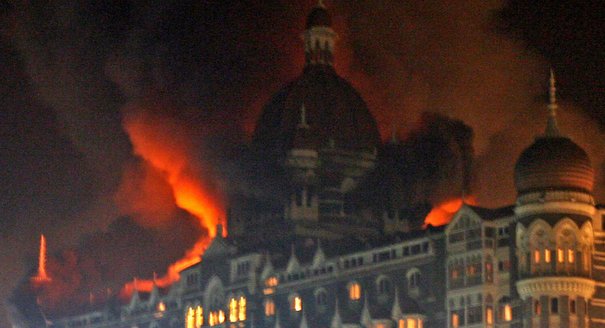
The world’s failure to respond appropriately to Mumbai has given a default victory to the terrorists who attacked the city. Terrorism is primarily a political struggle and has to be fought as such.
A Year After Mumbai: The Global Battle of IdeasIn the wake of the 2008 terrorist attack on Mumbai, many observers predicted that the outrage would prove a turning point in the global struggle against terrorism. A year on, however, it is far from clear if the attacks, and the lessons they hold out, have in fact changed the world’s perception of the problem of terrorism — and the responses it necessitates.
Few things today are, superficially at least, as consensual as the need to fight terrorism. International public opinion was indeed shocked by the Mumbai attacks; commentators articulated their outrage; leaders expressed their condemnation. If there was any such thing as a global impact of the Mumbai attacks, its nature was at the very least ambiguous.
True, messages of sympathy did abound. At the practical level, many countries offered their services as soon as the Indian government started articulating its technical needs for counter-terrorism. Proposals for equipment and training of special forces did multiply. But it is not clear that India has received the kind of effective solidarity that the genuine sense of a common threat should have generated.
If there is one single thing that has characterised the global response to the Mumbai attack, it is confusion. On the one side, all major actors have understood the nature of the problem. Many comprehend the responsibility, at the very least indirect, that India’s neighbour Pakistan bears for the brutal terrorist attack against India. Moreover, all major countries did pressure Pakistan to crack down on militant groups operating from its soil.
At the same time, however, the world’s anti-terrorism objectives clashed with the larger anti-insurgency objectives of the war in Afghanistan. Some of the major players in the international community started asking India to exercise restraint in its reaction. India was called on to make concessions, notably in the form of accepting an early resumption of dialogue with Pakistan.
The idea was that this dialogue would help persuade the Pakistani security establishment to commit its means in the fight against insurgents in the Federally Administered Tribal Areas and more generally along the Afghan border. This does not mean, of course, that the world absolved Pakistan of any responsibility to act in the wake of Mumbai. However, by acting as they did, key world players implicitly accepted the illusion that the Pakistani posture was essentially reactive. The underlying suggestion was that should India prove willing to address Pakistan’s concerns, Islamabad would show greater goodwill in its commitment to anti-terrorism.
That the Mumbai attacks took place in the context of the “war on terror”— language the new administration in the United States has partly toned down but not abandoned — did not help. After seven years of waging a largely unsuccessful anti-Taliban war in Afghanistan and an uncertain anti-terrorism struggle, the temptation to implicitly blame India’s intransigence, or at least share the responsibility for the worsening situation on both South Asian neighbours, was considerable. Many in the international community jumped on the bandwagon.
In such a context, and as its own security situation deteriorated, it became relatively easy for Pakistan to convince the international community that it was facing a threat from its periphery. It argued that this threat was the consequence of the war in Afghanistan and its participation in the international effort against terrorism. It was not necessary to approve of Islamabad’s policy in order to accept this idea.
The Indian government shares part of the responsibility for the idea gaining credence. If it fought Pakistan’s argument diplomatically, it left the international public space wide open for Islamabad’s propaganda. It made little difference, given the growing currency this discourse enjoyed, that the organisations Pakistan was combating at the time — the Tehreek-i-Taliban Pakistan and the Tehreek-e-Nifaz-e-Shariat-e-Mohammadi — were not actively fighting in Afghanistan. In fact, they had been created of the Pakistani state. Their mere existence demonstrated Pakistan’s commitment against terrorism. The generic term ‘Taliban’ made them radicals of the worse kind which needed to be fought and eliminated if possible. New Delhi and Islamabad were thus deemed to be facing the same enemy and the weaker of the two had to be helped and encouraged. Pakistan was still responsible for its own “mistakes,” but was no longer the sole one to be blamed. India and the rest of the international community, it was argued, shared a collective responsibility in the increase of violent extremism.
In the process, the mistakes of the early days of the anti-Taliban offensive in 2001-2002 were repeated and, in a way, aggravated. When the U.S. administration had de facto accepted a distinction between regional and internationalist groups, it lessened the pressure on Pakistan to crack down on them, provided it showed some results in the fight against the al-Qaeda. The nature of the main operator of the Mumbai attacks, the Lashkar-e-Taiba was, and is, still misunderstood. Although the organisation has had a global agenda from the time of its creation, it is still perceived by many western observers as a regional organisation active mainly in Jammu and Kashmir.
Despite this, the distinction between regional and internationalist groups was considered operational. More important though, it meant that the growing role of the LeT (and other parent organisations) on the Afghan border was either unnoticed or considered marginal; at least of only secondary importance in FATA itself.
Post-Mumbai, then, the Pakistani security establishment and its terrorist proxies won the battle of ideas, although by default. Everybody protested and blamed the attackers. But neither India nor its actual or potential partners put up the kind of intellectual fight that was necessary to counter the pernicious arguments that turned the victim into a part-culprit. Ironically, though, Pakistan — which ultimately emerged from the process as a victim —fell victim to its own propaganda.
For one, the state’s embrace of the argument it made on Mumbai left the population in a state of total psychological denial, unable to understand the motivations of an attack which made no sense to the vast majority of citizens. The trauma of the attack was evaded through all sorts of conspiracy theories which represented Pakistan as the victim of a Hindu-Zionist plot backed by the U.S. Confused, too, were many Pakistani intellectuals who, deprived of any prospect of a real political alternative, preferred to choose radical nationalism as their last resort. They encouraged, if not fed, the popular paranoia which they often shared.
Infinitely more worrying, however, was the confusion of a part of the Pakistani security establishment. It still did not realise that it was about to lose control of the Frankenstein it had created. In believing that it could reassert its dominance over the terrorist groups which were ultimately to turn their weapons against their sponsors, this part of the security establishment demonstrated that blindness had been added to arrogance.
There is a real possibility, over time, of an increased polarisation of populations along religious lines, which could erode the social and national cohesion as well as the trust between nations and their government. This outcome will be hastened if, by action or perhaps more importantly by omission, impunity and even legitimacy are conferred on such acts.
Terrorism is primarily a political struggle, and has to be fought as such. Refusing to do so will make political violence an acceptable means of solving political issues and lead to the erosion of the solidarity and determination of the international community. Sadly, the world’s failure to respond appropriately to Mumbai has given a victory, if by default, to the terrorists who attacked the city.
Former Nonresident Senior Fellow, South Asia Program
Frédéric Grare was a nonresident senior fellow at the Carnegie Endowment for International Peace, where his research focuses on Indo-Pacific dynamics, the search for a security architecture, and South Asia Security issues.
Carnegie does not take institutional positions on public policy issues; the views represented herein are those of the author(s) and do not necessarily reflect the views of Carnegie, its staff, or its trustees.
Russia is testing the waters of NATO’s mutual defense clause. What do strikes in Romanian territorial waters mean for the alliance’s posture toward Moscow?
With its public finances in shambles, the far right polling at 35 percent ahead of the 2027 presidential election, and a growing protest movement, is France’s crisis a threat to the EU’s geopolitical awakening?
Ahead of a tough winter for Ukraine, Donald Trump’s swing back toward Russia bodes ill. But instead of panicking, Kyiv’s European allies are focusing on action.
Funding Ukraine remains a priority for European leaders. As Russia’s war of aggression heads into another winter, two feasible options to mobilize support for Kyiv should be fast-tracked.