

Commentary
Fabrice Pothier
{
  "authors": [
    "Fabrice Pothier"
  ],
  "type": "legacyinthemedia",
  "centerAffiliationAll": "dc",
  "centers": [
    "Carnegie Endowment for International Peace",
    "Carnegie Europe"
  ],
  "collections": [],
  "englishNewsletterAll": "ctw",
  "nonEnglishNewsletterAll": "",
  "primaryCenter": "Carnegie Europe",
  "programAffiliation": "SAP",
  "programs": [
    "South Asia"
  ],
  "projects": [],
  "regions": [
    "Asia",
    "Europe",
    "South Asia",
    "Afghanistan"
  ],
  "topics": [
    "Foreign Policy"
  ]
}
Source: Getty
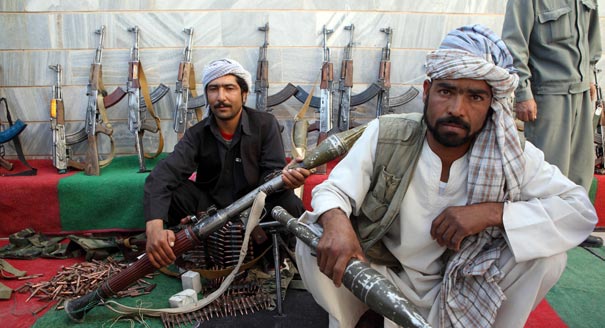
At the international conference on Afghanistan in London, the international community should address the only issue that really matters for peace in Afghanistan: how to make the Taliban part of a lasting solution.
Source: Foreign Policy

A new reconciliation program to be presented by Afghan President Hamid Karzai in London and supported by U.S. funding is an encouraging first step, but not a long-term solution. It might temporarily take small groups of local fighters away from the battlefield, but it does not lay the foundation for long-term peace. Recent statements by both the U.S. defense secretary and Gen. Stanley McChrystal have failed to address the fundamental ambiguity that has long undermined the Afghanistan mission: Is reconciliation meant for immediate, short-term stability gains or as part of longer-term political efforts to build peace? If it is the former, this program will likely contribute to advancing local corruption and little else. However, by drawing a distinction between the war against the Taliban and the one against al Qaeda, and by setting a timeline for the progressive drawdown of U.S. combat troops, President Barack Obama has created a context in which a reconciliation program could become part of a broader peace process. For this to happen, the process must be underpinned by a real political strategy, which is why timing and shape matter greatly.
The credible return of the United Nations is also crucial, after the embarrassment of the Afghan presidential election and years of being relegated to the impossible role of aid coordinator. Despite its flaws, the United Nations remains the only organization legitimate enough in the eyes of many to broker a final political settlement. This does not exclude the United States from playing a key role, especially in an initial phase (probably already begun) of secret contacts, but essentially the United Nations is the only one able to close the deal. The Afghan president should lead a compact for peace under U.N. auspices with the support of key regional stakeholders like Saudi Arabia and Turkey. Under a reinvigorated and more political Security Council mandate, the United Nations could appoint an international negotiator, a Lakhdar Brahimi-type figure, who has the respect of the permanent members, especially the United States.
Other regional stakeholders will have to be brought onboard. Despite Pakistan's strategic ambiguity, its military elites will recognize that it is in their interest for the Taliban to join the mainstream Afghan political process because that provides guarantee for Pakistan's long-lasting influence in Afghanistan. Iran, Russia, and India, on the other hand, have been long opposed to the Taliban's return. To convince them, the United States will need to step up and offer some serious security guarantees. This is especially true for India, which will see a settlement with the Taliban as a victory for Pakistan; to sweeten the deal, the United States will need to lean hard on Pakistan to rein in terrorist groups like Lashkar-e-Taiba, which masterminded the November 2008 attacks on Mumbai. But these countries' cooperation is key: As a permanent member of the U.N. Security Council, Russia is an important partner, while India and Iran can have a real impact on local politics in Afghanistan.
Who these stakeholders will negotiate with is an open question, and it's not clear the Taliban themselves know the answer. The so-called Quetta Shura, headed by Mullah Omar and Gulbuddin Hekmatyar, leader of the insurgency in eastern Afghanistan, will certainly be two major stakeholders in the talks.
The talks' timing is probably the most important and complex factor. The London conference could be an opportunity to make the first official appeal for the insurgents to lay down their arms in exchange for recognition as a legitimate opposition group and the removal of their leaders from the U.N. terrorist list. Of course, such an appeal could fall on deaf ears, at least in the short term. The Taliban think they are on a winning streak and see the Afghan government as doomed to collapse. However, the Taliban will ultimately face the dilemma of when to cash in on their momentum. McChrystal's counterinsurgency campaign could inflict serious damage, forcing them to make that decision sooner rather than later. They also must understand that a return to the chaos and fragmentation of the 1990s is not an option. At best, they can hope to consolidate their presence in the Pashtun belt and get a share of the power in Kabul. At that point, having lost the main impetus for their insurgency, the Taliban would have to answer to the Afghan people, who overwhelmingly oppose their return to power.
Following a cease-fire, the first step would be to call a series of loya jirgas where an agenda of substantive policy questions could be set. Questions about topics such as the balance of economic and political power between Afghanistan's various ethnic communities, the place of religion in society, and how justice should be administered will need to be addressed. Such broad-ranging discussions are likely to be divisive and time-consuming. However, cosmetic measures, such as giving a few "moderate" Taliban seats in the Afghan government, will fail to address the deeper political and social fractures in Afghanistan. All parties will have to be ready to make difficult compromises. The Taliban will need to sever ideological and operational ties with al Qaeda. Karzai must reduce his dependence on international protection and restore his credibility with the Afghan people, primarily by tackling corruption. The West can facilitate a lasting political solution for Afghanistan and finally bring its young service members home, but to do so it will have to accept that its values will not be the only ones shaping Afghanistan's future.
Achieving a power-sharing arrangement for peace will not be easy; one need only look at Northern Ireland, where more than 10 years after the Good Friday Agreement, the main parties are still engaged in "critical talks." The temptation for expediency and short-term gains among commanders and politicians is immense. But the choice now is either accepting full defeat or managing failure with a long-lasting political exit scenario.
Former Director, Carnegie Europe
Pothier, director of Carnegie Europe, is a noted commentator on European policy in Afghanistan and Pakistan, transatlantic issues, and global drug policy.
Recent Work
Fabrice Pothier
Fabrice Pothier
Carnegie does not take institutional positions on public policy issues; the views represented herein are those of the author(s) and do not necessarily reflect the views of Carnegie, its staff, or its trustees.

A summer of escalation in the Black Sea has hurt Ukraine economically and is exacerbating world food security. A truce is needed—as is a broader reframing of Europe’s Ukraine strategy.

Thomas de Waal

Are Germany’s economic, industrial, and political struggles becoming a liability for the EU’s ability to rise to the geopolitical moment?

Rym Momtaz, ed.

European Commission President Ursula von der Leyen is about to give her annual address on the state of the EU. Here’s what she won’t—but should—say.
Rym Momtaz

Radical-right parties are expected to do well in upcoming elections in four of the EU's biggest member states. If successful, they could prevent the union from addressing key challenges ahead.

Stefan Lehne

The aftermath of the Ceuta crisis shows Europe has drawn the wrong lessons. Rather than doubling down on failed migration policies, the EU needs to address the underlying roots of such episodes.

Richard Youngs