

Article
Thomas de Waal
{
  "authors": [
    "Thomas de Waal"
  ],
  "type": "legacyinthemedia",
  "centerAffiliationAll": "dc",
  "centers": [
    "Carnegie Endowment for International Peace",
    "Carnegie Europe"
  ],
  "collections": [],
  "englishNewsletterAll": "ctw",
  "nonEnglishNewsletterAll": "",
  "primaryCenter": "Carnegie Europe",
  "programAffiliation": "russia",
  "programs": [
    "Russia and Eurasia"
  ],
  "projects": [],
  "regions": [
    "Middle East",
    "Türkiye",
    "Caucasus",
    "Russia"
  ],
  "topics": [
    "Political Reform",
    "Democracy",
    "Economy"
  ]
}
Source: Getty
The Turkish government’s new foreign policy of building bridges with old enemies, including the Armenians and the Greeks, is working to slowly bring about a new spirit of tolerance in modern Turkey.
Source: BBC News

Worship ended here in 1923 when modern Greece and Turkey exchanged their Christian and Muslim populations and the local Christian Greeks from this region left en masse.
But in the last decade, Greek pilgrims, calling themselves tourists, have started coming back here on the old feast-day of the Virgin Mary.
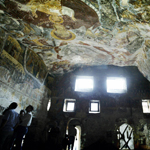
Last August I was at the monastery, officially a state museum, as a Greek Orthodox service sounded out again outside its walls — but it lasted just 30 seconds.
A black-cassocked monk began to sing the liturgy in deep tones before a Turkish museum curator broke up the service. A fight threatened to break out. The gathering broke up in recriminations and grandstanding speeches.
Old homeland
One step forward, one step back. The story of the-service-that-wasn't at Soumela is a suitably Byzantine tale that takes in Turks, Greeks and Russians and plenty of different factions amongst them.
The background to it is that the government of the moderately Islamic AK Party is challenging tenets of the modern secular Turkish state and reviving memories of the multi-ethnic Ottoman era.
The new foreign policy of "zero problems with neighbours" is building bridges with old enemies, including Armenians and Greeks and that has been welcome for curious Black Sea Greeks who want to revisit the old homeland which they call the Pontus.
Musicians have led the way. Both the Black Sea Turks and the Pontic Greeks play an instrument they call the kemenje or lyra and in English you might call a lyre.
It is small, light and three-stringed, made of cherry-wood, played with a bow and held against the knee. Its visceral music sets the rhythm for the round dances that both Greeks and Turks seem to know instinctively.
Two musicians in particular, the Greek anthropologist and lyre-player Nikos Mikhailides and Adem Erdem, a local Turkish player, have blazed a trail.
The album they recorded together in the Pontic Greek dialect has become a smash hit with Pontic Greeks from Thessaloniki to Tashkent. Although not on sale in Turkey, it has been a hit too in Trabzon in thousands of pirate copies.
One of the secrets of this part of Turkey is that tens of thousands of local Muslims, whose ancestors were once Christian, still speak and understand this archaic version of the Greek language.
Festive frenzy
Trabzon is more famous to English ears as Trebizond, the city of Rose Macaulay's novel The Towers of Trebizond.
Nowadays Macaulay's magical city is a functional Turkish Black Sea port. But last August its past stirred into life again. The day before the feast-day of 15 August, half the valley seemed to be talking Greek.
At a Turkish wedding feast we watched a middle-aged blonde woman with a string of pearls round her neck step smoothly into the dance. It turned out she was a professor of law at Athens University. We were the strangers here, not her.
The next morning we ascended the valley to Soumela.
It was a heady Alpine summer's day. From a distance it could be a Tibetan monastery, a yellowing beehive high above the gorge. Hundreds of people toiled up the path.
The atmosphere was both excited and tense, with watchful Turkish policemen at every corner. Outside the monastery gate, a Greek lyre-player with a fine set of pointed moustaches was whipping a crowd of dancers into a festive frenzy.
The beaming Sotiria Liliopoulos had come from Earlwood, New South Wales - her father, now aged 98, was born in Maçka and came here as a child. In an accent veering from Greek to Australian, Sotiria said, "This is the happiest day of my life."
But politics was humming in the background.
A wealthy member of the Russian parliament of Greek descent named Ivan Savvidi, who is making a pitch to be the leader of the Pontic Greek community, had chartered a ferry to ship Russian Greeks here across the Black Sea.
The nationalist local authorities in Trabzon were nervous of his intentions. When Savvidi's Russian party made it to the top of the path, they were an incongruous mix - there were attractive young women in yellow T-shirts and baseball caps with Byzantine eagles on them, and a bearded man dressed in white shirtsleeves and shades (a priest ordered to remove his cassock) carrying a large icon, which Greeks stopped to venerate and kiss.
Radicals
The politician himself waved to the crowd and persuaded a Greek priest to start a service.
The priest began to sing, but the Turkish museum curator had orders to stop any religious ceremony on her territory. She pushed out of her ticket booth into the crowd, shouting in Turkish, and tried to wrest a lighted candle out of Savvidi's hands.
Greek and Turkish television cameras whirred. The divides between the Greeks came to the surface. Some of them, the radicals, started a provocative rendition of the Greek national anthem. Others shushed them.
There seemed to be only two winners here, the Turkish curator and the Russian MP, both of whom had played heroes to the cameras.
Standing on a wall, Savvidi told the Greek crowd that the Turks had offended civilisation and he would complain in Brussels.
He said that he had informed the Russian foreign ministry of his plans, but failed to mention if he had permission from the Turkish government.
As Savvidi spoke, other Greeks - ones who have spent years quietly building bridges with the locals - were drifting away, angry at the way the feast day was being taken from them.
At the bottom of the valley, my mood lifted again. The lyra-musicians were performing and a couple were dancing in extravagant rhythms. The crowd clapped and whooped.
Music is irrepressible and it draws people together, even when the politicians cannot manage it.

Senior Fellow, Carnegie Europe
Thomas de Waal is a senior fellow at Carnegie Europe, specializing in Eastern Europe and the Caucasus.
Recent Work
Thomas de Waal
Thomas de Waal
Carnegie does not take institutional positions on public policy issues; the views represented herein are those of the author(s) and do not necessarily reflect the views of Carnegie, its staff, or its trustees.

European Commission President Ursula von der Leyen is about to give her annual address on the state of the EU. Here’s what she won’t—but should—say.

Rym Momtaz

Radical-right parties are expected to do well in upcoming elections in four of the EU's biggest member states. If successful, they could prevent the union from addressing key challenges ahead.

Stefan Lehne

An overwhelming victory by a far-right-wing party in a small state in eastern Germany will have major repercussions for Chancellor Friedrich Merz’s coalition.

Judy Dempsey

The EU’s responses to two recent incidents expose the gulf between European perceptions and capabilities. Unless the union can bridge that gap, it will never become a real geostrategic power.
Rym Momtaz

European states control several Overseas Countries and Territories around the world that carry strategic, economic, and environmental weight. As great powers challenge the rules-based order, defending them is a geopolitical imperative for Europe.

Marc Pierini