

Commentary
Uri Dadush
{
  "authors": [
    "Uri Dadush"
  ],
  "type": "legacyinthemedia",
  "centerAffiliationAll": "",
  "centers": [
    "Carnegie Endowment for International Peace",
    "Carnegie Europe"
  ],
  "collections": [
    "Transatlantic Cooperation"
  ],
  "englishNewsletterAll": "",
  "nonEnglishNewsletterAll": "",
  "primaryCenter": "Carnegie Endowment for International Peace",
  "programAffiliation": "",
  "programs": [],
  "projects": [],
  "regions": [
    "North America",
    "United States",
    "Western Europe",
    "Germany",
    "Europe"
  ],
  "topics": [
    "Economy"
  ]
}
Source: Getty
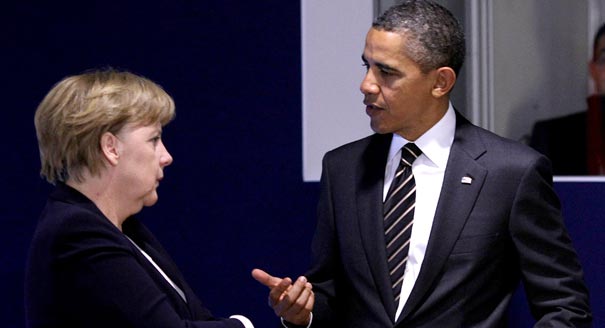
The United States has a vital interest in containing the Euro crisis, and Germany’s leadership or lack of it will determine whether the response to the crisis succeeds or the euro zone unravels.
Source: L'Espresso

Why is Obama – whose economy is recovering well - so worried about Europe? For a start, he knows that a sustained U.S. recovery depends on the success of his export initiative and that requires growth in Europe, which is the world’s largest trading block and the destination of 20% of U.S. exports. Furthermore, the Euro’s 20% decline against the dollar since the start of December creates big complications: it makes American aircraft, cars, machines and agricultural produce less competitive in Europe, at home in the U.S., and on third markets; and it makes China even more reluctant to revalue, increasing the chances of a protectionist backlash in the Congress that would invite retaliation.
But these are actually the smaller of the threats posed by the Euro crisis to the U.S. The bigger risk is the return of fear: a renewal of the global credit crunch that sank the global economy 18 months ago. This time it would be triggered by a sequence of sovereign debt crises that spreads like wildfire from Portugal and Spain onto Italy and then a long list of other countries. This scenario is both plausible and extremely dangerous, because while bad banks can be bailed out by the public, there is no recourse when banks fail because the public can no longer pay. Already, banks are increasingly wary of lending to each other, especially to European banks. And, while sovereign crises in small and poor countries occur frequently and can be managed, everyone had better understand that advanced countries unable to refinance trillions of Euros of public debt would pose a formidable menace to the international financial system.
What does Obama want Merkel to do exactly? In a word, Obama wants Germany to lead. Despite the fact that Germany is the largest creditor of the euro zone and would be the biggest loser were it to implode, its leadership record in dealing with the European debt crisis has been dismal. The lateness of the Greek rescue has greatly increased its cost and was due to German recalcitrance. The European Central Bank vital decision to buy government bonds helped break the panic but was taken in the face of strong Bundesbank resistance. And, when Germany decides to act, as when it suddenly announced a ban on short selling, it does so without consultation, adding to market jitters.
Now, to avoid Europe going into a deflationary spiral as troubled countries cut budgets, Obama wants Germany to increase domestic spending. All the troubled economies are ultra-dependent on European markets, which in turn depend on German demand. But Germany is set on a diametrical path – in fact following her defeat in the Rhine-Westphalia election which undermined her coalition, Merkel first backtracked on her proposed tax cuts and then announced new austerity measures to meet the Maastricht criteria by 2013.
Yet Germany can afford to spend more. Considering the recession, its budget deficit is modest, and its stimulus effort has been timid compared to those of the other two giant economies, China and the United States. Since its post-unification boom Germany’s domestic demand and wages have grown about half as fast as the European average, while its labor productivity grew faster, giving it an enormous labor cost advantage. Germany’s export share in GDP increased by 24 percentage points since 1995 and it became the world’s largest exporter. Before the crisis hit, Germany’s current account surplus exceeded 7% of GDP. Now, with emerging markets booming and half its exports directed outside of Europe, the Euro devaluation will hugely benefit Germany.
So Obama is right to pressure Merkel to spend more. He is also right to ask the complacent Spanish government to take far-reaching wage cutting and bank restructuring measures, which it is now doing. Meanwhile, the Italian government, whose debt is twice that of Spain has adopted modest austerity measures and refused to cut wages. Let us hope Obama will not have to call Rome more often.

Former Senior Associate, International Economics Program
Dadush was a senior associate at the Carnegie Endowment for International Peace. He focuses on trends in the global economy and is currently tracking developments in the eurozone crisis.
Recent Work
Uri Dadush
Uri Dadush
Carnegie does not take institutional positions on public policy issues; the views represented herein are those of the author(s) and do not necessarily reflect the views of Carnegie, its staff, or its trustees.

The EU can impose sanctions but struggles to enforce them without the United States. With Washington increasingly disinterested in backing European interests, the bloc must now fend for itself.


Nicu Popescu, Tiago Antunes

Russia is testing the waters of NATO’s mutual defense clause. What do strikes in Romanian territorial waters mean for the alliance’s posture toward Moscow?

Dimitar Bechev

With its public finances in shambles, the far right polling at 35 percent ahead of the 2027 presidential election, and a growing protest movement, is France’s crisis a threat to the EU’s geopolitical awakening?

Rym Momtaz, ed.

Ahead of a tough winter for Ukraine, Donald Trump’s swing back toward Russia bodes ill. But instead of panicking, Kyiv’s European allies are focusing on action.
Rym Momtaz

Funding Ukraine remains a priority for European leaders. As Russia’s war of aggression heads into another winter, two feasible options to mobilize support for Kyiv should be fast-tracked.


Vladyslav Rashkovan, Gregory P. Wilson