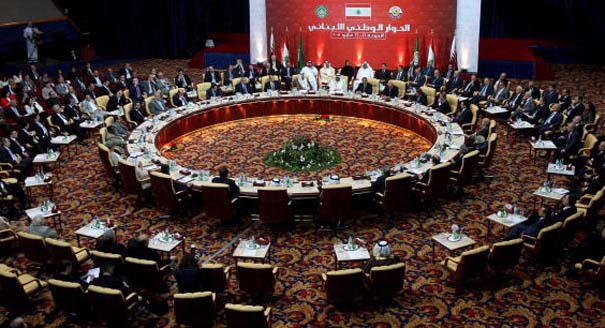
Following the failure of the Syrian-Saudi mediation and the collapse of the government, Lebanon is facing significant political divisions and security risks.
Lebanon Tribunal Crisis Opens Wider DisputesAs the crisis in Lebanon deepens over the UN Tribunal investigating past assassinations, the negotiations to find a resolution have brought in wider political and security issues. If negotiations succeed they could defuse the crisis and lead to the formation of a new government and a return to stability; if they fail, the crisis will get rapidly more acute with the possibility of violence.
Saudi King Abdullah and Syrian President Bashar Assad had been working toward a deal for some months. The talks, which had been shrouded in secrecy, collapsed ten days ago. This led to the resignation of opposition ministers from office and the fall of the government. Qatar and Turkey rushed to fill the diplomatic void and have been trying to pick up where the Saudi-Syrian talks left off.
Press reports have begun to reveal the outlines of the behind-the-scenes negotiations. Saudi Arabia and the March 14 movement in Lebanon led by Prime Minister Saad Hariri, have apparently been pressing Syria and the March 8 camp led by Hizbullah, to accept significant political and security concessions in exchange for a break with the international tribunal.
The concessions would include Syrian cooperation in disarming Palestinian groups in Lebanon and cancelling arrest warrants that a Syrian court had issued against over 30 of Hariri’s associates. Domestically they would include an abrogation of the Doha Agreement of 2008 that had given veto power to the opposition in the government, and a return to the Taif Agreement of 1989 in which the Sunni Prime Minister enjoyed more influence over his cabinet and the executive branch.
In other words, Saudi Arabia and March 14 have been trying to use the pressure of the tribunal to reduce the influence of Syria in Lebanon—and Hizbullah in state institutions. Lebanon and the Arab states would help deflect blame from Hizbullah and Syria over the Hariri assassination, in exchange for Syria reducing its role in Lebanon, and Hizbullah reducing its obstruction of the Sunni prime ministership in Lebanon, while maintaining its arms and role as a national resistance.
Each side blames the other for the failure of the talks. Hariri and Saudi Arabia have not been willing to accept breaking support for the tribunal without a significant gain; and the opposition is interested in a wider, rather than a narrower role, in government. Saudi foreign minister Saud al Faisal went so far as announcing that Saudi Arabia had suspended all talks over the matter and warning that Lebanon might face “secession and division”.
The dispute indicates the depth of division over the future of the country. Hariri and Saudi Arabia, having adjusted since 2006 to the reality that Hizbullah was not going to be defeated, are seemingly proposing a division of labor in which the Shiite community maintains an armed Hizbullah along with its extensive services, while the Sunni community regains a freer hand in leading the central government. Hizbullah and the opposition, on the other hand, while taking for granted the armed continuation of the resistance, want a wider share of state power. This would be either through being granted more seats in government and more security and economic posts in the state, or—as some have suggested—a renegotiation of the Taif Agreement that ended the civil war in 1990, with the aim of according the Shiite community more power.
Given the complexity of the issues involved and the wide gap between the parties, it is unlikely that an agreement can be reached anytime soon. Meanwhile the international tribunal is expected to announce the results of its investigation in the coming weeks. This means that Lebanon will face the full impact of expected indictments against Hizbullah and maybe others without a new government and with fundamental political and security issues unresolved.
If the disputes are not managed politically, it is possible that Hizbullah could use its power to deal a blow to the March 14 coalition as it did in May 2008, and push for the establishment of a March 8 government that would do its bidding. This might deteriorate into sectarian clashes and the further loss of state control over parts of the country. If this occurred, Lebanon would enter a period of serious civil unrest which probably could not be resolved without a full renegotiation of the Taif Agreement.
The crisis over the international tribunal, therefore, has raised even more complex issues: over power-sharing and security in the state, and over Lebanon’s alignment in regional and international disputes.
The Saudi-Syrian track was correct in trying to make political headway in the midst of dangerous tension, and regional and international players should support the current Turkish and Qatari efforts. At best they could still find a political agreement to resolve the various elements of the current crisis and provide a fresh foundation for stability in Lebanon; at worst, they would provide a mechanism for managing a crisis in Lebanon that threatens to be long and acute.
Carnegie does not take institutional positions on public policy issues; the views represented herein are those of the author(s) and do not necessarily reflect the views of Carnegie, its staff, or its trustees.
A notable degree of participative democracy has firmly arrived in Europe. But to have more far-reaching impact, democratic deliberation needs to move into a radically new phase.
As the EU confronts profound challenges, several leaders have called for fundamental reform to the union’s model—but only modest, superficial changes have resulted. What if Europe really could be reimagined from zero today: What should such a redesigned European order look like?
Preparing candidate countries for EU membership is no longer enough. As the enlargement process becomes a reality, the union must also prepare its own societies.
Countries face several hurdles in joining the EU, including the final stage of ratifying their accession treaties. Procedural reforms and substantive adjustments could help move the process forward.