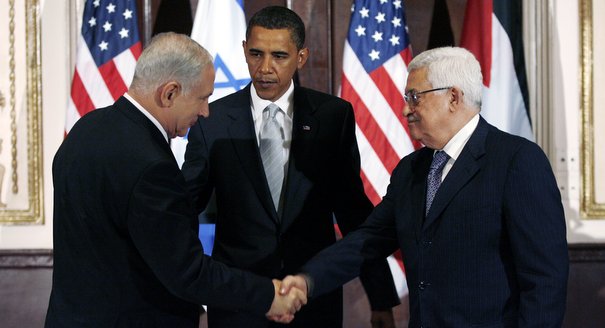
If Washington wants to avoid a UN resolution recognizing Palestinian statehood, President Obama needs to put his own plan on the table and take the lead in resolving the seemingly intractable Israeli-Palestinian conflict.
Something's Got to GiveSomething -- or someone -- has got to give. With international momentum building for a U.N. resolution recognizing Palestinian statehood, Washington is finally coming to the realization that the Israeli-Palestinian status quo is unsustainable.
President Barack Obama's administration signaled once again this week that it will oppose the Palestinian application for full membership to the United Nations when the issue arises in September. But if Obama wants to forestall a vote by the U.N. General Assembly, he needs to do a lot more than recite the usual platitudes about the need to revive peace talks. He needs to put his own plan on the table and take the lead in resolving the seemingly intractable conflict. Time is not on anyone's side.
Obama cannot afford to put off this issue until after the 2012 campaign. Given the nonviolent, democratic protests sweeping the region, there is no way the Palestinian street will remain silent until after the U.S. presidential election. Palestinian leader Marwan Barghouti's call for "millions" of Palestinians to march in support of the U.N. bid is just the latest sign that we could be heading toward a period of renewed popular protest.
There has been much hoopla over Obama's May 19 speech, in which he suggested that the prevailing borders before the 1967 Arab-Israeli war should be the basis of a peace agreement after mutually agreed-upon swaps. But if Obama really wants to revive the peace process, he's going to have to go further.
Any serious analyst recognizes that establishing the 1967 borders as the basis of a negotiated settlement is not a new idea -- even for an American president. President George W. Bush spoke of ending the occupation that started in 1967. President Bill Clinton put forward the Clinton parameters, which would have given 94 to 96 percent of the West Bank back to the Palestinians -- percentages of territory defined by the 1967 lines. Every negotiation -- whether public or private -- between the Palestinians and Israelis has used the 1967 borders as the foundation for an ultimate deal. So let's not get bogged down by this issue.
Obama has made a convincing argument for why the world needs to move on the peace process today. He has described how the shifting demographic balance poses a problem for Israel, how technology will make it more difficult for Israel to defend itself, and how the Arab uprisings and the fast-approaching U.N. vote will pose new challenges. But he has not gone far enough. If Washington wants to oppose action in the General Assembly, it must offer an alternative.
At the very least, the president must lay out a U.S vision of what can be an acceptable solution to the conflict -- much as Clinton did more than a decade ago. That vision must include the issues of a shared Jerusalem, an agreed solution to the refugee problem, and settlements.
Polls consistently show that a majority of Palestinians and Israelis believe that a two-state solution is the best possible outcome for the conflict -- and that such a solution is not possible today. A vision put forward by the United States will convince majorities on both sides that such a solution is indeed attainable.
Just as Arabs will no longer accept a low level of governance, Palestinians will no longer accept the continuation of the occupation and the expansion of Israeli settlements. They will not forever hold out hope for negotiations while their land is being taken from them.
Nor will Palestinians wait for their destiny to be decided by domestic U.S. considerations. The Palestinian leadership is therefore fully prepared to go to the United Nations despite Washington's opposition. It's not a matter of defying the United States -- it is simply an expression of the Palestinian people's desire to take their future into their own hands and an acknowledgement of the absence of U.S. leadership on the issue. (And in reality, the Palestinian statehood bid is not even a unilateral move, as it has been described by Israeli leaders and in many news reports, as the United Nations is the world's most prominent multilateral organization.)
It's important to remember that a resolution will not result in a Palestinian state and that the United Nations can't admit a new member without a recommendation from the Security Council -- a step that Obama has promised to veto. But the passage of a resolution in the General Assembly would be a clear indication that the occupation is illegitimate. It would be a significant moral victory and show the world that it can't sit silently while the "peace process" continues to stagnate.
Israeli Prime Minister Benjamin Netanyahu has argued that a U.N. vote threatens the chance for a negotiated peace and that Israel's West Bank settlements are a "non-issue." This is looking at it backward. There can be no bigger setback for the two-state solution than the continuation of the settlements, because it renders a viable and contiguous state impossible.
Any movement toward a two-state solution is not just in the interest of Palestine, but also Israel. Israel cannot isolate itself from what's happening in the Arab world. Instead of being able to present itself as the only democracy in the Middle East, Israel will increasingly be seen as an outlier -- occupying another nation while less friendly democracies emerge around it.
This is not a sustainable path forward for Israel. Netanyahu will be at a loss for how to act if his country is faced with waves of peaceful Palestinians demanding an end to the occupation. Clearly, the answer is not to shoot them.
The United States needs to step up now to avoid such a confrontation. And Washington must be consistent: It can't truly be for freedom in Egypt if it is not for freedom in Palestine. Obama has recognized the sweeping changes occurring elsewhere in the Arab world -- if he wants to be on the right side when this struggle reaches Palestine, he must act now.
Marwan Muasher is vice president for studies at Carnegie, where he oversees research in Washington and Beirut on the Middle East. Muasher served as foreign minister (2002–2004) and deputy prime minister (2004–2005) of Jordan, and his career has spanned the areas of diplomacy, development, civil society, and communications.
Carnegie does not take institutional positions on public policy issues; the views represented herein are those of the author(s) and do not necessarily reflect the views of Carnegie, its staff, or its trustees.
The EU’s new migration policy is not suited to today’s realities. With climate change increasingly becoming a driver of displacement, Europe needs to rethink its deterrence-focused approach.
Europe seems to have accepted its sidelining in the Middle East. The EU must reassert its support for the international rules-based order and step up engagement.
Amid uncertainty caused by the Iran war, the global drive for nonproliferation has stalled. With Europe diplomatically marginalized and countries reassessing their nuclear options, efforts to curb the spread of nuclear weapons risk becoming irrelevant.
Between the United States’ market-driven approach and China's state-led industrial strategy, Europe is reckoning with how it can remain competitive in the global economy. But is Europe in danger of becoming a U.S. or China colony?
Five countries staged the biggest political boycott in Eurovision history over Israel’s participation. With the FIFA World Cup and other sporting or cultural touchstones on the horizon, are boycotts effective?