

Commentary
Dmitri Trenin
{
  "authors": [
    "Dmitri Trenin"
  ],
  "type": "legacyinthemedia",
  "centerAffiliationAll": "",
  "centers": [
    "Carnegie Endowment for International Peace",
    "Carnegie Europe",
    "Carnegie Russia Eurasia Center"
  ],
  "collections": [
    "Europe’s Eastern Neighborhood"
  ],
  "englishNewsletterAll": "",
  "nonEnglishNewsletterAll": "",
  "primaryCenter": "Carnegie Russia Eurasia Center",
  "programAffiliation": "",
  "programs": [],
  "projects": [
    "Eurasia in Transition"
  ],
  "regions": [
    "Caucasus",
    "Russia"
  ],
  "topics": [
    "Economy",
    "Foreign Policy"
  ]
}
Source: Getty
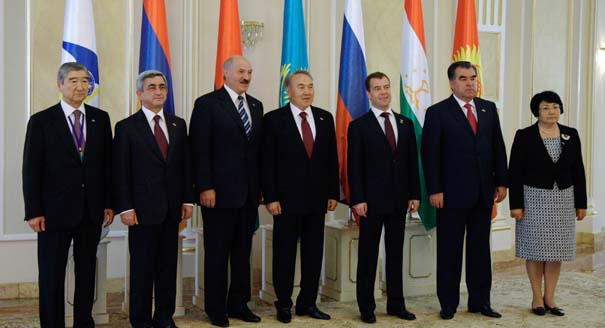
Vladimir Putin’s plans to create an economically integrated Eurasian Union could give Russia an opportunity to become a real regional leader, so long as Eurasian economic is voluntary and Moscow’s partners do not see the process as an attempt at political domination.
Source: Project Syndicate

One issue, however, has now shot to the top of Russia’s political agenda: Eurasian integration. In early October, Putin wrote a newspaper article that proclaimed what appears to be his reigning foreign-policy goal: a Eurasian Union of former Soviet states. Two weeks later, in St. Petersburg, he hosted a meeting of Commonwealth of Independent States (CIS) prime ministers, eight of whom signed an agreement establishing a free-trade area among their countries. On January 1, 2012, Belarus, Kazakhstan, and Russia, which now form a customs union, will join a single economic space.
And Putin wants even more: a “Eurasian Schengen” (free movement of people among the three countries, built on the example of the European Union) by 2015, followed by a currency union and, ultimately, full economic integration. Indeed, Putin wants to restructure Russia’s relations with the former Soviet states to create not merely a bigger market, but eventually an economic bloc-cum-security alliance.
The feasibility of this plan is not to be taken for granted. Ever since the Soviet Union broke up 20 years ago, there has been much talk about reintegrating the successor states. Little has come of it, owing mainly to Russia’s reluctance to support the other countries financially. At the same time, the other CIS countries have maintained an overriding focus on their own state-building and independence vis-à-vis Russia. Both factors, however, may now be changing – at least somewhat.
Russia, which a half-dozen years ago abruptly ended its energy subsidies to Ukraine, Belarus, Moldova, and others, is now expressing interest in supporting some of its struggling neighbors, in exchange for some of their most lucrative assets. During the 2008-2009 global crisis, Moscow began to strengthen its regional economic standing and promote the establishment of the customs union with Belarus and Kazakhstan, even at the risk of complicating its own bid for membership in the World Trade Organization.
For Russia’s partners, too, the current forms of integration, such as the customs union and the forthcoming single economic space, are pragmatic arrangements that serve their interests. In Belarus and Kazakhstan combined, Russia has gained 25 million potential new consumers; Belarus and Kazakhstan, for their part, have widened their access to the 140 million-strong Russian market.
The Russian market is also attractive to many others, from tiny Kyrgyzstan to sizable Ukraine. In the latter’s case, for example, the prospects of closer association with the EU have dimmed recently, owing to the EU’s internal difficulties, as well as to the Ukrainian authorities’ politically-motivated prosecution of former Prime Minister Yuliya Tymoshenko.
In his much-quoted newspaper piece, Putin denied that his new integration plans are aimed at restoring the Soviet Union under another name. This is a credible claim, for three basic reasons: the complete evaporation of Russia’s imperial élan, its unwillingness to pay other countries’ bills, and the new countries’ unwillingness to cede too much sovereignty to the former hegemon.
Consequently, Russia has been strict about the terms of its financial assistance to Belarus, pressing its government to open up its economy to Russian business. And, for all their interest in the Russian market, neither Belarus nor Kazakhstan has acceded to Russia’s desire that they recognize the independence of Georgia’s breakaway Abkhazia and South Ossetia regions.
Putin is ambitious, but he is also cautious. He probably sees that only mutual economic interest can do the trick. Creating a new Council for Mutual Economic Assistance (COMECON, the Soviet-era trade bloc), or a new Warsaw Pact, is as impossible as a latter-day Soviet Union. Eurasian economic integration, if it stands a chance, must follow a different path.
If all parties concerned join voluntarily, and proceed in a step-by-step manner, as with the EU or the North American Free Trade Agreement, Eurasian integration will benefit all of those involved. Rather than behaving like an empire secretly trying to re-invent itself, Russia has an opportunity to become a regional leader. But Eurasian integration will fail if Russia’s partners see the process as Moscow’s attempt at political domination.
All of this has geopolitical implications. In Eastern Europe, Russia is clearly drawing Belarus closer, and is competing with the EU over Ukraine’s future economic orientation. Meanwhile, in Central Asia, Russia, having built strong economic ties with Kazakhstan, is now reaching out to Kyrgyzstan, thus competing more actively with neighboring China. Rather than choosing between Brussels and Beijing, Moscow now seeks to turn Russia’s post-imperial neighborhood into a community. And, as a long-term goal, Putin envisions a close economic relationship between his Eurasian Union and the EU in what he calls a Greater Europe.
In the West, Putin’s best-remembered statement about the Soviet Union described its end as the “greatest catastrophe of the twentieth century.” But Putin’s other comments, less familiar to Western readers, refer to the Soviet system as “unviable.” In his ruthless judgment, those who want the USSR back “have no brains.”
Twenty years after the loss of its twentieth-century empire, Russia is ready to move toward a new kind of integration with its ex-provinces. This is not intended as a threat to others; rather, economic integration is a test of how much Russia has learned about the world since 1991, and of how much more modern it has become as a result.
Copyright: Project Syndicate, 2011.
This article originally appeared on Project Syndicate.
Former Director, Carnegie Moscow Center
Trenin was director of the Carnegie Moscow Center from 2008 to early 2022.
Recent Work
Dmitri Trenin
Dmitri Trenin
Carnegie does not take institutional positions on public policy issues; the views represented herein are those of the author(s) and do not necessarily reflect the views of Carnegie, its staff, or its trustees.
Nearly a year and a half after Europeans leaned into sucking up to Trump, the strategy has produced some benefits when it comes to Ukraine.

Rym Momtaz
As Russia's war on Ukraine drags on, NATO is expanding its footprint in the Black Sea. Turkey, Romania, and Bulgaria are upgrading their fleets and deepening trilateral cooperation.

Dimitar Bechev
While Russia is not ready to sue for peace on Europe’s terms, it could still either seek a ceasefire in Ukraine or try escalation. Brussels needs to prepare for both and prioritize that preparation over normative discussions.
Kadri Liik
For ninety years, Turkey has been positioned as the principal gatekeeper of Black Sea security. As a result, European and NATO efforts to support Ukraine will require closer engagement with Ankara.

Thomas de Waal

Western Europe’s dual-use infrastructure melted down during its latest heat wave. If a predicted hot weather event can take the continent by surprise, what chance does it have to withstand unexpected geopolitical crises?
Rym Momtaz