

Article
Bernd von Muenchow-Pohl
{
  "authors": [
    "Bernd von Muenchow-Pohl"
  ],
  "type": "legacyinthemedia",
  "centerAffiliationAll": "dc",
  "centers": [
    "Carnegie Endowment for International Peace",
    "Carnegie Europe"
  ],
  "collections": [],
  "englishNewsletterAll": "ctw",
  "nonEnglishNewsletterAll": "",
  "primaryCenter": "Carnegie Endowment for International Peace",
  "programAffiliation": "SAP",
  "programs": [
    "South Asia"
  ],
  "projects": [],
  "regions": [
    "South Asia",
    "India",
    "Western Europe",
    "Asia",
    "Europe"
  ],
  "topics": [
    "Economy",
    "Trade",
    "Foreign Policy"
  ]
}
Source: Getty
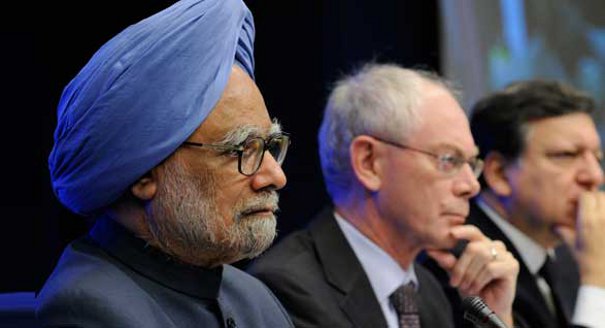
Despite initially high expectations, the enhanced relationship between India and the European Union has so far made relatively little impact and has fallen short of its own objectives.
Source: Great Indian Dream

From a historic perspective, the match seemed as if it would have a solid foundation. Adding a new dimension to its relationship with Europe, which was still overshadowed by the colonial past, New Delhi established diplomatic relations with the European Economic Community (EEC) as early as 1963. Ten years later, when Britain — India’s most important trading partner at the time — joined the original six EEC members, India’s loss of imperial trade preferences led to its first commercial cooperation agreement with the community. It took both sides another 20 years to sign their first political declaration after the EEC had morphed into an enlarged European Union of then twelve member states. In 2000, India’s raised economic and political profile and the EU’s desire to extend its newly defined political mission beyond the confines of the European continent after the end of the Cold War, brought about the first summit meeting in Lisbon. Successive annual summits heralded the EU-India Strategic Partnership (2004) and a voluminous Joint Action Plan for its implementation (2005).
Former Nonresident Scholar, South Asia Program
Von Muenchow-Pohl was a nonresident scholar in Carnegie’s South Asia Program, where his work focuses on Indian domestic, foreign, and economic policy.
Recent Work
Bernd von Muenchow-Pohl
Bernd von Muenchow-Pohl
Carnegie does not take institutional positions on public policy issues; the views represented herein are those of the author(s) and do not necessarily reflect the views of Carnegie, its staff, or its trustees.

An overwhelming victory by a far-right-wing party in a small state in eastern Germany will have major repercussions for Chancellor Friedrich Merz’s coalition.

Judy Dempsey

Canadian Prime Minister Mark Carney has twice inspired praise for standing up to U.S. President Donald Trump: at the 2026 World Economic Forum in Davos and on Canada-U.S. trade negotiations. Is Carney showing a third way better than the EU has in dealing with the Trump administration?

Rym Momtaz, ed.

The EU’s responses to two recent incidents expose the gulf between European perceptions and capabilities. Unless the union can bridge that gap, it will never become a real geostrategic power.
Rym Momtaz

European states control several Overseas Countries and Territories around the world that carry strategic, economic, and environmental weight. As great powers challenge the rules-based order, defending them is a geopolitical imperative for Europe.

Marc Pierini

In supporting Europe’s far-right, MAGA and Russia both want the same thing: a weaker EU. Europe must defend itself without abandoning the openness these forces exploit.

Armida van Rij