

Commentary
Thomas de Waal
{
  "authors": [
    "Thomas de Waal"
  ],
  "type": "legacyinthemedia",
  "centerAffiliationAll": "dc",
  "centers": [
    "Carnegie Endowment for International Peace",
    "Carnegie Europe"
  ],
  "collections": [],
  "englishNewsletterAll": "ctw",
  "nonEnglishNewsletterAll": "",
  "primaryCenter": "Carnegie Europe",
  "programAffiliation": "russia",
  "programs": [
    "Russia and Eurasia"
  ],
  "projects": [],
  "regions": [
    "Caucasus",
    "Georgia"
  ],
  "topics": [
    "Economy",
    "Foreign Policy"
  ]
}
Source: Getty
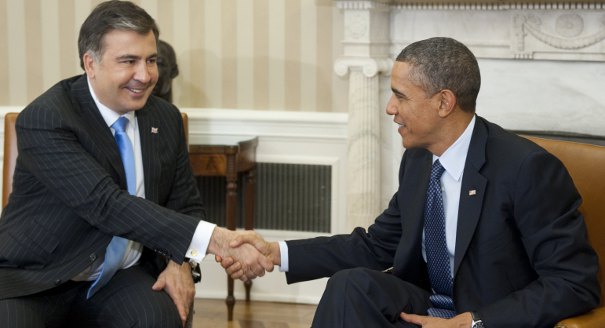
President Obama has praised Georgian President Mikheil Saakashvili for his track record of reform and reaffirmed U.S. support for Georgia’s future membership in NATO, but he also hinted that Saakashvili should step down once his term ends.
Source: Democracy & Freedom Watch

I think the meeting went well in the sense that both sides got something that they wanted out of it. I thought the body language between the two was not as natural as it was between Saakashvili and George W. Bush.
For President Saakashvili it was obviously important to get a meeting in the Oval Office in the first place. He also received warm words from Obama about Georgian reforms, a continuing commitment to Georgian NATO membership and US defense cooperation and the promise of a free trade agreement—which will obviously be much more important for Georgia than it will be for the United States.
President Obama wanted to publicly thank a loyal contributor to the NATO mission to Afghanistan, when other countries, such as France, are declaring that they will pull out early and put a bigger burden on Washington. But primarily he wants to see greater stability in the region and more trade opportunities, primarily with Russia. So it was important to express gratitude for Georgia’s cooperative attitude on the World Trade Organization deal with Russia.
For the United States to take advantage of Russia’s WTO accession and for US businesses to trade with Russia under the new rules, Congress must repeal the Jackson-Vanik amendment on trade with Russia. But there is a strong anti-Russia Republican contingent in Congress which will oppose repealing the amendment. Proposing a free trade agreement with Georgia is a good tactic to persuade these people in Congress to drop their objections.
So there was also a domestic political agenda in the meeting for Obama too. Whoever is the Republican presidential candidate will inevitably try to accuse him of being “soft” on Russia because of his re-set policy, especially after Vladimir Putin is re-elected president in Russia in March. And, prior to this meeting, there might have been accusations about “betraying” Georgia. That is no longer possible and this meeting was a kind of pre-emptive strike on that issue. It was good for Obama that the Georgian president left the meeting saying, “I am leaving this office very happy.”
Of course there was an element of ambiguity here and we don’t know what was said in the private meeting. But I think the phrase “formal transfer of power” [NB TRANSFER NOT TRANSITION] did contain a warning to President Saakashvili that he should not try to cling on to power by other means, such as becoming prime minister. I think this issue will be clarified when we see the behavior of both sides over the next few months and when Secretary of State Hillary Clinton visits Georgia.
If he takes this step, Saakashvili will survive in that the move will be legal. But I think it will tarnish his reputation in the West and he won’t be received at the same level. Saakashvili did well to rehabilitate himself after the disaster of 2008 but I doubt he could do so a second time. And I think he is beginning to hear that message from different Western interlocutors.
I cannot say. The Afghanistan mission will end in 2014 and NATO membership is a very long-term prospect, as President Obama also made clear after the meeting. Besides, neither of the two presidents mentioned the subject which everyone wants to ask, that of weapons sales to Georgia.
I wish I knew!
The elections will be scrutinized by the US and European bodies and institutions. The Georgian governing elite has set itself high standards and foreign observers will ask them to stick by them.
I think I answered this in question 1.
The parallels are very inexact. Mubarak had been in power for thirty years. Shevardnadze was Saakashvili’s former patron and agreed to step down and hand over power to his protégés, Zhvania and Saakashvili. I see this as part of the Georgian governing elite’s continuing efforts to “brand” Georgia abroad as the country of a peaceful revolution and successful reforms. They are brilliant at PR and in many ways more popular abroad than they are at home.
This interview originally appeared in Democracy & Freedom Watch.

Senior Fellow, Carnegie Europe
Thomas de Waal is a senior fellow at Carnegie Europe, specializing in Eastern Europe and the Caucasus.
Recent Work
Thomas de Waal
Thomas de Waal
Carnegie does not take institutional positions on public policy issues; the views represented herein are those of the author(s) and do not necessarily reflect the views of Carnegie, its staff, or its trustees.

The EU can impose sanctions but struggles to enforce them without the United States. With Washington increasingly disinterested in backing European interests, the bloc must now fend for itself.


Nicu Popescu, Tiago Antunes

Russia is testing the waters of NATO’s mutual defense clause. What do strikes in Romanian territorial waters mean for the alliance’s posture toward Moscow?

Dimitar Bechev

With its public finances in shambles, the far right polling at 35 percent ahead of the 2027 presidential election, and a growing protest movement, is France’s crisis a threat to the EU’s geopolitical awakening?

Rym Momtaz, ed.

Ahead of a tough winter for Ukraine, Donald Trump’s swing back toward Russia bodes ill. But instead of panicking, Kyiv’s European allies are focusing on action.
Rym Momtaz

Funding Ukraine remains a priority for European leaders. As Russia’s war of aggression heads into another winter, two feasible options to mobilize support for Kyiv should be fast-tracked.


Vladyslav Rashkovan, Gregory P. Wilson