Source: NewsHour
MARGARET WARNER: And late today, there were reports that the European Union had agreed in principle to ban imports of Iranian oil. At the same time, China, the biggest buyer of Iranian crude, criticized the new U.S. sanctions. And a Turkish official told Reuters that Ankara would seek a waiver for its biggest refiner, a major customer for Iranian oil.
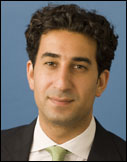
For more on the ratcheting-up of tensions, we turn to Haleh Esfandiari, director of the Middle East program at the Woodrow Wilson International Center for Scholars, and Karim Sadjadpour, an associate in the Middle East program at the Carnegie Endowment for International Peace.
And welcome back to you both.
There's a lot of saber-rattling, I mean, missile tests, naval exercises, threats, announcement about the nuclear fuel rod. What is driving this kind of in-your-face belligerence, this new round of it, Karim Sadjadpour, beginning with you, on Tehran's part?
KARIM SADJADPOUR, Carnegie Endowment for International Peace: The behavior of the Iranian regime has become fairly predictable.
The Iranian supreme leader's modus operandi has long been that you respond to pressure with threats of your own. So he wants to make clear to the outside world, specifically the United States, that Western pressure is only going to harden, not soften, Iranian behavior.
MARGARET WARNER: What would you add to that?
HALEH ESFANDIARI, Woodrow Wilson International Center for Scholars: I would add to it also that there is a domestic element to it, too, that they have to prove to the people that, look, when we are under threat -- when we are sanctioned, we are under threat. Therefore, we don't just sit and accept it. We react to it.
So I think there is the domestic element which is equally important.
MARGARET WARNER: Do you think that this threat to close the really critically important Strait of Hormuz, is that just bluster on Tehran's part, or is that a serious possibility?
HALEH ESFANDIARI: I think it's bluster on Tehran's part, because as soon as they announced it, then the commander of the army said that they don't think they will do that.
And, anyway, I mean, they can't risk losing the Hormuz, the Strait of Hormuz, because their own exports go through the strait, and they need the revenue.
MARGARET WARNER: So they'd be cutting off their nose to spite their face, Karim Sadjadpour?
KARIM SADJADPOUR: That's right. They likened it to drinking a glass of water. We could close the Strait of Hormuz as easily as we could drink a glass of water.
In reality, it would be like drinking a glass of gasoline. And I think the logic of closing the Strait of Hormuz for Iran is like the logic of conducting a suicide bombing. They would hurt others, but they will hurt themselves the most, and they will also be hurting their chief commercial and strategic patron, which is China. So I agree with Haleh.
MARGARET WARNER: Number-one buyer.
KARIM SADJADPOUR: Exactly. It's mostly bluster.
MARGARET WARNER: So, how -- what impact are all of these sanctions? We have had four rounds of U.N. sanctions. We have had U.S. sanctions, unilateral. We have had E.U. ones.
What has been the overall impact on -- first of all, let's begin with you, Haleh -- the economy of Iran?
HALEH ESFANDIARI: The last round of sanctions had been really back-breaking for the Iranian economy.
What you hear, what one hears from Iran is that cost of living has raised five times more, six times more. And there might be exaggeration. There are not exact figures, but people complain about it all the time, number one.
Number two, I think what these sanctions are doing is that they are also creating a rift, a division among the leadership, too. There are those who say, why do we bring this on ourselves for the first time? And also the population is unhappy with the position that Iran is taking.
MARGARET WARNER: And what about the currency devaluation, which really -- I mean, it's been devalued quite a bit since last year, but this week, with the signing of that bill, even worse. What does that -- how does that affect an average, an ordinary Iranian?
HALEH ESFANDIARI: It is -- in a way, a lot of people are now running to the banks and also to the money lenders, money dealers to change their savings into dollars, because they expect that the dollar will rise.
And the government cannot do anything about it. I mean there is this instability and uncertainty that has led to this current situation. Today, the government announced that they will only allow travelers to take with them $1,000. Until recently, they could take up to $5,000. If you went to the airport in Tehran, there was a big sign saying "$5,000 or less." So that -- because they need the currency themselves.
MARGARET WARNER: So, Karim Sadjadpour, then is the White House spokesman correct -- or do you agree with the assessment that a lot of this bluster really reflects a certain sense, if not of desperation, than of vulnerability on its part?
KARIM SADJADPOUR: Well, Iran has this schizophrenia because it simultaneously has delusions of grandeur and profound insecurity. You could call it the Sarah Palin of nations.
And I would say this about the White House strategy. What the Obama administration is trying to do is to subject the Iranian regime to enough pressure to bring it back to the table and get it to make meaningful compromises on the nuclear part. And there has been tremendous pressure in terms of the Central Bank sanctions, now the currency crisis.
There's external pressures as well. Their chief ally, the Syrian regime, is on the verge of collapse. The question is whether Iran's supreme leader, Ayatollah Khamenei, will calculate that -- whether he will seek deliverance in a nuclear compromise in order to bring about some relief to himself, or whether he will seek deliverance with a nuclear weapon itself, thinking that that will bring him a shield from outside pressure.
I think recent history doesn't bode very well, because the example, the lesson which Khamenei learned from the example in Libya, Gadhafi's example in Libya, was that when Gadhafi abdicated his nuclear program, that made him vulnerable to outside intervention.
MARGARET WARNER: And what do you hear or read on that score in terms of the effect that these sanctions are having on really the number-one question of interest to the United States and its allies, which is somehow providing enough of a disincentive or slowing down in other ways the nuclear development program?
HALEH ESFANDIARI: I think sanctions are affecting the average Iranian. And that is very important, because there's going to be an internal pressure on the government.
And they will take it a step further, because they would say, look, if your program is really a nuclear program for peace, then why not discuss it? Why not negotiate? Why not allow the IAEA to come into the country and have a...
MARGARET WARNER: But they do have inspectors, the IAEA.
HALEH ESFANDIARI: Yes, but under very rigid conditions and so on.
But open up everything. And I think if Ayatollah Khamenei is going to blink, it is because of internal pressure which is the result of the external pressure and sanctions.
MARGARET WARNER: Now, over the weekend, the chief negotiator for Iran did at least say publicly or to journal -- to a group in Europe that he had somehow let the five U.S. allies who have been conducting these negotiations that he was ready to reopen them. Do you consider that a sign of blinking? Or was this -- is this just a way to buy more time?
KARIM SADJADPOUR: The big question is whether Iran is after the pot of gold at the end of the rainbow or do they just want the rainbow, meaning are they interested in negotiations as a prelude to some type of a nuclear deal or do they just want negotiations as a way of buying time?
MARGARET WARNER: That's the rainbow only...
KARIM SADJADPOUR: That's the rainbow only. And I think that if past is precedent, there's a good deal of cynicism about whether Iran is willing and able to make the types of meaningful nuclear compromises that could bring about some type of a deal with the West.
MARGARET WARNER: And, of course, the leadership could see the pot of gold in fact is becoming a nuclear power.
HALEH ESFANDIARI: Yes, but then they also see the danger of accessing that pot of gold, which might be an attack on Iran, which they would like to prevent, definitely.
So, therefore, I think they will probably go in for negotiation, but they might drag it out. But, by now, the Europeans and the Americans know when to stop these negotiations. And they will say, OK, where do we go from here? What is the next step?
KARIM SADJADPOUR: There's a famous book about American negotiations called "Getting to Yes."
And I think that if that book was written from the Iranian vantage point, it would be "Staying on Maybe."
MARGARET WARNER: Karim Sadjadpour, Haleh Esfandiari, thank you.
HALEH ESFANDIARI: Thank you.
KARIM SADJADPOUR: Thank you.
HALEH ESFANDIARI: Thank you very much.
This transcript was originally provided by PBS' NewsHour.