

Commentary
Judy Dempsey
{
  "authors": [
    "Judy Dempsey"
  ],
  "type": "legacyinthemedia",
  "centerAffiliationAll": "",
  "centers": [
    "Carnegie Endowment for International Peace",
    "Carnegie Europe"
  ],
  "collections": [],
  "englishNewsletterAll": "",
  "nonEnglishNewsletterAll": "",
  "primaryCenter": "Carnegie Europe",
  "programAffiliation": "",
  "programs": [],
  "projects": [],
  "regions": [
    "Europe"
  ],
  "topics": [
    "Foreign Policy"
  ]
}
Source: Getty
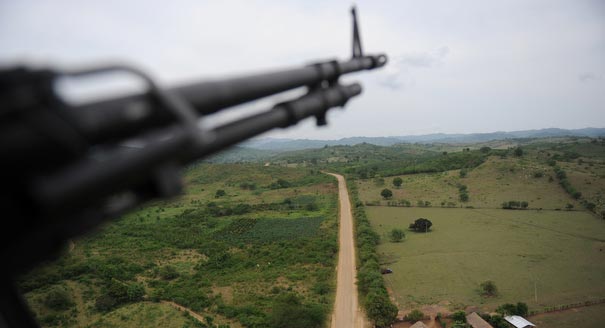
Too many EU countries have been exporting weapons to dictatorships and authoritarian regimes, often with scant regard to whether the arms were used for quashing dissent and propping up the status quo.
Source: New York Times

Many E.U. countries had been exporting weapons to dictatorships and authoritarian regimes, often with scant regard to whether the arms were used for quashing dissent and propping up the status quo.
Shamed by their support for these regimes, the Arab Spring has given Europe a chance to start fresh — not only with that region but also with how it does business with dictatorships in Central Asia.
But two new reports, one by the European Union and the other by Sipri, the Stockholm International Peace Research Institute, show that European companies and governments are seeking markets for their weapons outside Europe more eagerly than ever.
Not all these markets are in stable, conflict-free, democratic countries. This raises the question of how Europe can square its commitment to defending human rights with selling weapons to such countries.“European governments have sold weapons to bad guys for a long time,” Bates Gill, director of Sipri, said in an interview. “There are plenty of examples for that in spite of the high-sounding principled language about monitoring arms sales.”
On one level, this is hardly surprising. Defense spending is declining among most E.U. countries as governments cut budgets.
And with the need to protect jobs, governments and arms producers seek new markets.
Security experts say that the Middle East region and further afield in Central Asia will remain a lucrative market for European arms companies. Indeed, Sipri suggests as much in its annual report, published last week, in which it listed the 100 top arms companies by sales.
The list is not exhaustive. It excludes companies from China, Ukraine and Kazakhstan because of the unreliability of their statistics. Highly successful German arms producers, too small to make the top 100, are also excluded.
Nevertheless, the report is revealing for several reasons. It shows how the arms trade is thriving, despite the global financial crisis and the economic downturn across most of Europe. Sales of arms and military services increased to $411.1 billion in 2010 — a 1 percent increase compared with 2009 and a 60 percent increase since 2002.
The United States and Europe continue to dominate the arms-producing and military-services companies. Forty-four U.S. companies accounted for more than 60 percent of all arms sales listed by Sipri. The 30 European companies on the list account for 29 percent of total sales, or about $119 billion. The majority are French, German and British companies.
But probably the most interesting implication of the report is that Europe’s arms trade to many countries is at odds with the Union’s commitment to human rights. Member states continue to sell large quantities of weapons to dictatorships and authoritarian regimes, according to new statistics published by the Union.
This is despite the fact that the Union has its own code of conduct on arms exports. It was first agreed among the member states in 1998 and updated in 2008 in an attempt to harmonize arms export policies. But the Code of Conduct has serious shortcomings: National governments and not the Union decide the granting of arms export licenses.
“Despite efforts at the E.U. level, states continue to maintain final control of all aspects of arms export licensing,” Mark Bromley, a Sipri arms transfer expert, argued in a recent study of the Union’s arms exports policy published by the E.U. Non-Proliferation Consortium, a network of independent research groups. This is confirmed in the latest E.U. report on arms exports.
In 2010, for example, the report showed that member states together sold weapons worth €8.3 billion, or nearly $11 billion at current exchange rates, to the Middle East and North Africa.
“When the Arab Spring began in 2011, some of these arms were used to mow down democracy activists,” said Kaye Stearman, a spokeswoman for the Campaign Against Arms Trade, which is based in Britain.
The report is published annually because member states, only after long negotiations, promised to provide the figures. But there are glaring omissions.
The report states that statistics are compiled according to national standards by each member state. “Consequently, owing to current procedures in the area of arms export reporting or data protection legislation, not all countries have been able to submit the same information,” it adds.
Furthermore, it says that Belgium, Denmark, Germany, Poland, Greece, Ireland and the United Kingdom did not supply data concerning the value of arms exports in euros. Sweden declined to report the number of licenses issued. France and Italy did not provide information on the number of licenses issued or the value of the licenses issued in euros.
If the Union wants to rebuild its credibility across the Middle East and among civil society movements in non-democratic countries, it needs more than ever a strong security and arms exports policy to reflect its values.
So far, however, it seems that neither national governments nor the Union itself are pushing hard enough to export those values.

Nonresident Senior Fellow, Carnegie Europe
Judy Dempsey is a nonresident senior fellow at Carnegie Europe
Recent Work
Judy Dempsey
Judy Dempsey
Carnegie does not take institutional positions on public policy issues; the views represented herein are those of the author(s) and do not necessarily reflect the views of Carnegie, its staff, or its trustees.
Following Ursula von der Leyen’s gaffe equating Turkey to Russia and China, relations with Ankara risk deteriorating even further. Without better, more consistent diplomatic messaging, how can the EU pretend to be a geopolitical power?

Sinan Ülgen
Closer EU-UK ties could help address urgent European concerns. But is the EU ready for rapprochement with the United Kingdom?

Rym Momtaz, ed.
Europe has been standing by while its Southern neighborhood is being redrawn by force. To establish a path to peace between Israel and Lebanon, it’s time for Europeans to get involved with hard power.
Rym Momtaz
In Ukraine, Gaza, and Iran, AI warfare has come to dominate, with barely any oversight or accountability. Europe must lead the charge on the responsible use of new military technologies.

Raluca Csernatoni

Montenegro and Albania are frontrunners for EU enlargement in the Western Balkans, but they can’t just sit back and wait. To meet their 2030 accession ambitions, they must make a strong positive case.


Dimitar Bechev, Iliriana Gjoni