

Commentary
Judy Dempsey
{
  "authors": [
    "Judy Dempsey"
  ],
  "type": "legacyinthemedia",
  "centerAffiliationAll": "dc",
  "centers": [
    "Carnegie Endowment for International Peace",
    "Carnegie Europe",
    "Carnegie Russia Eurasia Center"
  ],
  "collections": [
    "Europe’s Eastern Neighborhood"
  ],
  "englishNewsletterAll": "ctw",
  "nonEnglishNewsletterAll": "",
  "primaryCenter": "Carnegie Europe",
  "programAffiliation": "russia",
  "programs": [
    "Russia and Eurasia"
  ],
  "projects": [],
  "regions": [
    "Russia",
    "Europe",
    "Western Europe",
    "Germany"
  ],
  "topics": [
    "Foreign Policy"
  ]
}
Source: Getty
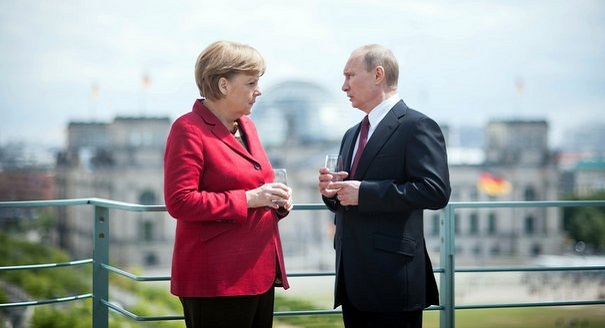
“Russen & Deutsche,” an exhibition at the Neues Museum in Berlin, is an ambitious attempt to show how the ties between Russian and German cultures have developed over a thousand years.
Source: New York Times

The exhibition “Russen & Deutsche” (“Russians and Germans”), on view here through Jan. 13, is an ambitious attempt to show how the ties between the two have developed over a thousand years. About 100,000 visitors have seen the show since it came to the Neues Museum in October, after opening last summer at the State Historical Museum in Moscow. Spread over several rooms, the display establishes its theme from the beginning with an intricately carved woodcut, dating to 1360 or 1370, that shows Russian hunters approaching German traders with furs and hides. The Germans stand, arms folded, waiting to bargain.
It is clear who has the upper hand. The elegant dress and demeanor of the Germans contrast with the simple clothes of the peasant hunters. The allure of things German — money, business savvy, confidence and culture — typifies the entire show.Catherine the Great, the German-born princess who ruled Russia as empress from 1762 to 1796, invited Germans there in the mid-18th century, hoping that their entrepreneurial and scientific skills would help modernize Russia. (Earlier, Peter the Great tried to open the country to Western influences.) More than two centuries later, Russia continues to look to Germany to help develop Russian industry and infrastructure, just as Germany still hopes that contemporary influences will bring Russia’s political and economic systems closer to European norms.
The “Russen & Deutsche” exhibition was developed over several years by cultural bodies in both countries. The Russian organizers wanted to show that the relationship between the nations under Peter and Catherine was not so one-sided, and that some Germans eagerly went to Russia to seek new livelihoods.
“In Europe there was either a plague or cholera,” Natalia Kargapolova, the show’s Russian curator, said at its opening in Moscow, Pravda.ru reported. “In addition, it was difficult to find a job.” Germans, she added, “had very successful careers at the royal court, as it was believed that the Germans were reliable.”
But for all the respect shown to the Germans, they were not encouraged to integrate. They received tax concessions but had to live separately. Catherine feared foreign ideas and designated an area along the Volga, in southern Russia, as the German settlement. There German immigrants preserved as much as they could of their language and way of life.
Still, Catherine’s ambiguous welcome did not impede the flow of commerce or artistic influences. The exhibition shows, for example, how Siemens, the electronic and engineering company, already had a foothold in Russia in the 19th century, providing modern lighting infrastructure, and how it is now building high-speed trains in Russia. Examples of work by Russians like Dostoyevsky and the painter Alexei von Jawlensky (1864-1941) demonstrate German influences.
But for all its attention to the complexities of the relationship between the nations, the exhibition brushes aside how deeply it has been affected by war and ideology. It gives little scrutiny to political dealings in the 18th and 19th centuries between Prussia and Russia, both absolute monarchies that opposed the French Revolution, allied against Napoleon and took part in dividing up Poland. It also devotes little space to the world wars or the interwar years, and makes no detailed reference to the Ribbentrop-Molotov Pact of August 1939, which led to Hitler’s and Stalin’s invasions of Poland and allowed Moscow to focus on the Far East.
“This is an appalling gap,” Tagesspiegel, a Berlin daily newspaper, said in a review. “Both sides must face the truth that in the past they were never closer to each other than during this moment of the most awful policy of violence.”
The room devoted to East Germany has pictures of smiling citizens, with no sense of Soviet repression and no reminder of the East German workers’ uprising of 1953, which was crushed by Russian tanks. Instead, it offers passing references to Mikhail S. Gorbachev’s policy of perestroika and snapshots of Russians, Jews and elderly Germans now living in the reunited Berlin.
The show also praises a close commercial tie West Germany and the Soviet Union forged, beginning in the early 1970s. One of the exhibition’s main sponsors is E.On, Germany’s big energy company, which cooperates with Gazprom, the Russian energy giant.
The German newspaper Die Welt commented, “This exhibition is being sponsored by the energy company E.On, which is a reminder of which energies really tie Russia and Germany together.”

Nonresident Senior Fellow, Carnegie Europe
Judy Dempsey is a nonresident senior fellow at Carnegie Europe
Recent Work
Judy Dempsey
Judy Dempsey
Carnegie does not take institutional positions on public policy issues; the views represented herein are those of the author(s) and do not necessarily reflect the views of Carnegie, its staff, or its trustees.

Before the next wave of EU enlargement takes place, the union needs to grapple with thorny questions of how power is distributed among its members.


Emil Sondaj Hansen, Ditte Brasso Sørensen

The new U.S.–Denmark–Greenland agreement will help Washington exert political, economic, and financial dominance under the guise of security. Yet, it acknowledged Copenhagen’s and Nuuk’s sovereignty on the island.

Marc Pierini

A summer of escalation in the Black Sea has hurt Ukraine economically and is exacerbating world food security. A truce is needed—as is a broader reframing of Europe’s Ukraine strategy.

Thomas de Waal

Are Germany’s economic, industrial, and political struggles becoming a liability for the EU’s ability to rise to the geopolitical moment?

Rym Momtaz, ed.

European Commission President Ursula von der Leyen is about to give her annual address on the state of the EU. Here’s what she won’t—but should—say.
Rym Momtaz