

Research
- +10
Rosa Balfour, Frances Z. Brown, Yasmine Farouk, …
{
  "authors": [
    "Moisés Naím"
  ],
  "type": "legacyinthemedia",
  "centerAffiliationAll": "dc",
  "centers": [
    "Carnegie Endowment for International Peace",
    "Carnegie China",
    "Carnegie Russia Eurasia Center"
  ],
  "collections": [],
  "englishNewsletterAll": "ctw",
  "nonEnglishNewsletterAll": "",
  "primaryCenter": "Carnegie Endowment for International Peace",
  "programAffiliation": "russia",
  "programs": [
    "Russia and Eurasia"
  ],
  "projects": [],
  "regions": [
    "North America",
    "United States",
    "East Asia",
    "China",
    "Russia",
    "Western Europe"
  ],
  "topics": [
    "Economy",
    "Climate Change",
    "Security",
    "Nuclear Policy",
    "Global Governance"
  ]
}
Source: Getty
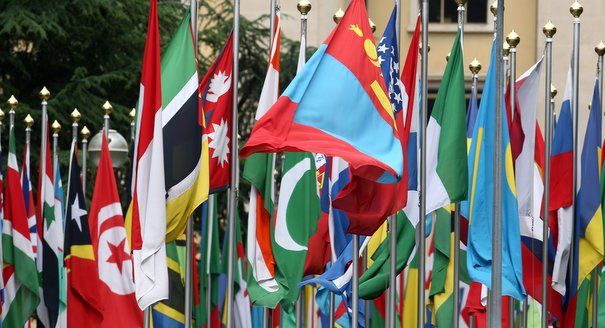
Although the world has grown increasingly more globalized and intertwined, there has been a simultaneous rise in the inability of countries to collaborate to tackle international challenges.
Source: Financial Times
What do Europe’s economic crisis, Syria’s civil war and global warming have in common? No one seems to have the power to stop them.
All three are part of a growing global trend: problems that no country can solve by acting alone. As globalisation has intertwined nations, communities, and businesses ever more tightly, the number of problems that cannot be solved by any one country – not even a superpower – on its own has soared.Today, finance ministers and central bank governors of the Group of 20 nations will meet in Moscow to tackle some of these kinds of problems. Their agenda includes usual suspects: how to co-ordinate policies to restore growth, contain indebtedness and strengthen financial regulations. These problems are as critical as their solutions have proved elusive.
The reality is that, despite many commitments by national leaders, the capacity of nation-states to co-ordinate their responses has dwindled. Problems may have gone global but the politics of solving them are as local as ever. It is hard for governments to devote resources to problems beyond their national borders and to work with other nations to address these challenges – while painful problems at home remain unsolved.
The changing landscape of global politics also plays a role. As the number and the interests of those sitting at the tables where agreements are negotiated have increased, the opportunities for consensus and concerted action have shrunk. Emerging powers such as the Brics (Brazil, Russia, India, China and South Africa), new international coalitions, and influential nongovernmental players are now demanding a say in the way the world handles its collective problems. Inevitably, when all these disparate and often conflicting interests need to be incorporated into any agreement, the resulting solutions fall short of what is needed to solve the problem.
This is why global multilateral agreements in which a large number of countries deliver on co-ordinated commitments have become increasingly rare. When was the last time you heard that an agreement with concrete consequences was reached by a large majority of the world’s nations? I think it was 13 years ago – the Millennium Development Goals. Since then, almost all international summits have yielded meagre results, most visibly those seeking to advance the global agendas on trade liberalisation and curbing global warming.
This gap between the growing need for joint international action and the declining ability of nations to act together may be the world’s most dangerous deficit.
In economics, when demand outstrips supply prices go up. In geopolitics the inability of nations to satisfy the demand for solutions to problems that transcend national boundaries results in dangerous instability. Pirates hijacking ships off the coast of Somalia, financial crashes that spread internationally at great speed, overfishing, the exploitation of the rainforest and nuclear proliferation are just a few well-known examples on the long list of problems that need international co-operation.
What to do? One possible way forward is “minilateralism”.
Minilateralism consists of gathering the smallest number of countries necessary to make a major change to the way the world addresses a particular issue – for instance, the 10 largest polluters, the 20 largest consumers of endangered fish stocks, the 12 major countries involved in aid to Africa as donors or recipients, and so on.
Minilateralism can serve small countries too, when it takes the shape of alliances of the few that have a greater chance of succeeding, but also of not being shut down by dominant powers. Inevitably, the countries left out of these negotiations will denounce these agreements as exclusionary and undemocratic as they run against the one-country, one-vote rule that is a pillar of multilateral institutions. And they surely have a point and it is indeed a problem. But perhaps it is a better problem to have than the catastrophes that loom ahead as a result of inaction.

Distinguished Fellow
Moisés Naím is a distinguished fellow at the Carnegie Endowment for International Peace, a best-selling author, and an internationally syndicated columnist.
Recent Work



Rosa Balfour, Frances Z. Brown, Yasmine Farouk, …
Moisés Naím
Carnegie does not take institutional positions on public policy issues; the views represented herein are those of the author(s) and do not necessarily reflect the views of Carnegie, its staff, or its trustees.

The EU can impose sanctions but struggles to enforce them without the United States. With Washington increasingly disinterested in backing European interests, the bloc must now fend for itself.


Nicu Popescu, Tiago Antunes

Russia is testing the waters of NATO’s mutual defense clause. What do strikes in Romanian territorial waters mean for the alliance’s posture toward Moscow?

Dimitar Bechev

With its public finances in shambles, the far right polling at 35 percent ahead of the 2027 presidential election, and a growing protest movement, is France’s crisis a threat to the EU’s geopolitical awakening?

Rym Momtaz, ed.

Ahead of a tough winter for Ukraine, Donald Trump’s swing back toward Russia bodes ill. But instead of panicking, Kyiv’s European allies are focusing on action.
Rym Momtaz

While the EU and European governments are embracing the much-lauded middle-power moment, this entails three difficult conundrums.

Richard Youngs