

Commentary
Before the next wave of EU enlargement takes place, the union needs to grapple with thorny questions of how power is distributed among its members.
Emil Sondaj Hansen, Ditte Brasso Sørensen
{
  "authors": [
    "Yaping Wang"
  ],
  "type": "legacyinthemedia",
  "centerAffiliationAll": "dc",
  "centers": [
    "Carnegie Endowment for International Peace",
    "Carnegie China"
  ],
  "collections": [
    "China’s Foreign Relations",
    "U.S.-China Relations"
  ],
  "englishNewsletterAll": "asia",
  "nonEnglishNewsletterAll": "",
  "primaryCenter": "Carnegie China",
  "programAffiliation": "AP",
  "programs": [
    "Asia"
  ],
  "projects": [],
  "regions": [
    "East Asia",
    "China",
    "Japan"
  ],
  "topics": [
    "Political Reform",
    "Security",
    "Arms Control",
    "Foreign Policy"
  ]
}
Source: Getty
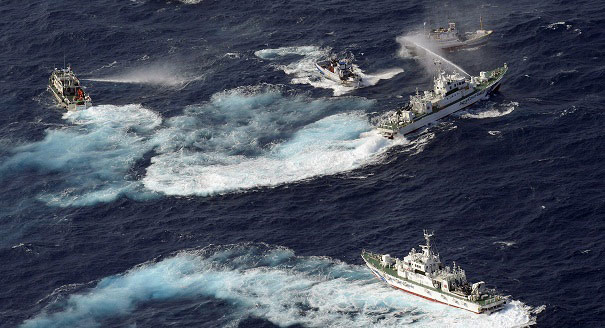
Beijing's strategy of “reactive assertiveness” in dealing with the disputed Senkaku/Diaoyu islands makes flawed calculations of risks and gains.
Source: Diplomat
Beijing has responded to Japan’s recent nationalization of the disputed Diaoyu/Senkaku islands, with activities on the ground (or water) designed to undermine Japan’s de-facto control of the islands. Beijing’s actions were rightly captured as “reactive assertiveness” by an International Crisis Group report, where “[China] exploits perceived provocations in disputed areas by other countries to take strong countermeasures to change the status quo in its favor.”
By inducing costs on the ground, Beijing’s goal is to make Tokyo recognize the existence of the dispute and agree to negotiate. However, this “reactive assertive” approach makes flawed calculations of risks and gains.
Beijing does have some logical reasons to pursue this course. One, inaction would be difficult to reconcile with boiling domestic nationalism. Two, Japan’s control of the islands does not give Tokyo any motive to recognize the existence of the dispute, much less the willingness to negotiate. Unless China gains some leverage vis-à-vis Japan, chances are thin that this issue will ever even reach the negotiating table. Three, Japan’s initial provocation may have inflamed China, but it offered Beijing the chance to retaliate by challenging Japan’s de-facto control of the islands while still claiming the moral high ground. Four, the economic ties between China and Japan, as well as U.S. interests, seem strong enough to keep potential armed conflicts at bay. To the extent that the U.S. is involved, its interests in these tiny, uninhabited rocks are marginal. Although its security treaty obligations with Japan bind it to action should the islands be attacked, the U.S. will attempt to deter the use of force. Finally, a strong and consistent response would effectively showcase to China’s other disputants, in the South China Sea for example, its resolve to defend its position in territorial disputes.
However, logical reasoning also supports strong countervailing arguments. First, the risk of military conflict is uncomfortably high. Chinese and Japanese ships are frequenting the disputed areas on a daily basis. It only takes one firebrand soldier or one miscalculation by a local commander to beget unpredictable escalation.
Second, while forces for peace exist in both China and Japan, so too do beneficiaries of conflict. Certainly any hostilities would play into the hands of Prime Minister Shinzo Abe and his right-wing coterie, as they try to push through an agenda to revise the Peace Constitution.
According to a May 3 Nihon Keizai Shimbun newspaper/TV Tokyo poll, only 28 percent of respondents object to constitutional amendments – the lowest level of opposition in the eight years of the poll. However, among the 56 percent supporting amendments, only 30 percent favor changing Article 9 of the Constitution, which renounces war as a sovereign right.
So while a significant number of Japanese support amending the Constitution, far fewer are willing to abandon its pacifist safeguard. Hyperbolizing Japan’s militarist trend, Beijing’s “reactive assertive” response risks alienating the very segment of the Japanese public least likely to view China as an enemy. Any clash on the high seas could tip public sentiment in Japan in favor a constitutional amendment, with irreversible repercussions for the security landscape in East Asia.
Third, the U.S. may have only a marginal interest in the islands themselves, but its interest in the issue is real. The U.S. will be obliged to stand by Japan in the event of an attack, not only because of its treaty obligations, but also for the sake of the alliance, which has significant implications for U.S. interests in the Asia-Pacific.
Fourth, an assertive approach, however reactive, will further stoke regional fears of bullying by China. The power asymmetry between smaller Asian countries and a big, rising China is Asia’s new reality. It is only natural for smaller Asian countries to be uncertain about China’s intentions. An assertive Beijing appears oblivious to this asymmetry. Its resolve to defend its territory is already assumed, and need not be stressed by bellicose statements or muscle flexing. Therefore, “showcasing” its resolve through the Diaoyu/Senkaku issue will only reaffirm fears of a bullying China and deteriorate China’s surrounding security environment in the long run.
Beijing’s proponents of the “reactive assertive” approach have relied on logical, but incomplete, reasoning. The adventurists have carried the day with their claims so far that should accidents happen on the sea, escalation could be contained, and that Tokyo has no interest of its own in escalating the conflict. Without any clear guarantee of the truth of such premises, Beijing’s actions constitute a dangerous gamble at best. Senior leaders in Zhongnanhai should carefully recalculate if they are genuinely willing to take on the risks in the slim hope of simply getting Japan to negotiate the disputed islands.

Yaping Wang
Former Senior Editor
Yaping Wang was senior editor of the Asia Program’s monthly web-based newsletter, Carnegie China Insight.
Carnegie does not take institutional positions on public policy issues; the views represented herein are those of the author(s) and do not necessarily reflect the views of Carnegie, its staff, or its trustees.

Before the next wave of EU enlargement takes place, the union needs to grapple with thorny questions of how power is distributed among its members.


Emil Sondaj Hansen, Ditte Brasso Sørensen

The new U.S.–Denmark–Greenland agreement will help Washington exert political, economic, and financial dominance under the guise of security. Yet, it acknowledged Copenhagen’s and Nuuk’s sovereignty on the island.

Marc Pierini

A summer of escalation in the Black Sea has hurt Ukraine economically and is exacerbating world food security. A truce is needed—as is a broader reframing of Europe’s Ukraine strategy.

Thomas de Waal

Are Germany’s economic, industrial, and political struggles becoming a liability for the EU’s ability to rise to the geopolitical moment?

Rym Momtaz, ed.

European Commission President Ursula von der Leyen is about to give her annual address on the state of the EU. Here’s what she won’t—but should—say.
Rym Momtaz