

Article
C. Raja Mohan, Darshana M. Baruah
{
  "authors": [
    "C. Raja Mohan"
  ],
  "type": "legacyinthemedia",
  "centerAffiliationAll": "dc",
  "centers": [
    "Carnegie Endowment for International Peace",
    "Carnegie India"
  ],
  "collections": [],
  "englishNewsletterAll": "ctw",
  "nonEnglishNewsletterAll": "",
  "primaryCenter": "Carnegie India",
  "programAffiliation": "SAP",
  "programs": [
    "South Asia"
  ],
  "projects": [],
  "regions": [
    "South Asia",
    "India"
  ],
  "topics": [
    "Security",
    "Military",
    "Foreign Policy"
  ]
}
Source: Getty
Bureaucratic and political holdups in India’s defense ministry have undermined New Delhi’s ties with its neighbors.
Source: Indian Express
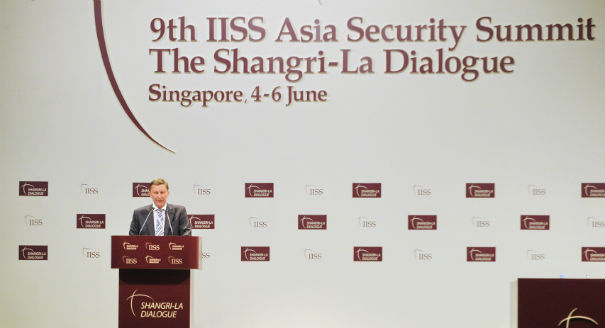
"Eighty per cent of success," Woody Allen famously said, is just "showing up." India's longest serving defense minister, A.K. Antony, however, was a "no-show" at Asia's leading annual defense forum, the Shangri-La Dialogue (SLD) in Singapore last week.
As Asia becomes the cockpit of great power rivalry and regional conflict, the SLD, organized by the International Institute of Strategic Studies, has become the vehicle for formal and informal consultations between the region's top defense policymakers. Running for more than a decade, with the support of the Singapore government, the SLD attracts defense ministers from all major countries in the region; China, which was initially opposed to the forum, now sends a very impressive delegation.
The MoD's approach to the SLD has been unprofessional, to say the least. Personal whims rather than a careful consideration of India's interests seem to define New Delhi's decisions. Consider the fact that Antony headed out to Singapore en route to Australia and Thailand on Monday. But he could not schedule participation in the SLD on the weekend that preceded it.While the SLD has become a regular fixture on the calendar of all Asian defense ministries—it takes place on the last weekend of May—the MoD never makes up its mind until the very last minute on who might represent the country. In a very lucky year Antony might agree, with great reluctance, to fetch up in Singapore. More often than not, it is the junior minister in the MoD who is dispatched; sometimes it is the National Security Adviser, Shivshankar Menon. This year, Admiral D.K. Joshi, the Chief of Naval Staff, was the top Indian delegate to the SLD.
Representation at less than the cabinet level, however, is a protocol handicap when it comes to speaking slots and meetings on the margins of the conference. At this year's SLD, there was no Indian speaker in the prestigious plenary sessions.
Antony, the minister, might be excused for not seeing the salience of India's defense diplomacy. But shouldn't the MoD bureaucrats be tendering professional advice rather than pandering to the minister's predilections? Why is it so hard for the MoD to decide on sending a substantive delegation led by the defense minister every year to the Shangri-La Dialogue, and touch base with all the Asian security establishments that are so eagerly seeking engagement with India?
Our foreign office can get the prime minister to sign up high-sounding declarations on the Look East policy and proclaim "strategic partnerships" with ASEAN nations. But when our southeast Asian interlocutors turn to the MoD for follow-up, they run into a brick wall.
In track-two interactions, ASEAN policymakers vent their frustration in dealing with the MoD—at the bilateral as well as the multilateral level. Many bilateral agreements with ASEAN countries on defence cooperation are languishing because of the MoD's inability to implement them.
Worse still, the MoD is also very suspicious that our armed forces are keen to develop deeper interaction with Asian militaries and the MEA, which recognizes defense diplomacy as a new quiver in its armory.
At a time when China and the United States have dramatically stepped up their defense diplomacy in Asia, the MoD seems out for lunch and a siesta. At the SLD last week, U.S. Defense Secretary Chuck Hagel invited all the ASEAN defense ministers for an interaction in Hawaii next year. China's People's Liberation Army has been engaging the ASEAN defense establishments, collectively, for many years.
No one expects the MoD's current leadership—both political and bureaucratic—to take bold new initiatives towards ASEAN. What surprises southeast Asia is the passive incoherence of the MoD's participation in the various defiance forums of ASEAN—neither ready to lead nor willing to respond.
Some tend to dress-up the MoD's feckless defense diplomacy as a deeply felt assertion of India's "strategic autonomy." Nice try. The real problem is the lack of political will in Delhi to take defense diplomacy in Asia seriously.
To be fair, Antony has occasionally referred to India's role as a "net security provider" in the Indian Ocean and beyond. What Antony needs is a strong institutional base in the MoD that can effectively collaborate with the armed forces and the foreign office and facilitate India's emergence as a valuable security partner for friendly Asian nations.
Former Nonresident Senior Fellow, Carnegie India
A leading analyst of India’s foreign policy, Mohan is also an expert on South Asian security, great-power relations in Asia, and arms control.
Recent Work

C. Raja Mohan, Darshana M. Baruah


Alexander Gabuev, Paul Haenle, C. Raja Mohan, …
Carnegie does not take institutional positions on public policy issues; the views represented herein are those of the author(s) and do not necessarily reflect the views of Carnegie, its staff, or its trustees.

The EU can impose sanctions but struggles to enforce them without the United States. With Washington increasingly disinterested in backing European interests, the bloc must now fend for itself.


Nicu Popescu, Tiago Antunes

Russia is testing the waters of NATO’s mutual defense clause. What do strikes in Romanian territorial waters mean for the alliance’s posture toward Moscow?

Dimitar Bechev

With its public finances in shambles, the far right polling at 35 percent ahead of the 2027 presidential election, and a growing protest movement, is France’s crisis a threat to the EU’s geopolitical awakening?

Rym Momtaz, ed.

Ahead of a tough winter for Ukraine, Donald Trump’s swing back toward Russia bodes ill. But instead of panicking, Kyiv’s European allies are focusing on action.
Rym Momtaz

Funding Ukraine remains a priority for European leaders. As Russia’s war of aggression heads into another winter, two feasible options to mobilize support for Kyiv should be fast-tracked.


Vladyslav Rashkovan, Gregory P. Wilson