

Article
C. Raja Mohan, Darshana M. Baruah
{
  "authors": [
    "C. Raja Mohan"
  ],
  "type": "legacyinthemedia",
  "centerAffiliationAll": "dc",
  "centers": [
    "Carnegie Endowment for International Peace",
    "Carnegie India"
  ],
  "collections": [
    "Arab Awakening"
  ],
  "englishNewsletterAll": "ctw",
  "nonEnglishNewsletterAll": "",
  "primaryCenter": "Carnegie India",
  "programAffiliation": "SAP",
  "programs": [
    "South Asia"
  ],
  "projects": [],
  "regions": [
    "Middle East",
    "Türkiye",
    "North Africa",
    "Egypt",
    "South Asia",
    "India"
  ],
  "topics": [
    "Political Reform",
    "Civil Society",
    "Foreign Policy"
  ]
}
Source: Getty
If there ever was a moment for India to stick by the principle of non-intervention in the internal affairs of other nations, this is it in the Middle East.
Source: Indian Express
As the old order crumbles in the Middle East, the imperative of recalibrating India's regional policy has been staring at Delhi for some time. The deepening political turmoil, regime instability and sectarian strife across the Middle East are all testing the established policies of major powers. India is no exception.
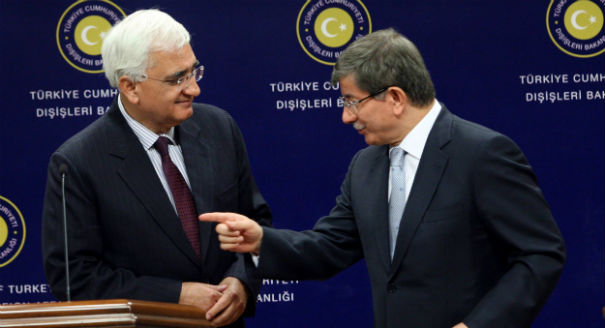
Delhi's approach to the Middle East has been shaped by intimate historic links, the profound impact of the region on India's domestic politics, its multiple internal conflicts and its relations with great powers. India's economic interaction with the region has significantly expanded over the last two decades. But the challenge of adapting to the structural changes in the region is likely to endure. While the prospects for near-term stability in the Middle East look bleak, India needs to step up its engagement with key regional powers. There are interesting openings unfolding right now with three of them — Ankara, Cairo and Tehran. All three, along with Saudi Arabia, have long shaped the region's destiny.External Affairs Minister Salman Khurshid's visit to Ankara this week ends the UPA government's prolonged neglect of Turkey. That this is the first trip by an Indian foreign minister in a decade—precisely the period when Ankara's regional and international standing has rapidly risen under the leadership of Recep Tayyip Erdogan—underlines this unfortunate fact. Khurshid's visit should set the tone for President Pranab Mukherjee's visit to Ankara later this year and lay the basis for sustainable political engagement with Turkey. Neither Erdogan's new troubles at home nor Ankara's close ties to Pakistan should be allowed to come in the way of building strong institutional ties to Turkey.
If there ever was a moment for India to stick by the principle of non-intervention in the internal affairs of other nations, this is it in the Middle East. The region is in the throes of a difficult political transition and Delhi must deal with the governments of the day, irrespective of their internal orientation. If India has managed to expand ties with Islamabad's major partners, like China, the United States, and Saudi Arabia over the last decade, there is no reason to let Pakistan define India's relations with Turkey.
Like Turkey, Iran has long been a major non-Arab regional power in the Middle East. Ankara and Tehran are not just at the two geographic extremities of the region. They are also widely perceived as contributing to the new sectarian dynamic between the Sunni and the Shia in the Middle East. As a neighbor, an important source of energy and a gateway to Afghanistan and Central Asia, Iran has re-emerged at the center of India's strategic calculus. But India's ability to build strong partnership with Iran has been constrained by Tehran's ongoing confrontation with the United States on the nuclear issue.
As Hassan Rowhani takes charge as Iran's president next month, hopes have risen for a productive dialogue between Tehran and Washington. Bringing an end to more than three decades of conflict between Iran and the U.S. will not be easy. But Delhi must extend full support to the efforts to ease Iran-U.S. tensions and reach out to the new Iranian leadership at the earliest.
If Turkey and Iran have seen themselves as different models of political Islam in the Middle East, recent developments in Egypt have put moderate secular forces back in control of Cairo and expand the possibilities for the region's future. India has no reason to agonize about whether the Egypt army's decision to end the brief rule of the Muslim Brotherhood is a political coup or not. The fact is that the army has laid out a bold plan for drafting a new constitution and holding parliamentary and presidential elections within six months.
Egypt's internal situation is bound to remain murky for a while, but the luxury of debating Egypt's internal developments should be left to the West and those regional powers that have partisan interests. Delhi, instead, must emphasize the principle of non-intervention and back Cairo's current efforts at political reconciliation and the construction of an inclusive constitutional order. Delhi also can't afford to miss the opportunities to engage the new leaders of Egypt who are so well disposed towards India.
Former Nonresident Senior Fellow, Carnegie India
A leading analyst of India’s foreign policy, Mohan is also an expert on South Asian security, great-power relations in Asia, and arms control.
Recent Work

C. Raja Mohan, Darshana M. Baruah


Alexander Gabuev, Paul Haenle, C. Raja Mohan, …
Carnegie does not take institutional positions on public policy issues; the views represented herein are those of the author(s) and do not necessarily reflect the views of Carnegie, its staff, or its trustees.

Funding Ukraine remains a priority for European leaders. As Russia’s war of aggression heads into another winter, two feasible options to mobilize support for Kyiv should be fast-tracked.


Vladyslav Rashkovan, Gregory P. Wilson

While the EU and European governments are embracing the much-lauded middle-power moment, this entails three difficult conundrums.

Richard Youngs

Europe is facing rising populism internally as well as external pressures from Russia, China, Turkey, and the United States.

Dimitar Bechev

A notable degree of participative democracy has firmly arrived in Europe. But to have more far-reaching impact, democratic deliberation needs to move into a radically new phase.
Richard Youngs

Much has been said of the changes Brussels is trying to make to the EU enlargement process. Here’s why gradual integration might—or might not—be the answer.
Dimitar Bechev