

Research
- +5
Alper Coşkun, Fatih Ceylan, Tacan İldem, …
{
  "authors": [
    "Sinan Ülgen"
  ],
  "type": "legacyinthemedia",
  "centerAffiliationAll": "",
  "centers": [
    "Carnegie Endowment for International Peace",
    "Carnegie Europe",
    "Malcolm H. Kerr Carnegie Middle East Center"
  ],
  "collections": [
    "Turkey’s Transformation"
  ],
  "englishNewsletterAll": "",
  "nonEnglishNewsletterAll": "",
  "primaryCenter": "Carnegie Europe",
  "programAffiliation": "",
  "programs": [],
  "projects": [],
  "regions": [
    "Middle East",
    "Europe",
    "Türkiye"
  ],
  "topics": [
    "Technology",
    "Political Reform",
    "Democracy",
    "Civil Society"
  ]
}
Source: Getty
Ubiquitous social media use is pulling back the curtain on governments' reliance on old tactics—policymakers can no longer rely on media censorship, public pressure, and overt force.
Source: Huffington Post
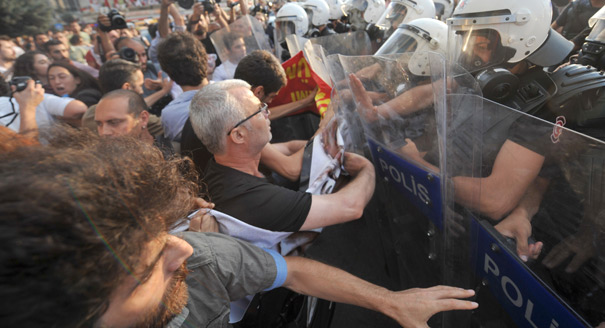
Social media is changing the game for governments under pressure. Events earlier this summer in Istanbul demonstrate that tough responses to disperse angry crowds only fuel the fire. Ubiquitous social media use is pulling back the curtain on governments' reliance on old tactics -- policymakers can no longer rely on media censorship, public pressure, and overt force.
Tolerating dissenting points of view is a core feature of democracies, so governments need a new playbook for responding to protests and it's in all of their interests to develop new international norms.
In Turkey it all started in Taksim Square when a few hundred people gathered to oppose a government decision to turn Gezi Park into a shopping mall. This peaceful gathering was disbanded when Istanbul police used excessive force with ample tear gas.But despite the lack of local media coverage, the heavy-handed response had the totally unintended consequence of swelling the ranks of the protesters given the power of social media. According to a recent online survey conducted among the protesters, the police's disproportionate use of force was influential for 91.3 percent of respondents attending the protests.
Security forces tried to rely on the severe self-censorship practiced by the mainstream media to hide their excesses from public view. After all, during the early days of the demonstrations a leading news channel gave more coverage to the sexual life of the penguins than to the protests that drew more than a hundred thousand people to the streets of Istanbul.
But fortunately social media fulfilled the role of real-time reporting that people had come to expect from the traditional media. The harshness of the police intervention was widely documented by the fast flowing postings on Twitter. A picture of a young woman dressed in red and being viciously sprayed by tear gas became one of the most emblematic symbols of the Taksim protests after going viral on Twitter.
Social media has suddenly turned into a powerful instrument of public scrutiny. And it is certainly here to stay. As a result, devising efficient means to subdue traditional media will not be sufficient anymore for governments intent on concealing the harshness of their law enforcement.
Still, social media cannot prevent police brutality on its own. More is needed to properly regulate the legitimate use of force in democratic societies. And it's in Ankara's and other country's own interests to find new ways that won't damage their domestic standing or dent their international reputations.
This means that there should be a new initiative to revise the international principles governing the use of force by law enforcement. The UN Basic Principles on the Use of Force and Firearms by Law Enforcement Officials codifies the current international norms. But the text was negotiated in 1990, at a time when the Cold War was just ending and the democratic transformations in much of the Eastern part of the European continent were still to happen. The agreed wording was heavily influenced by this international context and does not go far enough in today's world.
In much of the world, democratic standards have markedly improved since the early 1990s. Even the common understanding of a liberal democracy has shifted from the more shallow vision of an electoral democracy to a more ambitious definition comprising the rule of law, respect for human rights, and especially tolerance to nonviolent forms of dissent. This hard-won progress now needs to be reflected in the international norms that govern the legitimate use of force by governments.
In particular the concept of "the seriousness of the offence" that conditions the proportionality and the lawful use of force should be clarified. Unlawful and yet peaceful demonstrations could have been interpreted as serious offences by the many fragile and newly democratic regimes of the 1990s. But not today. Protesters need protection from harsh crackdowns.
An international effort to review and update these principles should be welcomed by Turkey and other emerging democracies -- they can only stand to benefit. It will help their domestic and international image and blunt the escalation of small-scale protests even with the uncontrollable, widespread use of social media.
This article was originally published in the Huffington Post.

Senior Fellow, Carnegie Europe
Sinan Ülgen is a senior fellow at Carnegie Europe in Brussels, where his research focuses on Turkish foreign policy, transatlantic relations, international trade, economic security, and digital policy.
Recent Work

Alper Coşkun, Fatih Ceylan, Tacan İldem, …
Carnegie does not take institutional positions on public policy issues; the views represented herein are those of the author(s) and do not necessarily reflect the views of Carnegie, its staff, or its trustees.

Are Germany’s economic, industrial, and political struggles becoming a liability for the EU’s ability to rise to the geopolitical moment?

Rym Momtaz, ed.

European Commission President Ursula von der Leyen is about to give her annual address on the state of the EU. Here’s what she won’t—but should—say.
Rym Momtaz

Radical-right parties are expected to do well in upcoming elections in four of the EU's biggest member states. If successful, they could prevent the union from addressing key challenges ahead.

Stefan Lehne

The aftermath of the Ceuta crisis shows Europe has drawn the wrong lessons. Rather than doubling down on failed migration policies, the EU needs to address the underlying roots of such episodes.

Richard Youngs

An overwhelming victory by a far-right-wing party in a small state in eastern Germany will have major repercussions for Chancellor Friedrich Merz’s coalition.

Judy Dempsey