

Paper
Renée DiResta, Rachel Kleinfeld, Margot Treadwell
{
  "authors": [
    "Rachel Kleinfeld"
  ],
  "type": "legacyinthemedia",
  "centerAffiliationAll": "dc",
  "centers": [
    "Carnegie Endowment for International Peace",
    "Malcolm H. Kerr Carnegie Middle East Center"
  ],
  "collections": [
    "Arab Awakening"
  ],
  "englishNewsletterAll": "democracy",
  "nonEnglishNewsletterAll": "",
  "primaryCenter": "Carnegie Endowment for International Peace",
  "programAffiliation": "DCG",
  "programs": [
    "Democracy, Conflict, and Governance"
  ],
  "projects": [],
  "regions": [
    "North America",
    "United States",
    "Middle East",
    "Syria",
    "Levant"
  ],
  "topics": [
    "Security",
    "Democracy",
    "Foreign Policy"
  ]
}
Source: Getty
Force, whether a threat or a reality, must be only one part of a comprehensive strategy. Such a strategy would internationalize this conflict, so that America is acting with allies to add legitimacy and share the burden.
Source: New York Daily News
Throughout the High Holy Days, Jews ask for forgiveness: We have lied, we have slandered, we have turned away from truth. Rabbis intone: We ask forgiveness of people we’ve wronged before we seek it from on high.
What hypocrites we are.
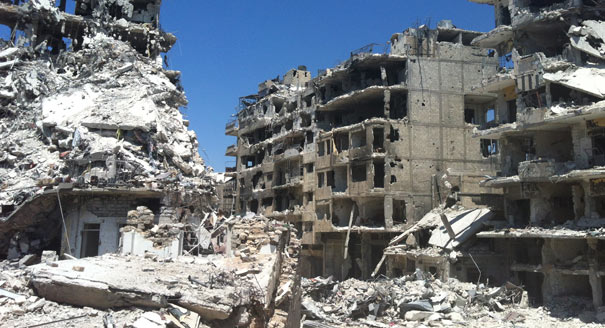
While we ask rhetorically, “Who by fire? Who by water?” many Syrians know how they will die: by gas, by bullet. We ponder who will be inscribed in the Book of Life, but do nothing while more than 100,000 are killed. We stand silent while millions are forced from their homes to wander.Many Americans argue that this is not our fight. The last thing we need is another war in the Middle East. Moreover, they say, Afghanistan and Iraq proved that we’re not good at solving others’ problems. They want to do nothing, or seize on Russia’s proposal as a way out.
And yet, children are being shelled in their beds as we lie idle.
Some say that while it’s tragic, Syria’s war has nothing to do with our national interest. But we have a core interest in curbing Iran and showing it America’s red lines shouldn’t be crossed; reducing the strength of terrorist organizations, and stabilizing the Middle East.
Thousands of foreign jihadists are already learning their deadly trade, to ply elsewhere later. How many more boys will be radicalized of the millions spending years in refugee camps? As the war spills into neighboring countries, Jordan, Israel’s most steadfast neighbor; Lebanon, and NATO ally Turkey are being destabilized and radicalized.
Meanwhile, Iran and Hezbollah are all-in with Syria, their greatest ally. Weakening Syria weakens Iran and its terrorist proxy Hezbollah. Doing nothing tells Iran that American red lines on, say, its nuclear program, are just as meaningless as our rhetoric on chemical weapons.
The problem is, “do something” is no strategy. A limited strike could do more harm than good. No one wants an American ground war. Many are seizing on the Russian offer to internationalize the chemical weapons as a real possibility.
There are useful things we can do. They require being hard-nosed about our interests and goals.
The Russian option is tempting — but we must be careful. It would be impossible to verify that Syria’s Bashar Assad had given up his chemical weapons, since we have no idea how much he has. Moving the weapons to a centralized location will allow them to be dispersed to Hezbollah and across the country. Meanwhile, accepting the proposal gives Assad a green light to continue killing his people conventionally.
However, the possibilities Russia has opened show that the threat of force can have real impact. Congress should allow the President to have that tool in his arsenal. As we have just seen, the credible threat of force is the only thing in two years that has pushed Assad to the negotiating table.
Force, whether a threat or a reality, must be only one part of a comprehensive strategy. Such a strategy would internationalize this conflict, so that America is acting with allies to add legitimacy and share the burden. It would combine force to degrade Assad’s air power with both intelligence operations to inform individual commanders that they will be held personally responsible for the use of chemical weapons and a political strategy to assist a moderate force and government-in-waiting in rebel-held areas.
Bringing in other countries is crucial. The threats we are working against are global, as is the humanitarian disaster. These conflicts require years of postfighting stabilization. If the UN can’t agree, NATO could act, ideally with the support of the Arab League.
War-weary Americans don’t want Syria to be our fight. But as we learned during World War II, “First they came for the Communists, and I didn’t speak because I wasn’t a Communist . . . then they came for the Jews . . . Then they came for me, and there was no one left to speak.”
This article was originally published by the New York Daily News.
Senior Fellow, Democracy, Conflict, and Governance Program
Rachel Kleinfeld is a senior fellow in Carnegie’s Democracy, Conflict, and Governance Program, where she focuses on issues of rule of law, security, and governance in democracies experiencing polarization, violence, and other governance problems.
Recent Work
Renée DiResta, Rachel Kleinfeld, Margot Treadwell
Political Violence Researchers, Rachel Kleinfeld, ed., Dalya Berkowitz, ed.
Carnegie does not take institutional positions on public policy issues; the views represented herein are those of the author(s) and do not necessarily reflect the views of Carnegie, its staff, or its trustees.

With its public finances in shambles, the far right polling at 35 percent ahead of the 2027 presidential election, and a growing protest movement, is France’s crisis a threat to the EU’s geopolitical awakening?

Rym Momtaz, ed.

Ahead of a tough winter for Ukraine, Donald Trump’s swing back toward Russia bodes ill. But instead of panicking, Kyiv’s European allies are focusing on action.
Rym Momtaz

Funding Ukraine remains a priority for European leaders. As Russia’s war of aggression heads into another winter, two feasible options to mobilize support for Kyiv should be fast-tracked.


Vladyslav Rashkovan, Gregory P. Wilson

While the EU and European governments are embracing the much-lauded middle-power moment, this entails three difficult conundrums.

Richard Youngs

Europe is facing rising populism internally as well as external pressures from Russia, China, Turkey, and the United States.

Dimitar Bechev