

Commentary
Dmitri Trenin
{
  "authors": [
    "Dmitri Trenin"
  ],
  "type": "commentary",
  "centerAffiliationAll": "",
  "centers": [
    "Carnegie Endowment for International Peace",
    "Carnegie Russia Eurasia Center"
  ],
  "collections": [],
  "englishNewsletterAll": "",
  "nonEnglishNewsletterAll": "",
  "primaryCenter": "Carnegie Russia Eurasia Center",
  "programAffiliation": "",
  "programs": [],
  "projects": [],
  "regions": [
    "North America",
    "United States",
    "South America",
    "East Asia",
    "China",
    "Japan",
    "Russia",
    "Western Europe"
  ],
  "topics": [
    "Democracy",
    "Security",
    "Global Governance",
    "Foreign Policy"
  ]
}
Source: Getty
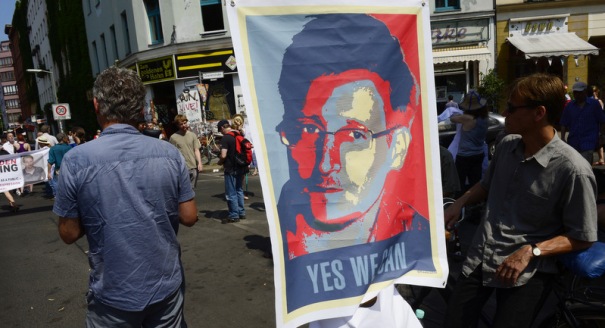
Edward Snowden revealed a lot not only about the National Security Agency activities, but also about the state of the world.
Edward Snowden, the Man of the Year, according to the Guardian and Euronews, revealed a lot not only about the National Security Agency activities, but also about the state of the world. Snowden's test of global geopolitics confirmed some predictable truths, but it has brought its own share of surprises.
Hong Kong, where Snowden first landed on his journey, showed its both faces. A city truly open to the world—though not to all citizens of mainland China, enjoying the British legal system and the freedom of speech, it is fully controlled, in terms of sovereignty and security, by Beijing. Hong Kong welcomed Snowden and gave him protection for a short while.
The rest depended on China. Typically still unwilling to confront Washington outside the area of its core interests, Beijing was only too happy to hand off Snowden to Moscow. Nationalist opinion in China chided their country's leadership for failing to stand up to the United States, but the leadership knows how to bide time. China continues to avoid the battles with the United States on issues which it deems nonessential or premature.
Not so Russia. The Kremlin had not planned to keep Snowden, but when his onward journey from Sheremetyevo—which was to be only a transit airport—was aborted, rose to the occasion. President Vladimir Putin did not have a problem standing up to President Barack Obama, declining the U.S. request for Snowden's extradition, in the absence of a treaty which Russia had wanted, and the United States declined, and accepted to pay the price: the cancelation of the U.S.-Russian summit in Moscow.
The original cause for the U.S.-Russian showdown was the success the U.S. government had with the fiery anti-U.S. regimes in Latin America who had promised Snowden an asylum. Ecuador recalled the travel documents it had issued to the fugitive. Cuba refused to accept an Aeroflot plane which would have taken Snowden to Havana end route to Ecuador. Venezuela was all talk, no action. Latin leftists actually demonstrated how much they valued relations with "North American imperialism." This month, at the Mandela funeral, Cuba's Castro was rewarded with an Obama handshake.
In the summer, when this surprising outcome was not yet clear, Washington feared a Latin American leader returning from a meeting in Moscow would have the temerity to take Snowden aboard his presidential plane. France, Spain, and Portugal used the occasion to demonstrate their loyalty to the United States by denying overflight rights to the Bolivian head of state, effectively forcing him to land in Austria for plane inspection. The incident reaffirmed that the U.S.-European alliance, forged in the Cold War, was still intact, with the Europeans in the familiar position of the wards of their senior ally.
When in the fall Snowden brought to light facts of the U.S. monitoring of German citizens, including the cell phone of Chancellor Angela Merkel, a real scandal ensued. The scandal revealed the Germans' special sensitivities, rooted in their history, but it also laid bare a degree of their political naïveté. Berlin's bid to make Washington sign a pact renouncing spying on each other and its draft UN resolution on the same issue testify to both its frustration and its idealism. It was soon shocked to learn that Britain, a fellow EU member state, was also spying on Germany.
Britain, unlike Germany, is a member of the group known as the Five Eyes, alongside Australia, Canada, New Zealand, and the United States. Since World War II, these countries have been regularly sharing their intelligence. Arguably, the five English-speaking nations form the inner core of the Western world. Germany, like France and other continental Europeans, remain outsiders.
In a stark contrast to Germany’s case, the Snowden-generated news that Sweden, a permanently neutral country, had been spying on Russia and passing along the intelligence to the United States, made headlines in Stockholm, but was barely noticed in Moscow, where this had always been assumed to be the case. In more general terms, the Russians appeared the least surprised by what Snowden had made public. They always believed that spying belongs to the principal instruments of statecraft, and that one cannot afford not to collect information on allies as well as adversaries.
The only country where Snowden's revelations may have had a material effect was Brazil. As the South American giant is beginning to shape its international identity, relations with the United States have come under scrutiny. President Dilma Rousseff has not only cancelled a visit to Washington; she opted to buy Swedish aircraft rather than U.S.-made ones, for the Brazilian Air Force. Elsewhere, Japan has just passed its first official secrets act after World War II, but this had nothing to do with either Snowden or the United States: Japan is warily watching China's growing military might and feels Beijing's new assertiveness over a string of disputed rocks in the East China Sea.
Former Director, Carnegie Moscow Center
Trenin was director of the Carnegie Moscow Center from 2008 to early 2022.
Recent Work
Dmitri Trenin
Dmitri Trenin
Carnegie does not take institutional positions on public policy issues; the views represented herein are those of the author(s) and do not necessarily reflect the views of Carnegie, its staff, or its trustees.

With its public finances in shambles, the far right polling at 35 percent ahead of the 2027 presidential election, and a growing protest movement, is France’s crisis a threat to the EU’s geopolitical awakening?

Rym Momtaz, ed.

Ahead of a tough winter for Ukraine, Donald Trump’s swing back toward Russia bodes ill. But instead of panicking, Kyiv’s European allies are focusing on action.
Rym Momtaz

Funding Ukraine remains a priority for European leaders. As Russia’s war of aggression heads into another winter, two feasible options to mobilize support for Kyiv should be fast-tracked.


Vladyslav Rashkovan, Gregory P. Wilson

While the EU and European governments are embracing the much-lauded middle-power moment, this entails three difficult conundrums.

Richard Youngs

Europe is facing rising populism internally as well as external pressures from Russia, China, Turkey, and the United States.

Dimitar Bechev